Every few years, we survey the practices relating to blackout & window periods (we’ve conducted over a dozen surveys in this area). Here’s the results from our latest one:
1. Which factor is most important in allowing a blackout period to end one day after an earnings release:
– Filer status being large accelerated filer and a WKSI – 19%
– Number of analysts providing coverage on company – 23%
– Average daily trading volume for the company – 10%
– None of the above is important – 48%
2. How many analysts covering the company is considered sufficient to allow blackout period to end one day after an earnings release:
– 1-5 – 3%
– 6-10 – 26%
– 11-15 – 13%
– 16 or more – 6%
– None of the above is important – 52%
3. What average daily trading volume is considered sufficient to allow blackout period to end one day after an earnings release:
– 1% of its outstanding common stock – 7%
– $5 million or more in average daily trading volume (daily trading volume x stock price) – 3%
– $10 million or more in average daily trading volume (daily trading volume x stock price) – 6%
– $25 million or more in average daily trading volume (daily trading volume x stock price) – 15%
– None of the above is important – 69%
Please take a moment to participate anonymously in these surveys:
Last week, the CII published a list of 159 directors who served on boards of 2018 & 2019 IPO companies that went public with dual-class share structures & no sunset provisions. The CII’s “Dual-Class Enablers Spreadsheet” identifies the other public boards on which these directors serve. Here’s an excerpt from the CII’s press release discussing its rationale for the “naming & shaming” approach:
“The board that brings a company to public markets with unequal voting rights is responsible for the decision to disempower public shareholders,” said CII Executive Director Ken Bertsch. “The board’s decision can be a red flag of discomfort with accountability to outside shareholders.” He said that investors “may want to raise concern about that in their engagement with other boards on which these directors serve. Some investors may choose to vote against directors of single-class companies who participated in pre-IPO board decisions to adopt dual-class equity structures without sunsets elsewhere.”
The release also says that the list may have a deterrent effect on private companies considering dual class structures. Perhaps that’s the case. After all, this is the first time that the CII has taken action that provides a potential reputational downside for the directors of these companies. But personally, I’m skeptical. I still think that companies will only be deterred from going public with dual class structures when investors finally abandon their “buy now, whine later” approach to investments in them.
BlackRock: “Remain Calm! All is Well!”
Remember my recent blog about BlackRock’s defense of the size of its investment positions in public companies? Well, it published another blog on the Harvard Governance Forum that defends the voting power those investments represent. BlackRock reviews various proxy voting scenarios – elections, M&A, say-on-pay & shareholder proposals and the average margins of victory for each. From that data, they draw this conclusion:
The view that asset managers are ‘determining’ the outcome of proxy votes is not supported by the data. The vast majority of ballot items are won or lost by margins greater than 30%, meaning that even the three largest asset managers combined could not change the vote outcome. While the small subset of votes on shareholder proposals tend to be closer, the considerable variation in voting records among asset managers negates the concept of a multi-firm voting bloc as the ‘swing vote”.
In other words, – “most votes aren’t close, so you shouldn’t worry that we have the ability to determine the outcome of all close votes.” These blogs certainly suggest that BlackRock is worried about the potential for regulatory intervention. But I don’t think they’re helping themselves by putting forward arguments that are so specious you can practically see beads of sweat forming on their upper lip.
Yesterday, the SEC announced an open Commission meeting next Wednesday – August 21st – during which it will consider two agenda items. The first relates to potential guidance “regarding the proxy voting responsibilities of investment advisers under Rule 206(4)-6 under the Investment Advisers Act.” With this agenda item, the SEC may be considering guidance that revisits the extent to which an asset manager can outsource voting decisions to proxy advisors consistent with its fiduciary obligations. (See this Cydney Posner blog).
As this Gibson Dunn blog notes, the second agenda item also relates to proxy advisors:
The second agenda item is a Division of Corporation Finance matter captioned “Commission Interpretation and Guidance Regarding the Applicability of the Proxy Rules to Proxy Voting Advice.” The notice describes this matter as follows:
The Commission will consider whether to publish an interpretation and related guidance regarding the applicability of certain rules, which the Commission has promulgated under Section 14 of the Securities Exchange Act of 1934, to proxy voting advice.
This item appears related to the rulemaking addressed in the SEC’s most recent Reg Flex agenda, which stated that the Division of Corporation Finance “is considering recommending that the Commission propose rule amendments to address certain advisors’ reliance on the proxy solicitation exemptions in Rule 14a-2(b).”
As I blogged at the time the SEC updated its Reg Flex Agenda, it’s unclear exactly what the SEC is going to propose about the ability of proxy advisors to continue rely on exemptions from proxy solicitation rules. Some commenters have called for the SEC to reconsider those exemptions – or at least impose additional conditions upon their use – as part of a broader initiative to regulate the proxy advisory industry.
These are controversial topics, so this should be an interesting meeting – well, I mean, if it goes forward. They seem to cancel these things with the same frequency as I cancel ‘Open Table’ reservations. We will be talking about the outcome of the SEC’s meeting at our “Proxy Disclosure Conference” coming up in a few weeks.
Fast Act S-K Simplification: Don’t Forget the New “Description of Securities” Exhibit!
In preparing an article for the most recent issue of “The Corporate Counsel” print newsletter, I looked at a bunch of 10-K filings made by large accelerated filers after the effective date of the Fast Act disclosure simplification rules. One of the more interesting things that I found was that nearly half of the filers whiffed on the requirements of new Item 601(b)(4)(vi) of Regulation S-K – which requires companies to include an exhibit briefly describing all securities registered under Section 12 of the Exchange Act.
So, consider this a reminder that you’ve got to include this exhibit in your next 10-K if you’re a large accelerated filer. If you’re wondering what it should look like, check out this recent blog from Stinson’s Steve Quinlivan, which reviews the new exhibit requirement & provides some samples.
After I posted this, Hogan Lovells’ David Crandall reached out with an idea about why so many companies may be overlooking this requirement:
We noticed that form checks by our associates were not picking up the new requirement, and it turns out that the eCFR website for Reg S-K Item 601 incorrectly lists the exhibit requirement as applying to Form 10-Ds rather than 10-Ks.
The adopting release omitted the headers to the Item 601 exhibit table and had the incorrect number of columns (14 compared to 16), which undoubtedly contributed to the error on the eCFR website. I’m not aware of any source that correctly lists the new requirement as applying to 10-Ks, absent the discussion of the amendment in the adopting release. There may be many diligent registrants out there who looked at Item 601 and figured that the new requirement only applied to asset-backed issuers filing on Form 10-D.
. . . And now, just a few hours after posting David’s comments, the eCFR website reference has been fixed! Thanks to David and to the folks in the government who addressed this so promptly.
Buybacks are Bad. Buybacks are Declining. The Decline in Buybacks is Bad.
The much criticized practice of corporate stock buybacks appears to have declined significantly this year. That’s great news, right? This Axios Markets report says “not exactly.” Here’s an excerpt:
After buying back more than $1 trillion of their own stock last year, public companies are slowing their share repurchases in 2019, and that will add to troubles for the market and the economy.
Why it matters: Buybacks have been a major catalyst for the market’s rise in recent years and remain an important driver of higher prices, as earnings growth has slowed and investors have become net sellers of equities. With the trade war weighing on business spending and confidence and earnings growth expected to weaken into negative territory for companies in both the second and third quarters this year, the stock market’s legs look increasingly fragile.
By the numbers: The record buyback binge in 2018 accounted for almost half of stocks’ EPS growth, the highest share since 2007. S&P reported earlier this year that Q1 2019 was the first quarter in 7 that the pace of buybacks slowed. That theme has continued through the year, as the 4-week average pace of buybacks has fallen 30% from 2018’s pace as of this week, data from Bank of America Merrill Lynch shows.
The report quotes a recent client note from BAML that says that investors have become “less enamored with buybacks,” and that late 2018 was “the turning point in this cycle of expanding debt balance sheets, buying growth and rewarding shareholders.” It says that the bottom line is that companies are preparing for the economy to slow and want to pare debt and hold cash in the event of a downturn.
Last week, the CLS Blue Sky Blog summarized a study on the use of humor in corporate earnings calls. The results were kind of interesting:
We find that managers are less likely to use humor on a call when the tone of analysts’ questions is negative, suggesting managers are deliberate about when to use humor. Further, our results indicate that managers are more likely to use humor if an analyst first uses humor on the call. We also find that the market reaction in the three days surrounding the conference call is more positive when managers use humor, a result that is partially driven by a muted reaction to negative manager tone when managers use humor. Additionally, our tests of analysts’ reactions indicate that managers’ use of humor is generally associated with upward revisions in analysts’ stock recommendations shortly after the call.
It looks like the takeaway here is that a little humor from your execs can give a bit of a bounce to your stock price. Everybody’s trying to make their earnings call stand out from the pack these days, and given the potential upside here it wouldn’t surprise me to see companies make a conscious effort to inject comic relief into the proceedings. Well, you folks can do what you want, but if you ask me, I’d be very cautious about trying to throw your CEO into the deep end of the humor pool.
My point is that comedy is a high-wire act, and chances are pretty good that your CEO isn’t funny. Worse, it’s almost a lock that most CEOs think they’re hysterical. After all, a lot of CEOs spend their days surrounded by people who tell them how awesome they are and laugh at all their jokes. That can lead to catastrophic consequences for CEOs who decide that Dave Chappelle has nothing on them and that breaking out their standup act on an earnings call is a great idea.
Here’s a case in point – last year at about this time, the subscription software provider Zuora attempted to turn its earnings call into a “dialogue” featuring ad-libbed attempts at humorous asides. The execs involved likely thought they were being amusing. According to this MarketWatch.com article, the market thought otherwise:
Wall Street didn’t seem too amused by the strange new take on an earnings call, which took place as shares were falling in the aftermarket. Zuora’s stock closed down 19% in Friday’s session, the largest single-day percentage drop in Zuora’s history as a public company.
Yikes! Any company that’s considering turning their next earnings call into an SNL skit should keep in mind Zuora’s cautionary tale – as well as the old theatrical adage that says “Dying is easy. Comedy is hard.”
The Dark Web: Troll Targets SEC Staffers
Like many governmental agencies, the SEC is never short of critics. The agency usually takes that criticism in stride – but one critic appears to be targeting individual Staff members online. This Claims Journal article says that the SEC thinks that crosses the line, and is taking some extraordinary steps to address potential reputational damage:
Elon Musk mocked it as the “Shortseller Enrichment Commission.” Billionaire Mark Cuban said it’s “useless.” Hedge fund legend Leon Cooperman called it “abusive.” For the U.S. Securities and Exchange Commission, such attacks come with the territory. But brushing them off is getting harder in the age of social media. One online foe has so troubled the agency’s staff that it’s made the remarkable move of seeking to hire an expert to burnish their images.
The contractor’s duties will include monitoring content about employees in the SEC’s vaunted enforcement division on the web and removing anything that’s “false or harmful,” according to a July 22 posting on a federal job site. The listing didn’t name the detractor, but the individual isn’t a well-known executive like Musk or Cuban, said a person familiar with the matter who asked not to be identified. The SEC accused the mystery adversary of violating securities laws, and the individual started assailing agency officials online, while taking steps to ensure Google and other search engines picked up the critiques.
While individual crackpots weren’t unheard of in the past, the article quotes John Reed Stark as saying that “before social media accounts became ubiquitous, most threats were confined to stock message boards.” Now everyone’s online, including most of the Staff – and that makes them easier targets for trolls.
Transcript: “How to Handle Hostile Attacks”
We have posted the transcript for the recent DealLawyers.com webcast: “How to Handle Hostile Attacks.”
Given the times in which we live, I guess it’s not surprising that some companies have added “risk factor” disclosure about the potential implications of an active shooter to their SEC filings. Here’s an excerpt from this WSJ article:
A handful of public companies have begun quietly warning investors about how gun violence could affect their financial performance. Companies such as Dave & Buster’s Entertainment Inc., Del Taco Restaurants Inc. and Stratus Properties Inc., a Texas-based real-estate firm, added references to active-shooter scenarios in the “risk factor” section of their latest annual reports, according to an analysis of Securities and Exchange Commission filings. The Cheesecake Factory Inc. has included it in its past four annual reports.
So, what do these risk factors look like? Here’s what The Cheesecake Factory said in its 2019 10-K (pg. 25):
Any act of violence at or threatened against our restaurants or the centers in which they are located, including active shooter situations and terrorist activities, may result in restricted access to our restaurants and/or restaurant closures in the short-term and, in the long-term, may cause our customers and staff to avoid our restaurants. Any such situation could adversely impact customer traffic and make it more difficult to fully staff our restaurants, which could materially adversely affect our financial performance.
Dave & Buster’s 10-K included identical language (pg. 23). The language in Del Taco’s 10-K (pg. 21), and Stratus’s 10-K (pg. 17) was a little different. While I understand why companies are doing this, I’m not sure this kind of thing is what risk factor disclosure is intended to capture. Our tendency (mine too) to throw any item that’s been added to our national anxiety closet into a risk factor isn’t very helpful to investors. The problem is that not all disclosure adds value – some just creates “noise.”
In the U.S., we’ve learned that an active shooter is the kind of random event could happen to anyone, and the effect of such an event on any business would be terrible. So to me, it’s sort of like getting struck by a killer asteroid. I think this is the kind of thing that Judge Easterbrook was getting at in this excerpt from his 1988 opinion in Weilgos v. Commonwealth Edison:
Issuers need not “disclose” Murphy’s Law or the Peter Principle, even though these have substantial effects on business. . . Securities laws require issuers to disclose firm-specific information; investors and analysts combine that information with knowledge about the competition, regulatory conditions, and the economy as a whole to produce a value for stock.
But let’s face it – you’re not going to change your approach here and neither am I. That’s because while we can debate risk factor metaphysics, the reality is that the explosive growth in event-driven securities class actions is a big part of our personal anxiety closets too.
Venture Capital: Snoop’s Got His Mind on His Money & His Money on His Mind
My kids think I’m dorkier than Ari Melber when I reference hip-hop. But there’s no way I’m not going to use a “Gin & Juice” reference in the title when this Pitchbook article says that Snoop Dogg is an investor in Swedish payment services provider Klarna, which is now Europe’s second most valuable VC-backed company with a $5.5 billion valuation following its recent $460 million capital raise. Here’s an excerpt:
Founded in 2005, Klarna provides consumer financing for purchases at third-party merchants. Rather than requiring consumers to pay in full via credit card at the time of sale, Klarna acts as a middleman to front the payment for a purchase, with merchants receiving the full amount upfront while the consumer repays Klarna over time.
The Swedish company is perhaps most recognizable for its partnership and investment relationship with Calvin Broadus, better known as Snoop Dogg. Broadus is front-and-center in Klarna’s recent marketing campaign, known as “Smoooth Dogg.” Such marketing efforts could prove beneficial as Klarna plans to use its new windfall to significantly expand in the US, Broadus’ home country and where his career grew rapidly in the 1990s.
Regular readers of this blog know that Snoop has some impressive culinary skills, but you also should note that this isn’t his first rodeo when it comes to venture capital. He’s an investor in both Reddit & the trading app Robinhood, and a general partner in Casa Verde Capital, which recently completed a $45 million capital raise & focuses on investments in – here’s a shock – the cannabis industry.
Cryptocurrencies: Kik Claps Back at SEC Complaint
In June, I blogged about the SEC’s decision to bring an enforcement action against Kik Interactive for its $100 million unregistered token deal. As that blog noted, Kik’s founders are crypto-evangelists who have raised a $5 million war chest to fund its defense against the SEC’s allegation that its tokens are “securities.” It recently filed a 130-page answer to the SEC’s complaint, in which it accuses the agency of “twisting the facts” about its Kin token. Check out this TechCrunch article for more details.
It’s not news to anyone reading this that the legal profession has big problems with depression, substance abuse, and other mental health issues. If you haven’t personally experienced any of these, you know friends or colleagues who have. But the question is, why are these problems so prevalent among lawyers?
This Law.com article is stirring up some controversy over its claims that when it comes to outside counsel, the problem is the client. Specifically, the article singles out law department attorneys as playing a big role in mental health issues among outside counsel. Here’s the gist of the argument:
Client demands for fast turnaround times, even on non-urgent matters, can leave outside counsel in constant crisis mode. That stress can lead to frayed relationships and mental health issues such as depression, addiction and anxiety, which firm lawyers are more likely to experience than corporate in-house counsel.
“We’re on this crisis level all the time because of the expectations coming from the clients,” said Dan Lukasik, the founder of Lawyers With Depression. He said “a change in the relationship” between firms and in-house clients is needed to improve law’s mental health culture.
Client demands are part of the stress equation, but so is the law firm environment, and I don’t think it’s at all fair to point the finger at in-house lawyers. If in-house attorneys set unreasonable expectations, it’s usually because their business people have set unreasonable expectations for them. In my experience, many in-house lawyers go out of their way to let you know if something they’re asking for isn’t urgent, and it’s exceedingly rare to find one who puts you through the ringer just for giggles.
I agree that most corporate lawyers operate “on a crisis level” all the time, but I think that has more to do with how we’re wired than it does with client demands or whether we’re in a law firm or a corporate setting. For instance, even if I know something’s not a crisis, I’ll often just assume the client needs me to attend to it immediately. That’s nuts, but I don’t think I’m alone. A lot of us are introverted, competitive, perfectionist, obsessive about our reputations & terrified of failure. Add in our professional bias toward catastrophic thinking, and you’ve got a bunch of gasoline-soaked rags just waiting for somebody to light a match when it comes to mental health problems.
Quick Poll: Why Do Lawyers Experience Mental Health Issues?
I just gave you my 2 cents about why I think so many of us struggle with mental health issues – check out this ABA Journal article for what other lawyers have to say about this topic. Here’s an anonymous poll so you can provide your thoughts:
survey tool
Transcript: “Joint Ventures – Practice Pointers”
We have posted the transcript for the recent DealLawyers.com webcast: “Joint Ventures – Practice Pointers.” We’ll have our second installment for this topic in an August 6th webcast: “Joint Ventures – Practice Pointers (Part II).”
There’s a great quote from the 5th Circuit’s 1981 decision in Huddleston v. Herman & MacLean that says that “to warn that the untoward may occur when the event is contingent is prudent; to caution that it is only possible for the unfavorable events to happen when they have already occurred is deceit.” That quote pretty much sums up the basis for the SEC’s enforcement proceeding against Facebook that was announced yesterday. Here’s an excerpt from the SEC’s press release:
The Securities and Exchange Commission today announced charges against Facebook Inc. for making misleading disclosures regarding the risk of misuse of Facebook user data. For more than two years, Facebook’s public disclosures presented the risk of misuse of user data as merely hypothetical when Facebook knew that a third-party developer had actually misused Facebook user data. Public companies must identify and consider the material risks to their business and have procedures designed to make disclosures that are accurate in all material respects, including not continuing to describe a risk as hypothetical when it has in fact happened.
The misleading disclosures arose out of Cambridge Analytica’s unauthorized use of Facebook user data. Facebook allegedly found out about Cambridge Analytica’s antics in 2015, but didn’t revise its disclosure until two years later. Facebook consented to a “neither admit nor deny” settlement that, among other things, enjoins it from future violations of Section 17(a)(2) and (3) of the Securities Act and Section 13(a) of the Exchange Act & various rules thereunder.
The company also agreed to pay $100 million to settle the charges, which sounds like a lot, but is chump change to Facebook. After all, the company also agreed yesterday to pay a $5 billion fine to settle FTC charges arising out of customer data privacy lapses. Still, it seems to me that the real elephant in the room may not be the size of the settlement, but the fact that no individuals were named.
The SEC almost always names individuals in corporate disclosure cases, although it didn’t do so in last year’s high-profile data privacy case against Altaba (Yahoo!). In any event, there’s nothing in the press release to suggest that actions against any individuals are contemplated – despite language in the complaint to the effect that “more than 30 Facebook employees in different corporate groups including senior managers in Facebook’s communications, legal, operations, policy, and privacy groups” were aware that Cambridge Analytica had improperly been provided with user data.
The FTC Gives Facebook a New Board Committee!
Speaking of that FTC settlement, Bloomberg’s Matt Levine points out in his column that it has imposed some interesting governance obligations on Facebook that may curb some of Mark Zuckerberg’s power. One of the conditions imposed under the terms of the settlement is a new board privacy committee that is intended to be difficult for Zuckerberg to mess with. Here’s an excerpt from the FTC’s statement on the settlement:
The order creates greater accountability at the board of directors level. It establishes an independent privacy committee of Facebook’s board of directors, removing unfettered control by Facebook’s CEO Mark Zuckerberg over decisions affecting user privacy. Members of the privacy committee must be independent and will be appointed by an independent nominating committee. Members can only be fired by a supermajority of the Facebook board of directors.
Here’s Matt’s take on the independent privacy committee requirement:
The upshot is … look, it is not entirely clear to me what the upshot is; we’ll see what happens. But my rough analysis is that if Zuckerberg wanted to do a bad privacy thing, and the independent privacy directors told him not to, he’d have a tough time of doing it. He couldn’t remove the independent privacy directors from their posts.
Perhaps he could remove them from the board, but he’d have a hard time replacing them, because the independent nominating committee has “the sole authority” to pick new directors. I suppose he could replace the nominating committee too. These provisions aren’t ironclad. But surely their purpose really is to take the final authority over one aspect of Facebook out of the hands of Zuckerberg.
BlackRock: “Move Along – Nothing to See Here. . .”
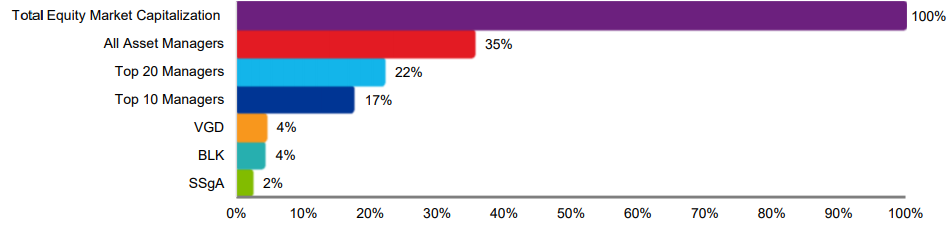
According to this recent Harvard Governance Blog from its Vice Chair, BlackRock would like you to know that it & the rest of the Big 3 are really small players in the grand scheme of things:
As index funds are currently growing more quickly than actively managed funds, some critics have expressed concern about increasing concentration of public company ownership in the hands of index fund managers. While it is true that assets under management (or “AUM”) in index portfolios have grown, index funds and ETFs represent less than 10% of global equity assets. Further, equity investors, and hence public company shareholders, are dispersed across a diverse range of asset owners and asset managers.
As of year-end 2017, Vanguard, BlackRock, and State Street manage $3.5 trillion, $3.3 trillion, and $1.8 trillion in global equity assets, respectively. These investors represent a minority position in the $83 trillion global equity market. As shown in Exhibit 1, the combined AUM of these three managers represents just over 10% of global equity assets.
Umm, gee – isn’t 10% of all the equity assets in the world kind of a lot? I don’t know why we’re supposed to take a lot of comfort from that number – particularly since the Big 3 reportedly control 25% of the stock in the S&P 500 and are on course to increase that stake to more than 40% over the next two decades. These numbers aren’t small.
The blog also says that those AUM numbers are misleading, because they represent “a variety of investment strategies, each with different investment objectives, constraints, and time horizons. For example, BlackRock has more than 50 equity portfolio management teams managing nearly 2,000 equity portfolios.” That’s great – but when Larry Fink comes out with annual letters telling boards of portfolio companies “how things are gonna be,” those 2,000 equity portfolios look pretty monolithic.
By the way, if this “50 portfolio managers/2,000 portfolios” pitch sounds familiar to you, it may be because at some point you heard the same pitch from one of the Big 3 when it was lobbying your client to allow it to go over a poison pill threshold. At least that’s where I first heard it.
It looks like a token issuer finally crossed the public offering goal line – at least when it comes to clearing Corp Fin’s review process. This Morrison & Foerster memo has the details. Here’s an excerpt:
On July 10, 2019, Blockstack Token LLC (“Blockstack”), a wholly-owned subsidiary of Blockstack PBC, a Delaware public benefit corporation, became the first company to have an offering of digital assets qualified by the U.S. Securities and Exchange Commission (“SEC”) under Regulation A.
Blockstack is a technology company that offers an open-source blockchain-enabled network for developers to build and publish their own decentralized applications. According to Blockstack’s website, over 165 applications have been built on the Blockstack platform. Purchasers of Blockstack’s tokens (“Stacks Tokens”) will be able to use the tokens on its platform.
Token offerings have been under increasing scrutiny, especially with respect to whether or not tokens are securities. In its offering circular disclosure, Blockstack acknowledges that the Stacks Tokens are characterized as investment contracts under the Howey test, while noting that the Stacks Tokens “will not have the rights traditionally associated with holders of debt instruments, nor…equity.” The disclosure, in its discussion about the nature of Blockstack’s decentralized network, also references the SEC’s recent guidance on evaluating whether digital assets constitute securities for purposes of the Securities Act of 1933.
Although there have been a boatload of Reg D token offerings, this is the first one that’s cleared SEC review. Here’s a copy of the company’s preliminary offering circular. As to how long the process took, the answer is about 3 months.
It appears that the initial Form 1-A filing was made on April 11, 2019. At least one substantive amendment to the filing was made in May, but the filing history is a little convoluted, because the deal originally involved a subsidiary entity & was converted to an offering by the parent company shortly before the SEC issued its qualification order. The subsidiary ultimately withdrew its filing, but the back & forth between two filers makes it difficult to determine how much of the time between filing and qualification was attributable to the Staff’s review process.
Registered ICOs: And Then There Were Two!
Blockstack may have been the first ICO to clear SEC review, but this Proskauer blog says that it had company just a day later:
The SEC also qualified the Regulation A offering circular of YouNow, Inc. (“YouNow”), for up to $50 million worth of Props Tokens (“Props”). Rather than solicit cash (or cryptocurrency) consideration for the sale of Props, YouNow and its affiliate, The Props Foundation Public Benefit Corporation, will use YouNow’s Regulation A program solely to distribute Props as rewards and grants to users, developers and other contributors within YouNow’s network of consumer-facing digital media applications.
Meanwhile, back in unregistered token deal land. . .
Blue Sky: New Jersey Sues Issuer of Unregistered Tokens
The SEC’s high-profile enforcement actions involving digital assets get most of the limelight, but as we’ve previously blogged, state securities regulators have been extremely active on the enforcement front when it comes to token deals. Last week, it was New Jersey’s turn to bring the hammer down. Here’s an excerpt from this “Modern Consensus” article describing the Garden State’s recent action:
New Jersey got in on the cryptocurrency offering enforcement action on July 18, suing blockchain-based online rental marketplace Pocketinns for an unregistered sale of securities last year. The state’s attorney general, Gurbir Grewal, was joined by the New Jersey Bureau of Securities today in announcing a three-count enforcement action against Princeton-based Pocketinns and its president, Sarvajnya Mada, over the January 15-31, 2018, sale of $410,000 in PINNS Tokens in an initial token offering.
The U.S. Securities and Exchange Commission (SEC) has brought several similar suits, initiating a high-profile action against blockchain instant messaging service Kik in June for its $100 million ICO in 2017. The agency released a long-awaited “plain English” guide defining when an ICO is a security in April.
Aside from violating the Garden State’s Uniform Securities Law by failing to register the offering, Grewal alleged that Mada acted as an unregistered agent and Pocketinns employed an unregistered agent during the sale.
The article says that the Pocketinns deal wasn’t very successful – it raised less than 1% of the $46 million it sought. But on the other hand, the company appears to have been extremely successful in buying itself all sorts of trouble.
Last week, Liz blogged about a recent rulemaking petition filed by a coalition of labor & progressive groups requesting the SEC to repeal & replace the Rule 10b-18 “safe harbor” under which most buybacks have been conducted.
The request to “repeal” 10b-18 is pretty straightforward, but what’s the “replace” part of the equation supposed to look like? The petitioners suggest that the SEC look at some 1970s-era proposals to limit buybacks, and point out that those proposals included:
– Limiting repurchases to 15 percent of the average daily trading volume for that security.
– Creating a narrower safe harbor and allowing repurchases that fall outside this safe harbor to be reviewed and approved on an individualized, case-by-case basis.
– Providing that repurchases inconsistent with the safe harbor are expressly “unlawful as fraudulent, deceptive, or manipulative.”
– Requiring various disclosures, including whether any officer or director is purchasing or disposing of the issuer’s securities, the source of funds to be used to effect the repurchases, the impact of the repurchases on the value of the remaining outstanding securities, and specific disclosures for large repurchases.
Companies continue to repurchase “massive amounts” of their own stock, and the market seems to be addicted to buybacks as well. So far, the SEC hasn’t seemed inclined to do much to further regulate buybacks, and tinkering with 10b-18 seems unlikely. But a presidential election’s looming, buybacks are getting clobbered in the media, & Democratic presidential hopefuls have them in the cross-hairs. When you throw into the mix the recent introduction of legislation that would ban open market buybacks, the SEC may at some point be faced with a situation where if it doesn’t act, Congress might.
ISS Policy Survey: Board Gender Diversity, Over-Boarding & More
Yesterday, ISS opened its “Annual Policy Survey.” In recent years, ISS used a 2-part survey, with a relatively high-level “governance principles survey” accompanied by a more granular “policy application survey.” This year, ISS is using a single survey with a more limited number of questions. ISS may have streamlined the process, but this excerpt addressing the topics covered in the survey shows that they’ve still covered quite a bit of ground:
Topics this year cover a broad range of issues, including: board gender diversity, director over-boarding, and director accountability relating to climate change risk, globally; combined chairman and CEO posts and the sun-setting of multi-class capital structures in the U.S.; the discharge of directors and board responsiveness to low support for remuneration proposals in Europe; and the use of Economic Value Added (EVA) in ISS’ quantitative pay-for-performance, financial-performance-analysis secondary screen for companies in the U.S. and Canada.
As always, this is the first step for ISS as it formulates its 2020 voting policies. In addition to the survey, ISS will gather input via regionally-based, topic-specific roundtables & calls. Interested market participants will also have an opportunity to comment on the final proposed changes to the policies.
SEC “Short- v. Long-Term” Roundtable: So What Happened?
Last week, the SEC hosted its roundtable on short-term v. long-term management of public companies. As Broc blogged when the roundtable was announced, the roundtable follows the SEC’s December 2018 request for comment on earnings releases & quarterly reporting. If you’re looking for a fairly detailed review of the discussion at the roundtable, check out this recent blog by Cooley’s Cydney Posner.
Following the lead of other federal law enforcement agencies, the SEC is looking to increase its capabilities when it comes to monitoring social media platforms. Here’s an excerpt from this GCN article:
The Securities and Exchange Commission also issued a sources sought notice for a commercial, off-the-shelf social media monitoring subscription to help it track emerging risk areas and activities of market participants to identify potential securities law violations.
Less interested in Twitter than the FBI, the SEC wants the ability to monitor Facebook, Instagram, YouTube, LinkedIn, and Reddit as well as public forums, blogs and message boards. It also requests sentiment analysis capabilities and the ability to identify bot accounts and fake user accounts. Data should be available through an application programming interface as well as through a browser.
I don’t know if anybody in SEC procurement is reading this, but I’ve got an idea that will save the taxpayers a lot of money. If you’re interested in “sentiment analysis capabilities,” don’t bother buying some crappy software license – just click on any random “Me on Facebook v. Me on Twitter” meme. It will tell you everything you need to know. You can Venmo me my reward money along with the thanks of a grateful nation.
Tomorrow’s Webcast: “Company Buybacks – Best Practices”
Tune in tomorrow for the webcast – “Company Buybacks: Best Practices” – to hear Skadden’s Josh LaGrange, Hunton Andrews Kurth’s Scott Kimpel, Simpson Thacher’s Lee Meyerson and Foley & Lardner’s Pat Quick provide practical guidance about how to conduct a stock repurchase program, including analysis of whether it’s the best use of funds.
FOIA Exemption 4 protects “trade secrets and commercial or financial information obtained from a person [that is] privileged or confidential.” However, most federal circuit courts have read in a “substantial competitive harm” test under which commercial information would be regarded as “confidential” only if its disclosure was likely to cause substantial harm to the competitive position of the person from whom it was obtained.
The substantial competitive harm requirement had its genesis in the D.C. Circuit’s 1974 decision in National Parks & Conservation Association v. Morton, and the standard had been widely adopted by other courts. But earlier this week, by a 6-3 vote, the SCOTUS invalidated the requirement in Food Marketing Institute v. Argus Leader Media. Here’s an excerpt from this Cleary Gottlieb memo that addresses the Court’s reasoning:
Notwithstanding that the lower courts have followed National Parks in one form or another for 45 years, the Supreme Court roundly rejected it. Writing for six members of the Court, Justice Gorsuch criticized the D.C. Circuit’s creation of the “substantial competitive harms test” based on its interpretation of legislative history as demonstrating a “casual disregard of the rules of statutory interpretation.”
Food Marketing Institute held that a court must begin its analysis of statutory terms by referencing the ordinary meaning and structure of the law itself, and when this leads to a clear answer, the court must not go further. The Court found that because there is “clear statutory language” in FOIA, legislative history should never have been allowed to “muddy the meaning” of this language.
The decision should substantially reduce the burden associated protecting confidential information submitted to the government, but the memo says that it also raises questions about how agencies and courts will apply existing regulations that incorporate the “substantial competitive harm” test, and whether they will need to revise such regulations or attempt to justify disclosure decisions on other grounds.
What Does the SCOTUS’s Decision Mean for CTRs?
The SEC is one of the agencies that will need to sort out how the SCOTUS’s decision to eliminate the “substantial competitive harm” standard impacts existing rules. In that regard, here are some insights that Bass Berry’s Jay Knight shared with us on how the Court’s decision complicates the SEC’s recently simplified CTR process:
As everyone may recall, in March the SEC adopted amendments to disclosure requirements for reporting companies, as mandated by the 2015 Fixing America’s Surface Transportation Act (the “FAST Act”). Among the amendments was a simpler CTR process, which now allows registrants to omit immaterial confidential information from acquisition agreements filed pursuant to Item 601(b)(2) of Regulation S-K and material contracts filed pursuant to Item 601(b)(10) of Regulation S-K without having to file a concurrent confidential treatment request. In short, registrants are permitted to redact provisions in such exhibit filings “if those provisions are both not material and would likely cause competitive harm to the registrant if publicly disclosed.” (emphasis added)
In the SEC’s adopting release, the SEC notes that it slightly revised the language of the amendment in the final rule to refer to information that “would likely cause competitive harm” to “more closely track the standard under FOIA.” (see page 25 of the adopting release) With the Supreme Court holding that FOIA exemption 4 does not have a competitive harm condition, it calls into question whether the “competitive harm” standard in Item 601 continues to be appropriate. (Other potential rules impacted are Exchange Act Rule 24b-2 and Securities Act Rule 406, which require that applicants for confidential treatment justify their nondisclosure on the basis of the applicable exemption(s) from disclosure under Rule 80, as well as Staff Legal Bulletin No. 1 and 1A, and Rule 83.)
Since that competitive harm standard is embedded in the SEC’s rules, at this point the prudent path for companies appears to be to continue to adhere the requirements of those rules until the SEC provides further guidance.
The Staff has informally advised us that they are evaluating the potential implications of the Food Marketing Institute decision on Rule 24b-2, Rule 406 & other rules that involve confidential treatment requests under FOIA. However, the Staff does not believe that Item 601(b) is implicated by the decision, since the new procedures relate to situations in which information need not to be filed with the SEC, rather than situations in which companies are seeking to use FOIA exemption 4 to protect information that has been filed.
Insider Trading: Lawyers Are Increasingly In the Cross-Hairs
Over the past year or so, we’ve blogged about a number of insider trading cases in which lawyers were involved directly or, sometimes, indirectly. If it seems like lawyers are being implicated more in insider trading cases, this Arnold & Porter memo says there’s a reason for that – they are:
A recent series of insider trading actions charging senior lawyers in legal departments of prominent public companies suggests that insider trading by lawyers may be on the rise. Over the past several months, the U.S. Securities and Exchange Commission has brought enforcement actions charging insider trading in advance of earnings announcements by senior lawyers at Apple and SeaWorld. In a third action, filed in early May 2019, the general counsel of Cintas Corporation was an unwitting victim of a house guest, a lifelong friend, who, the SEC alleges, surreptitiously pilfered merger related information from a folder in the lawyer’s home office.
These actions are noteworthy not only for the brazenness of the conduct involved, but because they suggest that insider trading by lawyers remains a “profound problem.” And, as the case of the Cintas general counsel demonstrates, innocent lawyers may also fall prey to others, such as close friends and family, looking to exploit their access to material nonpublic information, or MNPI.
Here at TheCorporateCounsel.net, we’re on record that if you’re a corporate officer who engages in insider trading, then – as one of my high school football coaches used to say – “you’re stuck on stupid.” But if you need more convincing, read the memo’s review of the recent proceedings involving lawyers, and the actions that companies & law departments can take to mitigate their insider trading risks.