In what has become an annual tradition, Cary Klafter of Intel again shares what I imagine has to be the world’s largest holiday disclaimer, running for 21 pages. Please take part in this anonymous poll:
survey services
The Compensation Holiday Card
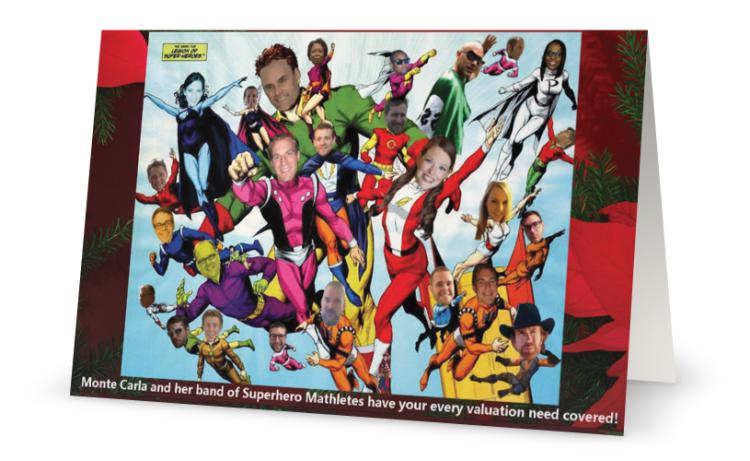
I’m proud that Cap’n Cashbags has been included in Aon Hewitt’s nifty “2014 Holiday Card” in a “Where’s Waldo” type of situation. The card also includes Monte Carla (aka Liz Stoudt), the co-winner of the “Survivor of the Top Consultants” panel from our conference! Click the image below to enlarge…
On Wednesday, the SEC proposed a number of JOBS Act changes to the thresholds for registration, termination of registration & suspension of ’34 Act reporting including (here’s an overview in this blog):
1. Amending Rules 12g-1 through 4 and 12h-3 which govern the procedures relating to registration, termination of registration under Section 12(g), and suspension of reporting obligations under Section 15(d) to reflect the new thresholds established by the JOBS Act
2. Revising the rules so that savings & loan holding companies are treated in a similar manner to banks and bank holding companies for the purposes of registration, termination of registration, or suspension of their Exchange Act reporting obligations
3. Applying the definition of “accredited investor” in Securities Act Rule 501(a) to determinations as to which record holders are accredited investors for purposes of Exchange Act Section 12(g)(1). The accredited investor determination would be made as of the last day of the fiscal year.
4. Amending the definition of “held of record” to provide that when determining whether an issuer is required to register a class of equity securities with the Commission under the Exchange Act Section 12(g)(1), an issuer may exclude securities:
– Held by persons who received them under an employee compensation plan in transactions exempt from the registration requirements of Section 5 of the Securities Act or that did not involve a sale within the meaning of Section 2(a)(3) of the Securities Act
– In certain circumstances, held by persons who received them in exchange for securities received under an employee compensation plan
5. Creating a non-exclusive safe harbor under which a person will be deemed to have received the securities under an employee compensation plan if the person received them under a compensatory benefit plan in transactions that met the conditions of Securities Act Rule 701(c).
The SEC’s press release from yesterday says that the Commission “voted yesterday” to approve this proposal. Since there wasn’t an open Commission meeting on Wednesday, these proposals were approved in seriatim. As noted in this blog, there’s nothing wrong with that as rules get approved or proposed in this manner on occasion, particularly in December. And the press releases issued by the SEC typically don’t state that action has been taken in seriatim – since it doesn’t really matter for our purposes…
How long does it take the Securities and Exchange Commission to develop a controversial rule forcing most companies to disclose the pay gap between CEOs and rank-and-file employees?
About 7,196 hours.
That’s how long staff of the agency have spent since 2011 on a proposal requiring companies disclose median worker pay and compare it with CEO compensation, according to SEC Chairman Mary Jo White. The figure translates to about $1.1 million in labor costs, Ms. White told House Financial Services Committee Chairman Jeb Hensarling (R., Texas) in a December 11 letter released Wednesday morning. The letter stresses the figures are rough estimates and doesn’t say the number of staff involved.
A requirement of the 2010 Dodd-Frank financial law, the rule wasn’t formally floated until September of last year and the five-member agency must vote on it a second time before it can go into effect. The commission is currently reviewing the more than 128,000 comments it has received on the proposal – many of them form letters – and Ms. White has said her goal is to complete the rule by the end of 2014. With the agency almost certain to miss that target, Mr. Hensarling and two other lawmakers urged Ms. White to delay finishing the measure, arguing in a letter last month that they are concerned the agency is “misallocating limited resources to non-essential projects.” Ms. White denied that concern in her letter last week. “The time spent by the staff on the pay ratio rulemaking does not mean that we have diminished our focus on fulfilling our rulemaking or other obligations,” she wrote. “Completion of all the commission’s mandated rulemakings continues to be a priority for me.”
Congressional Democrats continue to press the agency to finish the rule soon. Fifteen U.S. Senate Democrats, led by New Jersey’s Robert Menendez, wrote to Ms. White Tuesday asking for her to call a final vote on the rule before the end of the first quarter of 2015. “While some opponents may prefer not to disclose this information, Congress already enacted and the President already signed the requirement into law more than four years ago,” the senators wrote. “All that remains is for the implementing rules to be finalized, as the statute requires.”
NASAA Unveils Online Filing System for State Form D Filings
On December 15, 2014, the North American Securities Administrators Association, Inc. (NASAA) unveiled its Electronic Filing Depository (EFD) for use in connection with state Form D filings in Rule 506 offerings. The NASAA has been pursuing initiatives to streamline the state blue sky filing process for some time. In July of 2014, we reported on the NASAA’s proposed model rules that could be enacted by states to require electronic filings in connection with Rule 506 offerings. The EFD system dovetails with that initiative. While the availability of the EFD is an interesting and welcome development, there are a few important limitations to note.
During the recent annual AICPA Conference, SEC Chief Accountant Jim Schnurr delivered this speech about the SEC possibly continuing to consider the use of IFRS by domestic companies. As noted in this blog by George Wilson: “While he did not say anything definite, it is clear the IFRS is no longer on the back burner!”
As it typically does, the SEC has posted these additional speeches and PowerPoint presentations used by its Staffers during the AICPA Conference (here’s summaries of these from this Morgan Lewis blog and this Deloitte memo):
Here’s a presentation from the PCAOB’s Associate Chief Auditor that provides an overview of comments received on the Staff’s “Fair Value” Consultation Paper…
Vanguard’s CEO Speaks: Over 900 Letters Sent to Companies Over the Year
Here’s a recent speech by Vanguard’s CEO during which he noted that Vanguard sent 923 letters last year to companies and 358 of those letters requested specific governance structure changes – and that about 80 companies adopted substantive changes in response. He also urged boards to create a standing shareholder relations committee “for boards to gather those outside perspectives” discussed in the speech – and as noted in this FT article, Vanguard plans to send letters to companies about this idea next year…
More on “The Mentor Blog”
We continue to post new items daily on our blog – “The Mentor Blog” – for TheCorporateCounsel.net members. Members can sign up to get that blog pushed out to them via email whenever there is a new entry by simply inputting their email address on the left side of that blog. Here are some of the latest entries:
– Tips to Enhance Your Non-GAAP Disclosures
– Using Internal Audit to Assess & Improve Corporate Culture
– Considerations for Compliance Outsourcing
– Caremark Applies to Audit Committee Oversight of Internal Controls
– Corporate Political Spending Disclosure: Strategic Communications Plan
We have posted the transcript for our recent popular webcast: “Proxy Access: A New World of Private Ordering.”
I’m not a big SNL fan – but this recent bit about Hobbits in the style of “The Office” is hilarious. Gandolph is Michael Scott; Gollum is Dwight…
A Rare No-Action Letter on Reg S
This Bookbuilds no-action letter released by Corp Fin recently is nothing special as it just applies to very narrow circumstances. But it’s noteworthy because it is a rare no-action letter under Reg S. There are only a handful of Reg S letters since its adoption in 1990…
Thanks for the Gumball Mickey – Cooley, Palo Alto
In this 20-second video, the fine lawyers at Cooley in Palo Alto pay homage to the old Hasbro TV commercial. A real gumball machine in this one…
As noted in this Cooley blog and Davis Polk blog, the SEC, intervenor Amnesty International and amici Global Witness and Free Speech for People have filed their briefs in support of upholding the conflict minerals disclosure requirement in the appeals case. In a joint statement, SEC Commissioners Gallagher and Piwowar said they oppose the position taken in the SEC’s brief. Briefs from appellants are due in about 10 days.
It’s that time of the year – the time to give. But this article notes how folks are giving to charity funds rather than actual charities – and that actual charities aren’t receiving enough of the money…
Cap’n Cashbags: Time to Grant Stock Options (Seriously)
Did you ever want to see Cap’n Cashbags cry? In this 20-second video, Cap’n Cashbags – a CEO – is still hoping to get his mega-grant of stock options soon (here’s the related video):
As noted in this blog, the WSJ ran this follow-up article a few months ago to a previous piece about Corp Fin’s comment letters. The latest article focuses on the “readability” of SEC filings (what is also known as “usability”). Here’s what it says:
Examiners at the Securities and Exchange Commission, as we explained this weekend, spend some of their time catching typos, demanding better punctuation and asking companies to rephrase impenetrable parts of official filings. So is it working? Not really. SEC filings remain pretty impenetrable. We sent lengthy excerpts from a half-dozen documents filed by six big companies — Apple AAPL -1.21%, General Electric GE +1.26%, General Motors GM +0.70%, JPMorgan Chase JPM +0.34%, UnitedHealth Group UNH +1.42% and Wal-Mart Stores WMT +0.94% — to Educational Testing Service, the outfit that runs the SAT and other school-entrance exams.
All the excerpts came from the companies’ most recent annual reports, and we picked parts of the more accessible sections: descriptions of the companies’ businesses, the principle risks they face and discussions of their recent results. The verdict, according to ETS: The words used in the filings tended to be abstract, academic and generally difficult. Sentence structures were moderately difficult. Some of the excerpts were relatively disjointed, and none could be considered conversational. Using ETS’s yardstick, the language typically qualifies as grade 13 to 14 — a grade-level or two above what is considered “college and career ready,” with grade 12 “encompassing the complexity levels likely to be found in college textbooks.” (It’s also worth noting that ETS recently altered its grade-level standards, so today’s grade 12 is closer to grade 14 under older measures.)
The companies varied in their comprehensibility. General Motors fared best, at a grade level of 12.5, helped by language that was more concrete and built out of less-complex sentences. JPMorgan Chase fared worst, at a 13.7 overall grade level, hurt by syntactically complex sentences, less-familiar vocabulary and a fair amount of abstraction.
None of the English in the excerpts was particularly plain. All scored poorly when measures on how conversational the style was, with Apple, General Electric and General Motors all faring particularly poorly. (Wal-Mart and United Healthcare fared best by that measure.) JPMorgan spokesman Joe Evangelisti said the company has to balance clarity and thoroughness in a complex industry. “We’re trying to simplify, we’re trying to reduce redundancy,” he said. “The fact is, we have to be complete too.” GE said it has taken steps to make its filings more readable, in part by adding a summary to its discussion of quarterly results. GM declined to comment. It’s also worth noting that, with some noticeable exceptions, big companies tend to put more effort into making their filings readable. That suggests that the rest of the filings out there could well be worse.
It isn’t as if the SEC is having no effect. In Saturday’s piece, we looked at changes requested by the SEC to filings by Technology Applications International NUUU -0.68%, a small company that, among other things, uses NASA-patented technology to make cosmetics. An SEC attorney originally questioned the company’s reference to a device called a “rotatable perfused time varying electromagnetic force bioreactor.” Successive rounds of feedback from the SEC led the company first to rephrase and then to expand and simplify its original explanation of the device (and add a picture). The changes lowered the grade-level rating for the excerpt from 14.1 — among the highest of any of the samples we sent ETS — to about 12.9, closer to the relatively readable General Motors filings. The biggest improvements came with somewhat simpler vocabulary, more concrete language and a slight improvement in sentence complexity.
Still, by ETS’s reckoning, anyone who would struggle over a college textbook could expect to have trouble making sense of the filing — or any of the filings we sent them.
The NYSE proposes to amend its continued listing requirements in relation to the late filing of a company’s annual report with the SEC as set forth in Section 802.01E, or the Late Filer Rule, of the Listed Company Manual. As amended, the Late Filer Rule will:
– expand the rule to impose a maximum period within which a company must file a late quarterly report on Form 10-Q in order to maintain its listing; and
– clarify the NYSE’s treatment of companies whose annual or quarterly reports are defective at the time of filing or become defective at some subsequent date.
Crowdfunding: A Cool Infographic
In this blog, Anthony Zeoli bemoans the belated nature of final crowdfunding rules from the SEC. Meanwhile, I’m adding to my recent blog about states who have already opened its doors to crowdfunding by telling you about this nifty infographic from Orchard Platform…
Here’s a great piece by Professor John Coffee about the state of play with fee-shifting bylaws, which also includes some interesting ideas (also see this related Cooley blog). And this blog by Keith Bishop certainly is thought-provoking. Here’s an excerpt:
Reasonable attorney’s fees may be recovered when authorized by contract. This is because CCP § 1032(b) authorizes awards of costs to the prevailing party (except as otherwise provided by statute). CCP § 1033.5(a) then provides a long list of items constituting “costs”) under Section 1032. One fo these items is attorney’s fees when authorized by contract. Note that these provisions apply in both contract and tort actions so that a contract may provide for recovery of attorney’s in tort as well as contract actions. Civil Code § 1717 provides the authority for recovery of attorney’s fees when an action is on the contract. As most California attorneys should know, Section 1717 basically makes a unilateral attorney’s fee provision bilateral.
In my experience, many contracts include attorney’s fees provisions. In the corporate setting, these include employment agreements, indemnity agreements and compensation plans. These provisions may be very broadly drafted. For example, they may provide for the recovery of attorney’s fees by the prevailing party in litigation arising under or related to the agreement. In the case of an employment agreement, this could reach litigation related to the executive’s performance of that agreement.
Shareholders, of course, are not usually, if ever, parties to these agreements. However, California has found that a third party beneficiary of a contract may be liable for attorney’s fees if (i) there is a sufficient nexus; and (ii) the signatory party prevails. See, e.g., G. Voskanian Constr., Inc. v. Alhambra Unified Sch. Dist., 204 Cal. App. 4th 981 (2012).
Also see this piece by The Activist Investor. Meanwhile, Kevin LaCroix blogs about a letter writing campaign to Delaware legislators by CII & other institutional investors to support legislation that would limit fee-shifting bylaws – and Bob Lamm blogs about how a Senator has written to the SEC Chair so that fee-shifting bylaws are identified as “risk factors” in IPO prospectuses. Also check out this speech by Delaware Supreme Court Justice Ridgely about the role of bylaws in corporate governance…
Insider Trading: Newman Decision Makes It Harder to Bring Cases in 2nd Circuit
In what many are calling a “landmark” case, the Court of Appeals for the Second Circuit issued a long-anticipated decision a few days ago dismissing indictments against two defendants in United States v. Newman. The Court ruled that the government must prove that a remote tippee knows of the personal benefit received by a tipper in exchange for disclosing nonpublic information – and the Court held that the government must prove that the personal benefit is “of some consequence.” In other words, the benefits alleged by the government in United States v. Newman were not sufficient to support a conviction.
Speaking of trading, the SEC’s Inspector General reports that the agency still lacks reliable tools to monitor the trading of Staffers, as noted in this Bloomberg article…
Cybersecurity: Sleuths Looking for Material Nonpublic Information
As noted in this Cooley blog, a group of hackers is looking for nonpublic information to trade on – not the usual fare of credit card info, etc. The hackers are a sophisticated, native-English-speaking group, designated FIN4, that has targeted almost 100 public companies, primarily healthcare and pharma…
In my experience, there is no more widely read document than one that reveals how much others in similar situations make. It’s the bling baby. $$$. So folks should be excited about Equilar’s new study on general counsel pay at Fortune 1000 companies (which isn’t publicly available fyi; here’s Equilar’s site – and here’s last year’s findings). Here are the key findings:
– How Much – The median total compensation for General Counsels, broken out by revenue range was:
o Under $500 Million: $677k
o $500 Million to $1 Billion: $808k
o $1 Billion to $ 5 Billion: $1.1 million
o $5 Billion to $15 Billion: $1.8 million
o Over $15 Billion: $2.7 million
– #2 Lawyers Make About Half – Across all of the companies, #2 general counsels received 49% as much total compensation as top general counsels, on average, and the #2 general counsel received 51% as much as the top general counsel when examining median compensation.
– Smaller Companies Rely More on Salary – The ratio of median salary to median equity and long-term incentive compensation was 1.2 and 1.0 for the two lowest revenue ranges, and 0.7, 0.6 and 0.4 for the three highest revenue ranges. (Listed in ascending order of size.)
– Performance Awards More Common at Larger Companies – 78% of general counsels at companies in the highest revenue range received performance-based stock, compared to only 22% of executives in the lowest revenue range and 54% of executives in the second lowest revenue range.
– Perks – 62% of general counsels were eligible for perquisites, including 83% of executives at companies with over $15 billion in revenue.
Will We Ever See a Public Benefit Corporation? Yes, We Have The First (In Brazil)
Just as Lois Yurow muses in this blog whether it would be viable for a public company to become a benefit corporation – or for a benefit corporation to go public – comes the news of the first public B corp: Natura. However, Natura is not a US public company – but rather a Brazilian company. And as noted in this Cooley blog, Delaware Chief Justice Strine recently wrote that article praising the B Corp concept.
Meanwhile, B Lab has now certified 1200 B Corps – and Kickstarter has become a B Corp, as well as Green Mountain Power, a public utility. A lot of action in this area…
Notes from the ABA Fall Meeting: Reg D, Audit Reports & More
In his blog, Mike Gettelman has been providing a number of entries covering the recent ABA Business Section meeting in DC. Check it out!
Spanking brand new. By popular demand, this comprehensive “Nasdaq Listing Standards Handbook” covers the corporate governance listing standards for companies listed on the Nasdaq. A “must have” for any listed company (or for those that work for listed companies). This one is a real gem – 93 pages of guidance. Goes nicely with its companion: “NYSE Listing Standards Handbook.”
A new fee structure and increased fee rates for the Nasdaq Global Select, Global and Capital Markets will become effective on January 1, 2015, subject to several transition provisions described below. All companies that list securities on these Nasdaq markets after January 1, 2015 will be subject to the all‑inclusive annual fee, subject to transitional relief for companies that apply to list on Nasdaq prior to January 1, 2015 but complete their listing after that date. Effective January 1, 2018, all Nasdaq-listed companies will be subject to the all‑inclusive annual fee.
Companies that are listed on the Nasdaq Global Select, Global or Capital Markets before January 1, 2015 and want to opt into the all‑inclusive annual listing fee structure for 2015 must complete and file the opt-in form available through the NASDAQ OMX Listing Center not later than December 31, 2014. Companies should be aware that this election is irrevocable. Companies that do not opt into the all‑inclusive annual fee will continue to be billed under the current annual fee structure for 2015, and will also continue to be subject to additional fees for listing additional shares, corporate actions and other Nasdaq regulatory fees, as applicable. Nasdaq‑listed companies should compare their current and anticipated listing and other fees under the current fee structure (using the new fee rates) with the fees payable under the new all‑inclusive fee structure to determine whether they might benefit from opting into the all‑inclusive fee structure. Further information is available in the Nasdaq Continued Listing Guide.
As shown in the tables in the memo, the all‑inclusive annual fee for companies listed on the Nasdaq Global and Global Select Markets other than ADRs and closed-end funds will range from $45,000 to $155,000 for 2015. The all‑inclusive annual fee for companies listed on the Nasdaq Capital Market other than ADRs and closed-end funds will range from $42,000 to $75,000 for 2015.
First Issuer Completes NASAA Coordinated Review Program
Here’s a blog by Stinson Leonard Street’s Steve Quinlivan:
There has been somewhat of a controversy surrounding the SEC’s rulemaking in connection with Regulation A+ under the JOBS Act. Should larger Tier 2 offerings preempt state blue sky regulation (my preference) or be subject to state blue sky regulation (the state regulators’ preference)? To make state regulation an easier pill to swallow, the North American Securities Administrators Association, or NASAA, previously announced that it adopted a streamlined multi-state review protocol to ease regulatory compliance costs on small companies attempting to raise capital under the JOBS Act.
The first and only issuer has apparently completed a NASAA Coordinated Review in connection with an existing offering under the existing, but rarely used, Regulation A. Following completion of the review, the issuer filed a comment letter with respect to the Regulation A+ rulemaking with the SEC.
Among other things, the issuer noted “the Coordinated Review program has created value by defining concrete service standards. For us, the value of receiving comments in a timely fashion outweighs the marginal costs of filing in multiple states. The legal certainty this affords is substantial, and does not exist in federal review. The uniform application of NASAA’s Statements of Policy has been very helpful, and we have been able to comply with these policies despite the presence of certain conditions within our company which pertain to these policies.”
Upon learning about the comment letter, members of the House Financial Services Committee, Maxine Waters (D-CA) and Stephen Lynch (D-MA), sent SEC Chair Mary Jo White a letter. The letter asks the SEC to study NASAA’s Coordinated Review program, and not undermine crucial investor protections by preempting the states’ regulators.
By the way, here are recommendations of the “Investor as Owner Subcommittee” of the SEC’s Investor Advisory Committee about impartiality in the disclosure of preliminary voting results. In addition to the recommendations, there is a good description of the current state of play in this area…
Shareholder Proposals: Evelyn Y. Davis (“Dougie” Version)
I’ve vowed to step up my game making videos – and one of my new styles is the jump-cutting that has made the Green brothers so successful. So see if you like this new version of my educational video about Evelyn Y. Davis:
Here’s a video about how to really do the “Dougie”…
Poll: Would You Use “Gadfly” In a Sentence?
Oops, I just did myself in the title of this blog! Anyways, what is your ten cents: