Yesterday, the SEC proposed amendments to the proxy rules that would require parties in a contested election to use universal proxy cards that would include the names of all director nominees. The proposal would permit shareholders to vote by proxy for their preferred combination of board candidates – as they could do if they attended the meeting & voted in person. Here’s the 243-page proposing release (and see Ning Chiu’s blog).
The proposed rules would:
– Allow shareholders to vote for the nominees of their choice by requiring proxy contestants to provide shareholders with a universal proxy card including the names of both management & dissident nominees.
– Enable parties to include all nominees on their universal proxy cards by changing the definition of a “bona fide nominee” in Rule 14a-4(d).
– Eliminate the Rule 14a-4(d)(4)’s “short slate rule,” since dissidents would no longer need to round out partial slates with management’s nominees.
– Require proxy contestants to notify each other of their respective director candidates by specific dates.
– Require dissidents to solicit shareholders representing at least a majority of the voting power of shares entitled to vote on the election of directors.
– Require proxy contestants to refer shareholders to the other party’s proxy statement for information about that party’s nominees and inform them that it is available for free on the SEC’s website.
– Require dissidents to file their definitive proxy statement with the SECby the later of 25 calendar days prior to the meeting date or five calendar days after the registrant files its definitive proxy statement.
The SEC also proposed amendments to Rule 14a-4(b), which would require proxy cards to include an “against” voting option for director elections when that vote has a legal effect, & also enable shareholders to “abstain” in a director election governed by a majority voting standard.
The ability to provide a “withhold” voting option when an “against” vote has legal effect would be eliminated. In addition, the proposed amendments to Item 21(b) of Schedule 14A would require disclosure about the effect of a “withhold” vote in an election of directors.
SEC Modernizes Rules 147/504 – & Rule 505 of Reg D Goes Poof!
The changes to the Rule 147 safe harbor include amendments updating Rule 147 & adoption of a new Rule 147A:
– Amended Rule 147 will remain a safe harbor under Section 3(a)(11) of the Securities Act, so that issuers may continue to use the rule for offerings relying on current state securities law exemptions.
– New Rule 147A – which is based on the SEC’s general exemptive authority under Section 28 of the Act – will be identical to Rule 147, except that it would not condition the safe harbor on Section 3(a)(11)’s requirement that offers be made only to in-state residents & would permit companies to be organized out-of-state. Sales would continue to be permitted only to in-state residents.
The amendments to Regulation D are intended to facilitate regional offerings. The final rules amend Rule 504 to increase the amount of securities that may be offered and sold from $1 million to $5 million. The rules also apply “bad actor” disqualifications to Rule 504 offerings. In light of the changes to Rule 504, the final rules repeal Rule 505 of Regulation D.
Amended Rule 147 and new Rule 147A will be effective in 150 days; revised Rule 504 will be effective in 60 days; and the repeal of Rule 505 will be effective in 180 days – all timed from publication in the Federal Register.
My Favorite Deal: Take Me Out to the Ballgame
Watching the Indians & Cubs in the World Series brings back a lot of memories – not only of baseball, but of my favorite deal. Most sports fans would give a kidney to spend a couple of months hanging out with – or just around – their favorite teams. I had that chance in 1998, when I was part of the underwriters’ counsel team for the Cleveland Indians’ initial public offering.
Working on that deal is still the most fun I’ve ever had practicing law – and there were plenty of legal challenges as well. The best part of the deal was that we were in the loop on trades, contract extensions, etc. well before everybody else was. You can keep your million dollar stock tips – this is the kind of material non-public information that I want!
Corp Fin took an interest in our deal too – or at least a couple of the reviewers did. On the day the deal priced, we’d asked to go effective at 4:00 pm, but by 4:30, we still hadn’t heard from the reviewer. I called my counterpart at company counsel, and she placed a couple of calls to the Staff to check on the status.
Finally, she called me around 4:45 to let me know that she’d spoken with the SEC, and we were effective. She was laughing when she told me this. When I asked why, she said the reviewers were apologetic for not calling sooner – but they had been distracted arguing about who was the best right hand power hitter in the American League.
The deal was criticized at the time, but investors got a pretty good return when the Dolan family purchased the team less than two years later – the 1998 IPO price was $15.00, and the team sold in early 2000 for more than $22.00 per share. However, there was another investment angle to the IPO – the memorabilia factor. I confess to setting aside some prospectuses for myself – and that turned out to be a pretty good investment too.
By the way, the video archive is up for yesterday’s “”Say-on-Pay Workshop” – the ‘SEC All-Stars’ panel spent a chunk of time on the more recent non-GAAP comment letter trends. You can still register to access the archives. Catch-up now!
Non-GAAP: “Equal Prominence” Applies to Percentages Too…
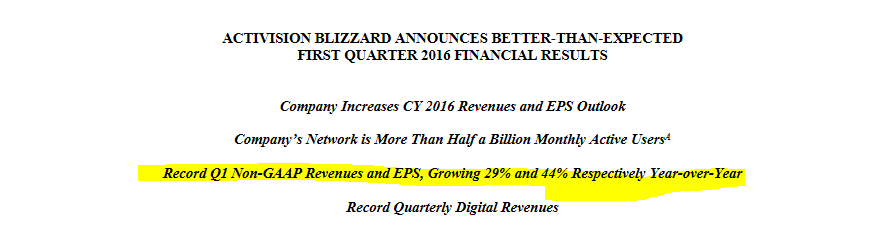
Hat tip to Bass Berry’s Jay Knight for providing this recent Corp Fin comment to Activision Blizzard’s Q1 earnings release that reinforces that non-GAAP equal prominence rules apply to percentages also:
Form 8-K filed May 5, 2016; Exhibit 99.1
2. Your headline references “Record Q1 Non-GAAP Revenues and EPS, Growing 29% and 44% Respectively Year-over-Year” but does not provide an equally prominent descriptive characterization of the comparable GAAP measure. We also note several instances where you present a non-GAAP measure without presenting the comparable GAAP measure. This is inconsistent with Question 102.10 of the updated Compliance and Disclosure Interpretations issued on May 17, 2016 (“the updated C&DI’s”). Please review this guidance when preparing your next earnings release.
Response: We acknowledge the Staff’s comment and will review and reflect the guidance included in the updated C&DI’s when preparing our next earnings release.
John & I had a lot of fun taping our 2nd “news-like” podcast. This 8-minute podcast is about disclosure overload & the new Fall TV season. I highly encourage you to listen to these podcasts when you take a walk, commute to work, etc. And as we tape more of these, it’s inevitable we’ll figure out how to be more entertaining…
This podcast is also posted as part of our “Big Legal Minds” podcast series. Remember that these podcasts are also available on iTunes or Google Play (use the “My Podcasts” app on your iPhone and search for “Big Legal Minds”; you can subscribe to the feed so that any new podcast automatically downloads…
Today is the “Say-on-Pay Workshop: 13th Annual Executive Compensation Conference”; yesterday was the “Tackling Your 2017 Compensation Disclosures: Proxy Disclosure Conference” (video archive is now posted). Note you can still register to watch online by using your credit card and getting an ID/pw kicked out automatically to you without having to interface with our staff. Both Conferences are paired together; two Conferences for the price of one.
– How to Attend by Video Webcast: If you are registered to attend online, just go to the home page of TheCorporateCounsel.net or CompensationStandards.com to watch it live or by archive (note that it will take about a day to post the video archives after it’s shown live). A prominent link called “Enter Conference Here” – on the home pages of those sites – will take you directly to today’s Conference (and on the top of that Conference page, you will select a link matching the video player on your computer: Windows Media or Flash Player). Here are the “Course Materials,” filled with 180 pages of talking points & practice pointers.
Remember to use the ID and password that you received for the Conferences (which may not be your normal ID/password for TheCorporateCounsel.net or CompensationStandards.com). If you are experiencing technical problems, follow these webcast troubleshooting tips. Here is today’s conference agenda; times are Central.
– How to Earn CLE Online: Please read these “FAQs about Earning CLE” carefully to see if that is possible for you to earn CLE for watching online – and if so, how to accomplish that. Remember you will first need to input your bar number(s) and that you will need to click on the periodic “prompts” all throughout each Conference to earn credit. Both Conferences will be available for CLE credit in all states except for a few – but hours for each state vary; see this “List: CLE Credit By State.”
Shareholder Proposals: An Influx When the Crisis Hits
In most cases, a company facing a crisis will receive more shareholder proposals than when it’s not. For example, many of the larger banks received a slew of shareholder proposals in the wake of the ’07 financial crisis. Another example is the likelihood of Wells Fargo receiving a bunch of new proposals in the wake of its $185 settlement with the CFPB – see this Reuters article about some of those proposals that the company recently received (also see this ICCR press release).
It’s wise to warn the board that they should be expecting a proposal “windfall” if a crisis hits…
Survey: How Many Shareholder Proposals Do You Think Wells Fargo Will Receive for ’17?
Please participate in this anonymous survey by guessing how many shareholder proposals will Wells Fargo receive (some of which may be withdrawn or negotiated out):
Today is the “Tackling Your 2017 Compensation Disclosures: Proxy Disclosure Conference”; tomorrow is the “Say-on-Pay Workshop: 13th Annual Executive Compensation Conference.” Note you can still register to watch online by using your credit card and getting an ID/pw kicked out automatically to you without having to interface with our staff. Both Conferences are paired together; two Conferences for the price of one.
– How to Attend by Video Webcast: If you are registered to attend online, just go to the home page of TheCorporateCounsel.net or CompensationStandards.com to watch it live or by archive (note that it will take about a day to post the video archives after it’s shown live). A prominent link called “Enter Conference Here” – on the home pages of those sites – will take you directly to today’s Conference (and on the top of that Conference page, you will select a link matching the video player on your computer: Windows Media or Flash Player). Here are the “Course Materials,” filled with 180 pages of talking points & practice pointers.
Remember to use the ID and password that you received for the Conferences (which may not be your normal ID/password for TheCorporateCounsel.net or CompensationStandards.com). If you are experiencing technical problems, follow these webcast troubleshooting tips. Here is today’s conference agenda; times are Central.
– How to Earn CLE Online: Please read these “FAQs about Earning CLE” carefully to see if that is possible for you to earn CLE for watching online – and if so, how to accomplish that. Remember you will first need to input your bar number(s) and that you will need to click on the periodic “prompts” all throughout each Conference to earn credit. Both Conferences will be available for CLE credit in all states except for a few – but hours for each state vary; see this “List: CLE Credit By State.”
I couldn’t help repeating this creative haiku about the CDIs, from this blog by Gunster’s Gus Schmidt:
Question 128C.01
A “CACM”
That reasonably reflects pay
Can be utilized
Question 128C.02
Hourly pay rates
Can we use to calculate?
No! These will not work
Question 128C.03
To calculate it
You must use recent data
90-day limit
Question 128C.04
Furloughed employees?
You must include them too, but
Use annualized pay
Question 128C.05
What about ICs?
Ignore classification
If you set their pay
More on “The Mentor Blog”
We continue to post new items daily on our blog – “The Mentor Blog” – for TheCorporateCounsel.net members. Members can sign up to get that blog pushed out to them via email whenever there is a new entry by simply inputting their email address on the left side of that blog. Here are some of the latest entries:
– Restatements Hit a New Low
– ISS’ “2016 Board Practices Study”
– Is Tracking Stock Making a Comeback?
– Audit Report Transparency: Netherlands Trumps US – Hands Down
– Omnicare Applied to Audit Reports
Yesterday, as noted in this Cooley blog, Corp Fin issued one new – and two revised – CDIs dealing with Rule 701 as well as the Rule 144(d) holding period. The 701 CDIs are:
This recent Equilar blog has a nifty chart about the relative trends among industries to have “financial experts” on the audit committee. Interesting, the blog notes that S&P 500 companies had a median of two financial experts in ’15 (with 27% composed solely of financial experts) – up about a third since ’11. Learn more about this topic in our “Audit Committee Disclosure Handbook“…
SOX Compliance Costs & Audit Fees: Continue to Rise
Here’s something from Dan Goelzer of Baker & McKenzie:
Recently, consulting firm Protiviti released its “2016 Survey of Sarbanes-Oxley Act Compliance Costs.” As in its 2015 and 2014 surveys, Protiviti found that, for many companies, costs associated with SOX compliance continue to rise. And, similar to prior years, significant numbers of respondents point to the PCAOB’s inspection program as the cause of these cost increases.
Survey Highlights
– Internal compliance costs – The average annual internal cost of SOX compliance for the largest public companies (large accelerated filers) was $1.335 million. For the next tier of public companies (accelerated filers), average annual internal costs averaged $914,000, while still smaller companies (non-accelerated filers) averaged $1.219 million. The highest costs were incurred by emerging growth companies –smaller, recently-public companies – at $1.430 million. On an industry basis, healthcare payers had the highest internal SOX compliance costs ($2.31 million), while media companies had the lowest ($856,000).
– External audit fees – Half of large accelerated filers reported that their external audit fee increased in fiscal 2015, while 8 percent reported a decrease, and 42 percent said the fee remained the same. For non-accelerated filers, 41 percent reported an increase, and 52 percent reported a decrease.
– External auditor reliance on the work of others – High percentages of companies of all sizes reported that their external auditor was relying “to the fullest extent possible” on the work of others (e.g., internal audit) for the testing of controls over medium- and low-risk processes. For example, 81 percent of accelerated filers indicated that this was the case, as did 95 percent of non-accelerated filers.
– Number of entity-level and process-level SOX controls – The average number of entity-level controls reported by survey respondents was 50, of which 60 percent were classified as “key.” The average number of process-level controls reported was 96, of which 63 percent were deemed key.
– Changes in SOX compliance – The compliance area in which the highest percentage of respondents reported “extensive/substantial” change in 2016 was process control documentation for high-risk processes. In addition, 26 percent of respondents reported extensive/substantial increases in the testing of controls over management judgments and estimates.
– Cybersecurity disclosure impact – One-fifth of respondents stated that their company made a cybersecurity disclosure in fiscal 2015, in accordance with the SEC’s staff’s guidance on disclosure obligations relating to cybersecurity risks and cyber incidents. The significance of this figure is tempered by the fact that 42 percent of respondents didn’t know whether or not such a disclosure had been made. Of those who reported a cybersecurity disclosure, 47 percent said that total hours devoted to Sarbanes-Oxley compliance increased 11 percent or more as a result.
Role of the PCAOB
As was reported in last year’s survey, many respondents blame increases in their Sarbanes-Oxley compliance costs on the activities of the PCAOB. Of those respondents who said that their audit firm required changes to the company’s Sarbanes-Oxley compliance procedures in 2015, 44 percent attributed those changes to the PCAOB’s inspection program. Across all respondents, significant percentages thought that PCAOB inspection reports had an effect on the organization’s Sarbanes-Oxley compliance costs in specific areas. For example, 50 percent thought that the PCAOB’s inspections reports had an extensive/substantial impact on the costs of testing reports and other information generated by the company’s systems; 46 percent thought that the PCAOB had caused increases in the testing of review controls.
The compliance cost impact of the PCAOB’s new related party auditing standard also seems to have been significant. Fifty-eight percent of respondents reported that the company was required to update its documentation to identify related parties as a result of Auditing Standard No. 18 (ASC 2410, which governs the auditing of related party transactions). This documentation updating increased total Sarbanes-Oxley compliance hours by an average of 8 percent.
Not surprisingly in light of the cost impact that respondents thought the PCAOB was having, 75 percent of public company respondents reported that someone in the company was “keeping abreast of guidance on PCAOB inspections issued by the PCAOB.”
Role of the Audit Committee
Protiviti also asked who in the organization had primary responsibility for “executive sponsorship” of Sarbanes-Oxley compliance and who had primary responsibility for “execution.” As to executive sponsorship, 46 percent indicated that the audit committee was the sponsor, while 39 percent identified executive management. These numbers reflect a surprising shift to audit committee responsibility during the past 12 months. In the 2015, only 25 percent pointed to the audit committee as the executive sponsor. With respect to execution responsibility for Sarbanes-Oxley compliance, 14 percent of respondents identified the audit committee in 2016, compared to only 2 percent last year.
Comment: Audit committees may have opportunities to consider whether there are ways to convert some of their company’s SOX compliance costs into an investment in more effective and efficient financial reporting and information gathering processes. Sixty-seven percent of public company respondents believe that the company’s internal control over financial reporting has “significantly/moderately improved” since ICFR auditing was required.
Broken down by size, majorities of companies with revenues over $5 billion and under $500 million agreed with that statement. The survey results indicate that large companies have done better than midsize companies at generating value from SOX compliance. In Protiviti’s view “SOX compliance requires a significant investment for many organizations in terms of budget and hours. But the results reflected [in the 2016 survey] * * * reinforce the reasons these investments are needed and the value they create.”
Yesterday, the SEC posted a Sunshine Act notice for an open Commission meeting to propose universal proxy ballots next Wednesday, October 26th. This controversial rulemaking has been in the works for years, with the House of Representatives going so far to vote a few months ago to stop the rulemaking. Check out this piece on page 5 of the November-December 2014 issue of the Deal Lawyers print newsletter entitled “The Quest for Universal Ballots: Might Boards Benefit Too?”…
In addition, the SEC will vote to adopt rules to facilitate intrastate & regional offerings (amendments to Rule 147 & 504) – and to repeal Rule 505 of Regulation D…
How is Morale at the SEC? A 2016 Job Satisfaction Survey
Here’s the SEC’s “2016 Federal Employee Viewpoint Survey.” You can see how the various Divisions & Offices within the SEC compare to each other, as well as how the responses compare to a government wide ratio. The overall number of responses is pretty high, over 3200 Staffers. Compare the results to the 2014 survey…
“Material Plan Amendment” When You Increase Tax Withholding Rate? Nasdaq’s New FAQ
Yesterday, the Nasdaq posted this new FAQ #1269 regarding shareholder approval of plans (also see this Mike Melbinger blog about it):
Question: Is an amendment to an equity compensation plan to increase the withholding rate to satisfy tax obligations, such as from the minimum tax rate to the maximum tax rate, considered a material amendment?
Answer: Generally, an amendment to increase the withholding rate to satisfy tax obligations would not be considered a material amendment to an equity compensation plan. Allowing the holder of an award to surrender unissued shares to pay tax withholdings is similar to settling the award in cash at market price, and neither creates a material increase in benefits to participants nor increases the number of shares to be issued under the plan.
This type of change also is not an expansion in the types of awards provided under the plan. This analysis is the same regardless of whether the plan allows the shares surrendered for tax withholdings to be added back to the pool of shares available for issuance as future awards. Accordingly, an amendment to an equity compensation plan to increase the withholding rate to satisfy tax obligations would not be considered a material amendment to the plan.
Just in time for our “Proxy Disclosure Conference” coming up on Monday – in Houston & by video webconference – Corp Fin issued these 5 CDIs on Item 402(u) yesterday (we’re posting memos in our “Pay Ratio” Practice Area on CompensationStandards.com):
Evaluating these Compliance & Disclosure Interpretations will be among the many “pay ratio” discussions taking place over 20-plus panels. Register now!
Transcript: “Board Refreshment & Recruitment”
We have posted the transcript for our recent webcast: “Board Refreshment & Recruitment” – which tackled board diversity disclosure & more!
Should Say-on-Pay Votes Be Binding?
Here’s an excerpt from this blog – “Should Say-on-Pay Votes Be Binding?” – by two Canadians about the effectiveness of non-binding say-on-pay votes (I’ve recently blogged about binding SOP heading perhaps to the UK):
Some findings reveal disturbing and unintended consequences. For instance, studies suggest that shareholders base their votes on the performance of a company’s stock rather than on an analysis of the firm’s compensation policies and practices. If company shares do better than those of its peers, almost any compensation package will be approved. This perverse result tends to increase the pressure on management to focus on short-term stock performance, sometimes through decisions that may negatively affect future performance.
This is not surprising, though. It has become far harder to read and understand the particulars of executive compensation. Indeed, for the 50 largest (by market cap) companies on the Toronto Stock Exchange in 2015 that were also listed back in 2000, the median number of pages needed to describe their executives’ compensation rose from six in 2000 to 34 in 2015, with some compensation descriptions consuming as many as 66 pages. Investors holding shares in hundreds of different firms face a formidable task. The simplest approach is to vote according to the stock’s performance or, more likely, to rely on the recommendations of proxy advisory firms, which also base their “advice” in part on relative stock market performance.
Thus, 66 percent of corporate directors do not agree that say-on-pay resulted in a “right-sizing” of CEO compensation. Yet 83 percent of directors very much agree or somewhat agree that say-on-pay increased the influence of proxy advisors, according to a 2016 PwC and Cleary Gottlieb survey: Boards, shareholders, and executive pay.
For the many of you that have registered for our Conferences coming up next Monday, October 24th, we have posted the “Course Materials” (attendees received a special ID/PW yesterday via email that will enable you to access them; note that copies will be available in Houston). The Course Materials are better than ever before – with numerous sets of talking points comprising 180 pages of practical guidance. We don’t serve typical conference fare (ie. regurgitated memos and rule releases); our conference materials consist of originally crafted practical bullets and examples. Our expert speakers certainly have gone the extra mile this year!
Here is some other info:
– How to Attend by Video Webcast: If you are registered to attend online, just go to the home page of TheCorporateCounsel.net or CompensationStandards.com to watch it live or by archive (note that it will take a few hours to post the video archives after the panels are shown live). A prominent link called “Enter the Conference Here” – which will be visible on the home pages of those sites – will take you directly to the Conference (and on the top of that Conference page, you will select a link matching the video player on your computer: Windows Media or Flash Player).
Remember to use the ID and password that you received for the Conferences (which may not be your normal ID/password for TheCorporateCounsel.net or CompensationStandards.com). If you are experiencing technical problems, follow these webcast troubleshooting tips. Here are the conference agendas; times are Central.
– How to Earn CLE Online: Please read these “FAQs about Earning CLE” carefully to see if it’s possible for you to earn CLE for watching online – and if so, how to accomplish that. Remember you will first need to input your bar number(s) and that you will need to click on the periodic “prompts” all throughout each Conference to earn credit. Both Conferences will be available for CLE credit in all states except for a few – but hours for each state vary; see our “CLE Credit By State” list.
– Register Now to Watch Online: There is still time to register for our upcoming pair of executive pay conferences – which starts on Monday, October 24th – to hear Keith Higgins, etc. If you can’t make it to Houston to catch the program in person, you can still watch it by video webcast, either live or by archive. Register now to watch it online.
– Register in Houston to Watch In-Person: Starting on Friday, you will no longer be able to register to attend in Houston through this site – but you can still register to attend when you arrive in Houston! You just need to bring payment with you to the conference and register in-person. Through Thursday, you can still register online to attend in Houston…
For five consecutive years, the number of auditor malpractice claims against one of the Big Four auditors has stood in the single digits. A high of 46 claims was reached in 2002 – reflecting the chaos in the wake of the dot-com bubble – whereas only two claims were filed during each of the years 2014 and 2015. 2015 was also a relatively quiet year for auditor malpractice settlements. The totals of such cases were not enough to break into the Top 50 All Time Accounting Malpractice Settlements since 1991- the threshold of which is now $68 Million, as shown in the chart below.
Here’s an excerpt about restatements:
After six years of relatively steady levels, the total number of Financial Restatement disclosures filed in 2015 dropped by 12.7%. The total number of Re-issuance Restatements and the number of companies restating reached a low of 161 disclosures issued by 141 companies. Similarly, the number of Revision Restatements in 2015 also showed a decline. They dropped to 516 from 605 the year before, and accounted for 76.2% of the restatements disclosed.
The largest negative restatement in 2015 came from Alphabet, Inc. (Google’s parent). The $711 million adjustment reduced Alphabet’s previously reported 2014 net income by roughly 2%. Although the $711 million adjustment was the largest in the past three years, it was still dramatically less than amounts disclosed from 2002 to 2006.
In this post, our second annual “best-of-the-year” review, we’ll look at 2015 filings for some of the highlights of the year: the largest restatement, for example, and the biggest overseas stash. We’ll also look at lengthy comment letter correspondence, give a quick recap of auditor ratification, present some notable non-timely filings, and update disclosure controls.
As John blogged recently, Corp Fin recently announced that it would no longer require companies to include “Tandy letter” representations in their responses to Staff comments. The question that I got from some members was: “I presume Tandy reps are still required for acceleration requests?” The answer is “no, the Staff no longer seeks Tandy language in acceleration requests.” This is consistent with the rationale for no longer requiring the language in comment response letters…
Here’s a blog by Keith Bishop highlighting that he had questioned whether Tandy reps were enforceable several months ago. By the way, these were called “Tandy” representations because of a position that the SEC Staff took in the mid-’70s against the Tandy Corporation…
Tune in tomorrow for the webcast – “Virtual-Only Annual Meetings: Nuts & Bolts” – to hear HP’s Katie Colendich, Broadridge’s Cathy Conlon, Ciber’s Sean Radcliffe, GoPro’s Eve Saltman and the Veaco Group’s Kris Veaco as they describe the recent trend towards virtual-only annual meetings, including numerous first-hand accounts of the processes necessary to pull them off.
Political Contributions: Senator Warren Still Red Hot
As noted in this WSJ article, Senator Elizabeth Warren recently wrote this scathing letter to President Obama about SEC Chair White’s failure to conduct political contribution disclosure rulemaking. I have blogged about this saga before…
Here’s a blog by Kevin LaCroix about Warren’s letter, noting it came on the heels of the SEC announcing record Enforcement activity…
This Audit Analytics blog highlights a recent study that suggests PCAOB regulation may be good for an auditor’s business:
In a recent paper titled “Regulatory Oversight and Auditor Market Share,” authors Daniel Aobdia and Nemit Shroff look into the PCAOB’s role in contributing to the perception of an auditor’s assurance value, and whether or not it has an effect on an auditor’s market share. If external stakeholders perceive the PCAOB inspection process to increase the quality of an inspected firm’s audit, then, they hypothesize, the demand for the inspected firm’s audits will increase.
Since all accounting firms that audit US publicly-traded companies are subject to PCAOB oversight, the study looked abroad to measure the effect of regulation on market share. The study concluded that firms with positive PCAOB inspection reports realized bottom-line benefits:
PCAOB-inspected firms do indeed see an increase in market share relative to the firms that are not inspected by the PCAOB. According to the data, the average inspected auditor’s market share increased by 0.4 to 0.9 percentage points, or 3.5% to 6.4%. When looking at only auditors who received substantial negative criticism, however, they found that, true to their hypothesis, the auditors experienced no change in market share.
The study notes that the effect of a favorable PCAOB inspection was particularly significant in countries with higher levels of corruption. Firms with good inspection outcomes saw an increase of 0.5 to 1.4% in high-corruption countries, while those in countries with a lower level of corruption only saw an increase of -0.4 to 0.4.
“Critical Audit Matters” Disclosure: Insurance Policy for Auditors?
As Cooley’s Cydney Posner points out in this blog, accounting firms have not been big fans of the PCAOB’s proposal to make audit reports more informative through disclosure of “critical audit matters” – or “CAMs.” Under the latest version of the proposal, critical audit matters would be defined to include any matter communicated to the audit committee that is material to the financial statements, and involves especially challenging, subjective, or complex auditor judgment.
According to a recent study, auditors may want to rethink their opposition to this proposed disclosure requirement:
It’s somewhat ironic to see the results of the study showing, among other things, that disclosure of CAMs could help protect auditors from legal exposure if a misstatement were subsequently discovered in the CAM area.
The study concluded that the “types of CAMs illustrated by the PCAOB are more likely to prompt a ‘disclaimer effect’ by warning users of the inherent subjectivity and complexity associated with auditing CAM areas. Specifically, we find that CAM disclosures lead to less confidence in the CAM area before a misstatement is revealed and less assessed auditor responsibility after a misstatement is revealed in the CAM area.”
Transcript: “Middle Market Deals – If I Had Only Known”
We have posted the transcript for our recent DealLawyers.com webcast: “Middle Market Deals: If I Had Only Known.”