Last night, SEC Chair Jay Clayton issued a statement on cybersecurity disclosing a 2016 hack of the SEC’s Edgar system. Here’s an excerpt:
In August 2017, the Commission learned that an incident previously detected in 2016 may have provided the basis for illicit gain through trading. Specifically, a software vulnerability in the test filing component of our EDGAR system, which was patched promptly after discovery, was exploited and resulted in access to nonpublic information. We believe the intrusion did not result in unauthorized access to personally identifiable information, jeopardize the operations of the Commission, or result in systemic risk. Our investigation of this matter is ongoing, however, and we are coordinating with appropriate authorities.
The statement did not indicate how long hackers may have had access to nonpublic information. A few years back, Broc blogged about “When Will the SEC’s EDGAR Get Hacked? (Or Has It Already?)” – and noted that if Edgar was ever hacked, the SEC hopefully would let us know.
Edgar’s test filing system represents an attractive target for hackers. Test filings are routinely made by public companies in order to verify that the system will accept a live filing of their documents – but are not publicly available. An intruder able to access those materials would have an advance look at SEC filings in essentially final form.
A July 2017 GAO report on the SEC’s information security practices said that the agency had improved the security controls over its key financial systems. However, the report also noted that the SEC had not fully implemented 11 recommendations from a 2015 GAO audit. These recommendations included “consistently protecting its network boundaries from possible intrusions, identifying and authenticating users, authorizing access to resources, auditing and monitoring actions taken on its systems and network, or encrypting sensitive information while in transmission.”
Cybersecurity is a high priority item for the SEC, and this event – along with the Equifax fiasco – is likely to only increase the emphasis on cyber issues. So it’s worth reading Jay Clayton’s statement in its entirety. The disclosure of the intrusion was part of a much broader statement addressing the SEC’s efforts on cybersecurity – both internally, and in its regulatory & enforcement programs. Doug Chia at “The Conference Board” has blogged some thoughts on the implications of the hack – and on the SEC’s disclosure about it.
Governance: Want Less Litigation? Hire a Lawyer as CEO
This “Harvard Business Review” article says that if boards of companies operating in high-risk environments want to reduce litigation & manage it better, they should make their next CEO a lawyer:
We found that lawyer CEOs were not only associated with less litigation but, conditional on experiencing litigation, were also associated with better management of litigation. So companies run by lawyers, if sued, spent less on litigation and did better — they settled less often when sued and lost less often when cases went to court.
Before you dust off your resume & throw your hat in the ring for the next CEO opening, it turns out there’s a reason that lawyers represent less than one-tenth of S&P 1500 CEOs:
We found that CEOs with legal training were associated with higher firm value, but only in a subset of firms, specifically, in high-growth firms and firms with large amounts of litigation. Outside of this setting, however, the effect of CEOs with legal training on firm value was negative. So companies in, say, the pharmaceuticals and airlines industries performed better when run by lawyer CEOs, all else being equal, while companies in, say, printing and publishing performed worse.
The authors speculate that the difference has to do with lawyers’ risk averse nature – it’s a positive in companies that face a lot of regulatory & litigation risk, but a negative in other settings. So, don’t quit your day job just yet.
Financial Reporting: Accounting for Disasters
This pales in comparison to the devastating human toll that our nation and our neighbors have experienced in the unprecedented series of hurricanes, wildfires & earthquakes that we’ve seen over the past several weeks – but for public companies, there’s also a financial reckoning that has to be made.
This Deloitte memo highlights the financial reporting implications of disasters for entities reporting under U.S. GAAP – which can include accounting for asset impairments, income statement classification of losses, insurance recoveries, and additional exposure to environmental remediation liabilities.
According to this Bloomberg article, a lot more companies are disclosing shareholder activism as a risk factor in their SEC filings. Apparently, 65 companies cited “shareholder activism” as a risk factor in SEC filings during the first six months of 2017, more than five times the number that cited activism during the same period three years ago.
Why is risk factor disclosure on the rise? The article suggests that companies are becoming increasingly aware of the prevalence of activism and the potential downside of being a target. The market cap of the companies including activism risk factors ranges from $45 million to $27 billion – although most are small caps & only a few are at the upper end of the market cap range.
The article identifies a number of companies that had activism risk factors in their recent 10-K filings – including:
Another Bloomberg article says that corporate risk factor disclosure about cyber threats is also growing – or maybe “exploding” is a better word:
More public companies described “cybersecurity” as a risk in their financial disclosures in the first half of 2017 than in all of 2016, suggesting that board and C-suite fears over data breaches may be escalating. A Bloomberg BNA analysis found 436 companies cited “cybersecurity” as a risk factor in their Securities and Exchange Commission periodic filings in the first six months of 2017, compared to 403 companies in 2016 and 305 companies in 2015.
There are plenty of sample cybersecurity risk factors to look at – and they run the gamut from boilerplate to highly specific disclosure. Here are a few that I thought were fairly robust:
In addition to activism & cybersecurity, as we’ve blogged before, President Trump is turning up in a lot of “risk factors” sections of SEC filings. In fact, the President is named so frequently in filings that “there’s an app for that” – the “Trump Tracker.”
Here’s an excerpt from this Sentieo blog introducing its Trump Tracker tool:
Today, we are excited to introduce the Trump Tracker. It’s a bot that constantly scans new public financial documents for mentions of President Trump. These documents include all SEC filings, conference call transcripts, investor presentations, press releases, and more. The bot instantly surfaces new mentions of Trump as soon as they’re published, while intelligent queries automatically sort them into topics like Obamacare, Mexico, and NAFTA.
Anyone interested in following the administration’s impact on public companies can engage with the Trump Tracker by checking the dedicated website, following the @trumptrackerbot Twitter account, or signing up for a daily email alert on the site.
Last week, Vanguard released its 2017 proxy voting report – along with an open letter to public company boards from CEO Bill McNabb. The letter stresses Vanguard’s long-term perspective, and sets forth its governance priorities. Meanwhile, the proxy voting report makes it clear that when it comes to asserting those priorities, the world’s largest index fund complex is more willing to throw its weight around.
The message that Bill McNabb delivered in his letter is an increasingly familiar one – it’s time for companies to improve board gender diversity & climate change disclosure. The letter also stressed the importance of engagement:
Timely and substantive dialogue with companies is core to our investment stewardship approach. We see engagement as mutually beneficial: We convey Vanguard’s views and we hear companies’ perspectives, which adds context to our analysis.
Our funds’ votes on ballot measures – 171,000 discrete items in the past year alone — are an outcome of this process, not the starting point. As we analyze ballot items, particularly controversial ones, we often invite direct and open-ended dialogue with the company. We seek management’s and the board’s perspectives on the issues at hand, and we evaluate them against our principles and leading practices.
To understand the full picture, we often also engage with other investors, including activists and shareholder proponents. Our goal is that a fund’s ultimate voting decision does not come as a surprise. Our ability to make informed decisions depends on maintaining an ongoing exchange of ideas in a setting in which we can cover the intention and strategy behind the issues.
The proxy voting report demonstrates that Vanguard continues to ramp up its engagement efforts. In 2017, it engaged with 954 companies – a nearly 40% increase over the 685 companies that it engaged with in 2015.
Moreover, the report shows that Vanguard is willing to vote against management when companies aren’t responsive to its engagement efforts. For example, Vanguard voted for a shareholder resolution calling for a gender diversity policy at a Canadian company because it concluded that the company wasn’t responsive to its concerns about diversity. For the first time, it also supported several climate change proposals – including one at ExxonMobil.
But Vanguard isn’t just sending a message to public company boards – as this Wachtell memo notes, its actions send an equally strong one to activists calling for index funds to relinquish their vote in contested situations:
With respect to activist and academic-sponsored attacks on the major index funds’ ability to participate in contested situations, Vanguard’s commitment to prioritizing responsible and long-term oriented investment stewardship is clear, having refused to outsource voting decisions to proxy advisory firms, doubled their internal team’s size since 2015, developed an intensive sector-based approach to analysis, engagement and voting and accessed the investment talent across Vanguard’s Investment Management Group and the 30 other investment firms managing Vanguard’s active portfolios.
Vanguard has been criticized for not being as active when it comes to governance issues as its peers BlackRock & State Street, but after some prodding from its own investors, it appears that the once slumbering giant is now wide awake.
New SEC Commissioner Nominee: Robert Jackson
On Friday, President Trump nominated Columbia law prof. Robert Jackson to fill one of the two remaining vacancies on the SEC. Here’s the White House’s announcement of Jackson’s nomination. Jackson would fill a Democratic slot on the SEC & would definitely make the meetings more interesting – he’s a leading advocate of a rule mandating disclosure of corporate political spending. In the past, Jackson’s also crossed swords with the SEC over the agency’s FOIA compliance.
In addition to the nomination of a new Commissioner, the SEC recently announced a number of appointments to Chair Jay Clayton’s executive staff.
Our September Eminders is Posted!
We’ve posted the September issue of our complimentary monthly email newsletter. Sign up today to receive it by simply inputting your email address!
A few days ago, the United Kingdom proposed specific reforms as reflected in this 68-page response to its “Green Paper.” The reforms proposed relate to three specific areas: Executive pay, strengthening the employee, customer and supplier voice and corporate governance in large privately held businesses.
The proposal waters down some of the more controversial aspects of the Green Paper (eg. binding say-on-pay votes) – but the remaining proposals are quite astounding. Here’s the ones relating to executive pay:
1. Require listed companies to report pay-ratio information annually (the ratio of CEO pay to the average pay of the company’s UK workforce), including a narrative explaining changes to the ratio from year to year and “setting the ratio in the context of pay and conditions across the wider workforce.”
2. Provide a “clearer explanation in remuneration policies of a range of potential outcomes from complex, share-based incentive schemes.”
3. Provide specific steps listed companies should take when there is significant shareholder opposition to executive pay policies and awards (which might include, for example, provisions for companies to respond publicly to dissent within a certain time period, or to verify that dissent has been sufficiently addressed by putting the company’s existing or revised remuneration policy to a shareholder vote at the next annual meeting).
4. Increase the responsibility of comp committees for oversight of pay and incentives across the company and require these committees “to engage with the wider workforce to explain how executive remuneration aligns with wider company pay policy (using pay ratios to help explain the approach where appropriate).”
5. Extend the recommended vesting & post-vesting holding periods for executive equity awards from three to five years to encourage a longer term focus.
6. Invite the Investment Association to maintain a public register of listed companies that receive shareholder opposition of 20% or more on say on pay, along with “a record of what these companies say they are doing to address shareholder concerns.”
In 2015 the NYSE amended its policy with respect to material news releases. One of the amendments was to include advisory text in Section 202.06 of the Listed Companies Manual requesting that listed companies intending to release material news after the close of trading on the Exchange wait until the earlier of the publication of their security’s official closing price on the Exchange or fifteen minutes after the scheduled closing time on the Exchange. The reason for the change was that securities trade in other markets after the NYSE closes, and investor confusion arises if the trades in other markets are at prices different than NYSE trades being completed at the NYSE closing price.
Notwithstanding the addition of the advisory text, the NYSE has continued to experience situations where material news released shortly after 4:00 p.m. has caused significant investor confusion. Accordingly, the NYSE now proposes to amend Section 202.06 to prohibit listed companies from issuing material news after the official closing time for the NYSE’s trading session until the earlier of publication of such company’s official closing price on the Exchange or five minutes after the official closing time. The NYSE believes that designated market makers are able to complete the closing auctions for the securities assigned to the market maker in almost all cases within five minutes of the NYSE’s official closing time.
In the proposed rule, the NYSE continues to recommend that companies that intend to issue material news after the NYSE’s official closing time delay doing so until the earlier of publication of such company’s official closing price on the NYSE or fifteen minutes after the Exchange’s official closing time. The foregoing change is in addition to changes to NYSE rules related to dividend announcements, which the NYSE is currently seeking to delay to facilitate implementation of the new rules.
Happy Labor Day! “Office Space” Style
Enjoy the long weekend – assuming you have your TPS Reports done. If not, I think Lumberg wants to see you.
Here’s the results from our recent survey on board approval of the 10-K:
1. When it comes to approving the filing of the Form 10-K with the SEC, our company’s full board:
– Convenes telephonically to approve it – 48%
– Relies on the audit committee to convene telephonically to approve it – 48%
– Management already has the board’s power of attorney to sign the 10-K, so there’s no audit committee or board meeting to approve it – 5%
2. When our directors are given a chance to comment on a draft of the 10-K, we typically receive back:
– No substantive questions or comments – 21%
– 1-2 substantive questions or comments – 43%
– 3-5 substantive questions or comments – 21%
– More than 5 substantive questions or comments – 15%
Dual-Class Structures: Does the Market Already Have a Fix?
Liz recently blogged about the decision of major indices to exclude “dual-class” companies that offer minimal voting rights to public shareholders. The debate about dual-class companies continues to rage – but this recent study suggests that the market may already have a solution, in the form of investors’ demand for a “risk premium” for these stocks. Here’s the abstract:
Critics advocate eliminating dual class shares. We find that founding families control 89% of dual class firms, potentially confounding economic inferences regarding limited voting shares. To identify the impact of dual class structures on outside shareholders, we examine stock price returns; finding that dual-class family firms earn excess returns of 350 basis points more per year than the benchmark.
Institutional owners garner a disproportionate fraction of these returns by holding over 97% of their floated shares. Overall, we show that investors demand a risk premium for holding dual-class family firms, suggesting a market-driven resolution to concerns about limited voting shares.
If the study’s right, these above-market returns may go a long way to explaining why – despite their harrumphing – institutions continue to throw money into these stocks.
Meanwhile, this LA Times article notes that tech companies are not likely to bow to S&P’s new dual-class rules…
Nasdaq to Dual-Class Companies: “We’ve Got Your Back”
The major indices may have “unfriended” dual-class companies like Snap, but this “Institutional Investor” article says that Nasdaq remains happy to provide a home for them. Here’s an excerpt:
Nelson Griggs, head of global listings at the Nasdaq Stock Market, said Nasdaq supports companies that want to go public with a dual-class structure, as long as investors know what they’re getting into. Companies often use multiple share classes – each with different voting rights – to help founders and CEOs maintain control or as a tool to fend off activists. Technology and media companies have been among the biggest users of multiple share classes.
“In the U.S., if companies disclose that they have multiple share classes, then investors can make a decision on whether they want to be a financial owner,” said Griggs. “We think it’s in the best interests of companies to have that option.”
With fewer companies going public, new listings are hard to come by – and companies with dual-class structures represent 10% of Nasdaq’s listings. That’s up from 2% a decade ago. You do the math.
When it comes to changing auditors, it looks like the best advice comes from “Macbeth” – “’twere well it were done quickly.” This Fredrikson & Byron blog flags a new study that says timing matters when it comes to a decision to change auditors – and sooner is a lot better than later:
Companies thinking about changing their auditors should do so before the end of their second fiscal quarter, according to a recent study by researchers at the University of Notre Dame and Ohio University. Although there are legitimate reasons to change auditors having nothing to do with company malfeasance or auditor malpractice, turnover is rare so it can raise questions. In an interview with CFO Magazine, the study’s lead author says that a company announcing the dismissal of its auditor after the second fiscal quarter risks being “lumped in with the bad apples” that want to end the auditor’s engagement to cover up “nefarious” doings.
The study found that companies that dismiss auditors after the 2nd fiscal quarter have “markedly higher rates of future restatements, material weaknesses and delistings” compared to firms that make the change shortly after filing the prior year’s 10-K.
Pre-IPO Companies: Private Liquidity Programs
One reason that some promising companies are electing to defer IPOs may be the growth in private liquidity alternatives for their shareholders. This MoFo blog discusses the Nasdaq Private Market’s recent report on private liquidity programs conducted through its trading platform during the first half of 2017. Here’s an excerpt:
Nasdaq Private Market reports increased activity in private company liquidity programs. Companies that are choosing to stay private longer are using structured and controlled liquidity as a recruitment and retention tool, according to the Nasdaq report. In the first half of 2017, the Nasdaq Private Market Platform had 19 liquidity programs, with a total program volume of $733 million and 1,765 program participants.
62% of the programs were share buybacks and the remaining 38% of the programs were structured as third-party tender offers. These programs had an average size of $40 million. The report notes that most of the 19 programs were employee-focused, where 84% of eligible sellers were current and former employees.
While Nasdaq says that private liquidity programs are appealing to a broader range of companies, most of the companies that have implemented them this year are “unicorns” – with a median valuation of $1.4 billion.
Dividends: NYSE Delays New Timing Requirements
Following up on something we blogged about a few weeks ago, here’s news from Ning Chiu’s blog:
The NYSE has asked the SEC to delay the effectiveness of its recently approved rule requiring listed companies to provide notice to the Exchange at least 10 minutes before making a public announcement about a dividend or stock distribution.
On August 14, when the rule change was approved by the SEC that would require listed companies to provide the Exchange with advance notice, including outside of the hours in which the Exchange’s immediate release policy operates, many assumed that the rule was immediately effective since nothing in the rule filing indicated otherwise.
In its proposal to the SEC, NYSE states that it is asking for the delay to provide listed companies with additional time to prepare and for the Exchange’s new technology systems to provide the necessary support to Exchange staff in reviewing notifications. The Exchange indicates that it will provide reasonable advance notice of the new implementation date to listed companies by emailing a notice to them that will also be posted on nyse.com, and that the new implementation date will be no later than February 1, 2018.
Until then, the text of Rule 204.12 continues to state that notice should be given as soon as possible after declaration of the dividend or stock distribution and in any event, no later than simultaneously with the announcement to the news media.
This recent WSJ article pointed out a significant decline in penalties levied by the SEC during the first half of 2017:
The SEC levied some $318 million in penalties during the first half of 2017, a search of federal court documents and all publicly available records on the agency’s website and data provided by Andrew Vollmer, a professor at the University of Virginia School of Law, showed. Last year, agency actions yielded $750 million in penalties during the same period, an agency spokesman said.
The article notes that fines & penalties imposed by other financial regulators were also down sharply. It cited a more business favorable climate under the Trump Administration & the winding down of financial crisis cases as contributing factors to a decline in SEC enforcement activity.
. . .Wait, Maybe Penalties Aren’t the Right Thing to Look At?
This CFO.com article by Labaton Sucharow’s Jordan Thomas says “not so fast.” The article claims that enforcement activity shows no signs of easing. Here’s an excerpt:
If the first half of the year was any indication, the SEC is on track to have another record year for enforcement activity in 2017. Looking at data compiled in our SEC Sanctions Database, which tracks a subset of enforcement actions that resulted in monetary sanctions exceeding $1 million, the agency shows no sign of easing its efforts to sanction bad actors.
The largest case thus far in 2017 was brought against Barclays, which agreed to pay $97 million in disgorgement and penalties for overcharging clients for mutual fund sales and advisory fees. Perhaps unsurprisingly, given where major financial firms are headquartered, cases were clustered regionally in the Northeast and West, with nearly half of all actions coming out of the Northeast. But actions coming from the South nearly doubled from last year and the Midwest saw a fivefold increase in the number of cases.
Also for the first half of 2017, more than 40% of cases we studied involved offering fraud. That’s almost double the number of offering fraud cases observed in the first halves of the last three years combined.
The article says that in light of this level of activity, the WSJ’s criticism of the SEC’s enforcement activity during 2017 is misplaced – and that it’s inappropriate to draw conclusions about the agency’s enforcement agenda by looking at 6 months of penalties in a vacuum.
Corp Fin Updates “Financial Reporting Manual”
On Friday, Corp Fin updated its “Financial Reporting Manual” to provide contact information for the Office of the Chief Accountant and to clarify guidance on the omission of financial information from draft & filed registration statements. The latter change adds references to the new CDIs on the same topic issued earlier this month.
Yesterday, the SEC issued this fee advisory that sets the filing fee rates for registration statements for 2018. Right now, the filing fee rate for Securities Act registration statements is $115.90 per million (the same rate applies under Sections 13(e) and 14(g)). Under the SEC’s new order, this rate will rise to $124.50 per million, a 7.4% increase. It could be worse – the current filing fee rate represented a 15% bump over fiscal 2016.
As noted in the SEC’s order, the new fees will go into effect on October 1st like the last five years (as mandated by Dodd-Frank) – which is a departure from years before that when the new rate didn’t become effective until five days after the date of enactment of the SEC’s appropriation for the new year – which often was delayed well beyond the October 1st start of the government’s fiscal year as Congress and the President battled over the government’s budget.
Revenue Recognition: Impact of New Standard on S-3 Financials
This Sidley memo addresses the potential need for some Form S-3 filers to retrospectively revise previously issued financials due to the adoption of the new GAAP revenue recognition standard. The memo addresses the impact of the full retrospective transition method on financial statement requirements in existing and newly filed S-3s, as well as how the timing of the new standard’s adoption could change that result.
Forward-Looking Statements: Does “We’re on Track” Qualify?
Over on “The Mentor Blog,” I recently blogged about a new case holding that you can’t insulate a non-forward looking statement by mixing it into a paragraph of forward-looking statements. Now, here comes this blog from Lyle Roberts about a recent case that illustrates how hard it can be to sort out forward-looking from non-forward looking statements in the first place.
At issue in the case was a remark that makes every securities lawyer cringe whenever it pops out of an executive’s mouth – a statement to the effect that a company is “on track” to meet performance expectations. Courts have reached different conclusions about whether or not this language is protected by the PSLRA safe harbor – and the blog notes a recent decision in which a California federal court said that it didn’t make the cut.
This excerpt summarizes the court’s opinion:
In Bielousov v. GoPro, (N.D. Cal. July 26, 2017), the court considered whether the CFO’s statement “We believe we’re still on track to make [GoPro’s financial guidance] as well” was a forward-looking statement covered by the PSLRA’s safe harbor. The court held that because the CFO included the phrase “we believe” in his statement, it was a statement of present opinion about “his and GoPro’s existing state of mind.” Accordingly, the PSLRA’s safe harbor did not apply and the statement should be examined under the Omnicare standard.
Last month, the House Financial Services Committee unanimously approved the “Improving Access to Capital Act” (H.R. 2864). The bill would eliminate the current provisions of Regulation A that prohibit its use by companies that are already subject to Exchange Act reporting requirements. This Duane Morris blog provides some background:
In implementing rules under the Jumpstart Our Business Startups (JOBS) Act in 2015, the SEC retained the historical restriction that only non-reporting companies could utilize Reg A. There was really no particular reason this could not have been changed.
Now that practitioners have witnessed the closing of well over 30 Reg A+ deals, three of which are now successfully trading on national exchanges, it would seem logical to expand the availability of Reg A+ to reporting companies. They would have a history of full disclosure, and could clearly benefit from utilizing a faster and cheaper option to raise money from the public.
The blog notes that the ability to use Reg A+ could prove particularly useful to reporting companies that don’t qualify to use Form S-3 for primary offerings.
Audit Committees: Proxy Disclosure Trends
In recent years, investors and other constituencies have called for greater disclosure in proxy statements about key audit committee activities – including more detail about decisions to retain independent auditors, auditor independence assessments, & risk oversight. This Deloitte study reviewed audit committee disclosures in 2017 proxy statements filed by the S&P 100.
Disclosures beyond those required by Item 407 of S-K have been trending upward in recent years, and the study says that trend continued – at a somewhat slower pace – in 2017. The most common areas of voluntary disclosure include the committee’s role & responsibilities, risk oversight, topics discussed by the audit committee, and oversight of financial reporting & the internal audit function.
This excerpt reviews the findings on audit committee disclosure of risk oversight:
The role of the board and its committees in overseeing risk continues to be a hot topic. 99% of the S&P 100 companies disclosed the role of the audit committee in overseeing risk. The level of responsibility assigned to the audit committee, however, differed from company to company.
Companies disclosed that the audit committee was responsible for overseeing risks associated with traditional areas such as financial reporting, internal controls, and compliance, and some noted that the audit committee’s role in risk oversight extended beyond these areas. 30% of the S&P 100 companies (versus 27% 2016) disclosed the audit committee’s role in overseeing cybersecurity risk.
Topics that drew the fewest disclosures among the S&P 100 included issues encountered during the audit, as well as matters relating to the committee’s role in determining auditor compensation. Also see this recent blog about a EY report on audit committee disclosures…
Board Diversity: The Pressure is Ratcheting Up
Over on our “Proxy Season Blog,” Liz recently noted State Street’s decision to vote against directors at approximately 400 companies that didn’t satisfy it with their efforts to improve board gender diversity – and we’ve previously blogged about BlackRock’s efforts to prod companies to make progress on the diversity front.
Now this Weil Gotshal blog says that it isn’t just institutional investors that are turning up the heat. As this excerpt points out, here come the politicians:
While these institutional investors are ratcheting up the pressure on public companies, certain members of the US Congress have been pushing the SEC for greater board diversity disclosure. In March, Representative Carolyn Maloney (D-NY) reintroduced her Gender Diversity in Corporate Leadership Act (H.R. 1611), modeled on policies in Canada and Australia, which would instruct the SEC to recommend strategies for increasing women’s representation on corporate boards, and require companies to report their gender diversity policies as well as the proportion of women on their board and in senior executive leadership.
In addition, 29 congressional Democrats have written a letter to SEC Chair Jay Clayton urging the SEC to require more disclosure about board diversity.
There have been a number of seven-figure awards under the SEC’s whistleblower program, so a recent $2.5 million award wouldn’t merit much attention – that is, if the recipient wasn’t an employee of a government law enforcement organization.
Typically, government law enforcement organization employees aren’t eligible to receive whistleblower awards – but as this Hogan Lovells memo notes, this award indicates the SEC Staff is inclined to read that limitation on eligibility narrowly:
The SEC indicated that although an employee of a law enforcement organization is not normally eligible as a whistleblower, there may be an exception when law enforcement is just one component of the agency’s purposes and the employee does not work for that component of the agency. According to the SEC, employees of law enforcement organizations—defined as organizations “having to do with the detection, investigation, or prosecution of potential violations of law”—are eligible for the award so long as they do not work for the “sub agency components that perform the law enforcement responsibilities.”
The memo points out that the ability of government employees to blow the whistle may complicate the relationship between companies & their regulators:
Personal gain could motivate a government employee to pass along information to the SEC in hopes of receiving an award, especially if the reward encourages competition among government employees to provide information to the SEC. Companies that regularly work and communicate with regulatory agencies should consider the risk of sharing information that could serve as evidence of securities violations, particularly if the likely sanctions could exceed $1 million, which is the threshold required to receive a whistleblower award.
The SEC Staff’s decision to read the law enforcement exclusion from eligibility narrowly also signals that the whistleblower program will continue to feature prominently in its enforcement efforts under the Trump Administration.
SRO Rulemaking: DC Circuit Decision May Slow SEC Action on Rule Proposals
A recent ruling from the DC Circuit may slow down the SRO rulemaking process by effectively raising the standard for SEC review of new rules. This Davis Polk memo explains:
The case, Susquehanna International Group, LLP, et al. v. SEC, decided on August 8, involved a petition by two options exchanges and two broker-dealers (“Petitioners”) for review of an SEC order approving a proposed change by the Options Clearing Corporation (“OCC”) to its rules. The proposed rule set out a plan to bolster its capital by restructuring its capital contribution requirements, fees, rebates and dividends. The proposal was filed by the OCC in 2015 and the SEC issued an order approving the proposal in February 2016.
In reviewing SRO rule changes, the court held that the SEC must undertake its own “reasoned analysis,” not take the SRO’s “word for it” that statutory standards are met, and that SEC approvals may be set aside as being “arbitrary and capricious” unless its determinations are supported by “substantial evidence.” The court reviewed the SEC’s discussion of various aspects of the OCC proposal and found the agency’s analysis concerning the satisfaction of statutory standards to have been insufficiently probing.
The SEC often relies on SRO statements about satisfaction of statutory standards in approving rule changes, and the Court’s insistence on a more probing analysis may slow a process that market participants complain is already too slow and cumbersome.
Links to Exhibits: Remember, Remember! The 1st of September. . .
Sorry for misappropriating & re-dating the famous verse about Guy Fawkes & the Gunpowder Plot – but I wanted to remind everybody that the new rules mandating links to Exhibits in SEC filings go into effect on September 1st. This Sidley blog has an overview of the requirements.
Broc blogged last week that it appears that Corp Fin has provided some informal guidance on how to link to very old exhibits. We continue to post memos in our “Exhibits” Practice Area.

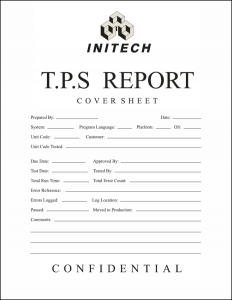 Enjoy the long weekend – assuming you have your TPS Reports done. If not, I think Lumberg wants to see you.