Recently, a member claimed that he heard that the SEC’s Public Reference Room was closed. I was surprised to hear that – so I paid a visit to find out that it indeed still exists. It does – albeit it’s now subsumed into the SEC’s library, with daily hours reduced to 10 am – 3 pm.
Of course, the importance of the Public Reference Room has greatly diminished over time. Before Edgar came online, that was the place to go to obtain SEC filings. There were times when there was a huge line to merely gain access to it – and it was often bedlam as described in this NY Times article from 1982. And here’s a GAO report from 1989 about how to improve its operations – remember microfiche! Here’s a pic of the room from 1937. And even when Edgar first started, there were many SEC-related documents that could be found only there.
But at this point, it’s more of a historic relic as information is readily available online, for free or a fee. In fact, the Public Reference Room now consists of what essentially is a one-person office with a solitary filing cabinet in it, filled with Form 144s. And if the SEC eventually requires the electronic filing of those forms (which Jesse Brill has urged for quite some time in The Corporate Counsel and more recently in this rulemaking petition), I imagine the Public Reference Room will truly be history. Please send your memories of the place – I won’t share without your permission.
How’s the SEC’s Library Looking?
I did visit the SEC’s library, which always has been one of my favorite spots. How many of the old-timers out there remember the library being jammed with both Staffers and visitors? And more than one Staffer perhaps getting a little shut eye? A nice quiet place for a nap. Send me your fond memories (and I won’t attribute unless you want it).
Getting in there is not as simple as the old days, when you could just walk in off the street. You still can walk in off the street – but you first must go through security and then wait in the Visitor’s Office until a librarian comes to fetch you. But it’s worth the trip! Of course, the library’s staff spends most of its time managing the numerous electronic resources available to the entire SEC – so the book collection is not visited often. It’s more of a museum. But for securities law nerds, it’s full of classic resources.
An exclusive group of heavyweights is chosen to deliberate over an obscure, yet crucial, policy matter. Two players who didn’t make the membership cut take offense, and spurn an invitation to join the discussion. It’s the stuff of classic Washington power politics intrigue. In this case, the tussle over the shape of an advisory panel has set up a behind-the-scenes tiff between the country’s top markets regulator – the Securities and Exchange Commission — on the one side, and two of the country’s biggest exchanges — the New York Stock Exchange, and Nasdaq – on the other.
The two exchanges are so upset the SEC didn’t offer either of them a seat on the agency’s Equity Market Structure Advisory Committee that they have spurned offers by the panel to participate in policy deliberations held by its members behind closed doors, according to people familiar with the matter.
Our February Eminders is Posted!
We have posted the February issue of our complimentary monthly email newsletter. Sign up today to receive it by simply inputting your email address!
Spanking brand new. By popular demand, this comprehensive “Materiality Handbook” covers a wide range of scenarios, from how 8-K, press releases and Reg FD to 10-Ks and 10-Qs and securities offerings. This one is a real gem – 32 pages of practical guidance – and its posted in our “Materiality” Practice Area.
The FASB’s “Materiality” Rulemaking: Comments So Far
The two FASB proposals for determining materiality continues to stir controversy. For example, these proposals have raised the ire of investors, including the SEC’s Investor Advisory Committee (see this comment letter from CII and this NY Times column). In its proposals, the FASB has said materiality is a legal concept – and in essence, isn’t an accounting concept. The latter is debatable as many courts have cited to the FASB’s concept of materiality in their decisions – and materiality has been discussed in both legal cases and in the accounting literature (eg. SAB 99). Here’s the comments on the FASB’s proposal so far – check out this one from Jack Ciesielski.
Audit Committees: Regulators Change Bank Duties
This blog by Steve Quinlivan notes how the Federal Reserve, FDIC and OCC recently issued an advisory to indicate their support for the principles in Parts 1 and 2 of the Basel Committee on Banking Supervision’s March 2014 guidance on “External audits of banks” referred to as the “BCBS external audit guidance.” Steven notes that Matt Kelly has written two blogs about the advisory, including this one about the practical implications of it…
Check out this blog by Mike Gettelman to hear what Delaware Chief Justice Leo Strine said this week at the San Diego conference…
Here’s something from Abby Jones, who recently retired from QEP Resources as corporate secretary:
Investor Relations and corporate governance teams increasingly are receiving investor questions about ESG matters. What should these teams do if they receive a call or letter?
How We Got Here – ESG stands for Environmental, Social and Governance. ESG has become shorthand for investment methodologies that consider sustainability. The ESG investment theory posits that considering ESG factors offers portfolio managers added insight into the quality of a company’s management, culture, and risk profile. ESG investors want companies to increase their disclosure of environmental, social and governance information so that investors can make investment decisions with that information in mind.
In February 2010, the SEC issued an interpretive release titled “Commission Guidance Regarding Disclosure Related to Climate Change.” In response, few companies provided climate change disclosure in their 10-Ks. Fearing the SEC guidance was inadequate, advocacy groups including the Global Investor Coalition on Climate Change, the Climate Disclosure Standards Board, and the Sustainability Accounting Standards Board issued carbon asset risk disclosure guidelines.
And some sustainability advocacy groups – such as Ceres – claim that most companies have failed to provide meaningful carbon asset risk disclosures in response to these guidelines. In order to obtain information, some large investors with ESG goals have begun to contact investors directly. Hence the calls.
Who is Calling Whom? – Some large investors such as state pension funds and large institutions with specialized funds have ESG teams devoted to gathering ESG information. Their first point of contact is typically someone in Investor Relations or the Corporate Secretary’s department.
What Do Investors Want to Know? – The information these investors seek can be very specific. For example, some investors have recently asked for greenhouse gas (GHG) emission totals, plans to submit data to the Carbon Disclosure Project, internal GHG emission targets, plans to adopt a corporate sustainability plans, and other related data. Those asking the questions are often well-informed about the subject matter and the industry involved.
What Should I Do Upon Receiving a Call or Letter?
Here are my suggestions:
1. Make sure all internal stakeholders are aware your company has been contacted. This will generally include Investor Relations, the Operations and/or the Health Safety and Environmental (HSE) team, the governance team, the CEO and CFO. Obviously, the list will vary depending on the organization.
2. Determine whether any of the information is proprietary, and your company’s willingness to release it, whether narrowly or broadly.
3. Determine whether your company has the information sought, and whether you measure it the same way the requesting investors do.
4. Ascertain which department(s) are responsible for gathering and maintaining the information.
5. Put together a working group to assemble the data to be released and to answer the policy questions.
6. Decide whether your company wants to provide the information just to the investor who requested it – or more broadly.
7. Set up a time to talk with the investor representatives. Even if your company plans to broadly disseminate the information, you should take the time to speak with the investors who contacted your company.
8. If you plan to disclose to just the individual investors, review all data you plan to provide with legal counsel to ensure you do not run afoul of Regulation FD. Have that counsel present during the call in case the answer to a question prompts disclosure of additional information.
9. If you plan to disclose the information more broadly, work with the Legal Department Investor Relations, Financial Reporting, and Corporate Communications to ensure adequate and accurate disclosure.
10. Have employees who understand the subject matter on the phone for the call. They are best qualified to have these discussions – and to answer specific questions.
11. If you have good facts to tell, by all means tell them. Investors want you to answer their questions – but in my experience they also like to hear about innovative processes your company has developed to advance ESG goals. Don’t be afraid to go “off topic” to provide good news.
Examining Carbon Reduction ROI & Competitive Positioning
Here’s a great blog by Pam Styles that analyzes disclosures companies have made about their ROI when it comes to carbon reduction initiatives. It includes some good sample purchasing company disclosures…
Transcript: “Audit Committees in Action: The Latest Developments”
We have posted the transcript for our recent webcast: “Audit Committees in Action: The Latest Developments.”
In an insider-trading case that will be closely watched until it is decided before the end of June, the U.S. Supreme Court granted certiorari to decide critical open questions about what is required to establish insider trading by a remote “tippee”—specifically, what kind of personal benefit must a “tipper” receive, and what knowledge of that benefit must the “tippee” have, for a conviction or sanction to stand.
The case is Salman v. United States, No. 15–628, and it involves a criminal defendant who traded on the basis of stock recommendations given to him by the brother of a Citigroup investment banker. The banker had given material nonpublic information about pending M&A deals as a gift to benefit his brother, who in turn gave the information to the defendant, Salman. Salman was convicted, and on appeal, he urged the Ninth Circuit to follow the requirements adopted by the Second Circuit in 2014 in United States v. Newman: that the government must prove that a remote tippee like Salman knew of the “personal benefit” that the original tipper received in exchange for the tip; and that the benefit must be “objective, consequential, and represent at least a potential gain of a pecuniary or similarly valuable nature.” Affirming Salman’s conviction, the Ninth Circuit refused to follow Newman, and held that it was sufficient for the government to establish that the tipper had made “a gift of confidential information to a trading relative or friend.” In so holding, the Ninth Circuit created a significant circuit split over the proper scope of remote tippee liability for insider trading.
To resolve this conflict, the Supreme Court must revisit its 1983 decision in Dirks v. SEC. Dirks held that, to establish tippee liability, the government must show, first, that the tipper of inside information “personally will benefit, directly or indirectly, from his disclosure,” for “[a]bsent some personal gain, there has been no breach of duty”; and, second, that the “tippee knows or should know that there has been a breach.” The Ninth Circuit in Salman and the Second Circuit in Newman each grounded their decisions in Dirks, but drew divergent lessons from it.
The Court’s eventual answer will define the outer boundaries of insider trading liability in future cases. But as we advised in our memo on Newman, whatever the Court’s answer turns out to be, corporations and financial institutions that have established compliance policies and systems to prevent the misuse of confidential information by their employees should continue to maintain, and vigilantly enforce, such controls. Although Salman may well reshape the outer boundaries of the law in this area, the core proscriptions against disseminating material nonpublic information will remain firmly in place, and as the recent In the Matter of Marwood Group Research proceeding illustrates, companies can face significant liability for failing to maintain robust systems and procedures to prevent the misuse of confidential information.
XBRL: SEC Staff Updates FAQs on Calculations
Yesterday, the SEC’s Division of Economic & Risk Analysis updated these FAQs on XBRL calculations. I will never read them personally…and thankfully…
The federal government in DC is quasi-open today – including the SEC – due to the weekend snow storm. There is a 3-hour delay for federal DC workers – with an option for unscheduled telework or leave…
Webcast: “Best Efforts Offerings – Nuts & Bolts”
Tune in tomorrow for the DealLawyers.com webcast – “Best Efforts Offerings: Nuts & Bolts” – to hear from Hunton & Williams’ Greg Cope, Arnall Golden Gregory’s Bob Dow and Pillsbury’s Bob Robbins to learn the nuances of Rule 10b-9 and “best efforts” offerings. Here’s our “Best Efforts Offerings Handbook“…
By the way, don’t forget the annual ASECA dinner for SEC alumni is on Friday, February 19th in DC. You don’t have to be an alum to attend. I won’t be there as I’ll be on vaca but I can say that the cocktail party is always fun beforehand…
As noted in this memo, in a speech delivered last month at the AICPA national conference, SEC Chair White suggested that the SEC will continue to scrutinize the use of financial measures that do not conform with GAAP. Also see Randi’s blog today in “The Mentor Blog” about an uptick on the number of comments related to non-GAAP measures…
The federal government in DC is still closed today – including the SEC – due to the weekend snow storm. See my earlier blog about how this might impact the processing of your filings (& what you can do if you have a deal that must go forward now).
– FAQ #15: Problematic Pay Practices & Equity Plans – Will consider three-year average concentration ratios above 30% for the CEO – or above 60% for the NEOs in the aggregate – as a signal that an equity plan is not broad-based
– FAQ #59: Externally-Managed Issuers – More details about the minimum level of disclosure required to avoid an automatic “against” recommendation
– FAQ #61: Subsequent event handling – More details about how ISS will evaluate agreements or decisions subsequent to the fiscal year covered by the CD&A
Whistleblowers: SEC Grants $700k Award to Expert Outsider
As reflected by this recent SEC whistleblower award, the SEC is willing to provide an award to someone outside the company if they can provide useful information…
Webcast: “Alan Dye on the Latest Section 16 Developments”
Tune in tomorrow for the Section16.net webcast – “Alan Dye on the Latest Section 16 Developments” – to hear Alan Dye of Section16.net and Hogan Lovells discuss the most recent updates on Section 16, including new SEC Staff interpretations and Section 16(b) litigation.
In response to this new GAO report on board gender diversity, Rep. Carolyn Maloney (D-NY) sent a letter to SEC Chair White earlier this month urging amendments to the proxy statement rules to require that companies disclose each board nominee’s gender, race, and ethnicity – as was proposed by nine large public pension funds in a March 2015 petition to the SEC.
That petition seeks this amendment to Item 407(c)(2)(v) of Regulation S-K (proposed new text underlined):
Describe any specific minimum qualifications that the nominating committee believes must be met by a nominating committee-recommended nominee for a position on the registrant’s board of directors, and describe any specific qualities or skills that the nominating committee believes are necessary for one or more of the registrant’s directors to possess. When the disclosure for this paragraph is presented in a proxy or information statement relating to the election of directors, these qualities, along with the nominee’s gender, race, and ethnicity should be presented in a chart or matrix form.
The petitioners describe the current diversity disclosure requirement (Item 407(c)(2)(vi)) of Regulation S-X) as inadequate to determine racial and ethnic and even gender diversity in certain cases, but view it as complementary to their suggested approach.
Here are the key findings of the GAO study, which was prompted by Rep. Maloney’s request in May 2014:
In 2014, women comprised about 16% of board seats in the S&P 1500 – up from 8% in 1997
Even if equal proportions of women and men joined boards each year beginning in 2015, it could take more than four decades for women’s representation on boards to be on par with that of men’s.
Even if every future board vacancy were filled by a woman, the GAO estimated that it would take until 2024 for women to approach parity with men in the boardroom.
The GAO identified various factors that may hinder women’s increased representation among directors. These include boards not prioritizing recruiting diverse candidates; few women in the traditional pipeline to board service—with CEO or board experience; and low turnover of board seats
Most stakeholders interviewed supported improving SEC disclosure requirements on board diversity.
The U.S. lags behind other industrialized nations, including Australia, Canada, the UK, Germany and Norway – where serious, concerted efforts have been made to address discrimination against women in the board room.
Among the potential strategies identified in the report for increasing board gender diversity in addition to expanded disclosure requirements are:
– Requiring a diverse slate of candidates to include at least one woman
– Setting voluntary diversity targets
– Expanding board searches beyond the traditional pool of CEO candidates
– Expanding board size to include more women
– Adopting term or age limits to address low turnover
– Conducting board performance evaluations
Rep. Maloney is a senior member of both the House Financial Services Committee (where she serves as Ranking Member of the Subcommittee on Capital Markets) and House Oversight and Government Reform Committee, and Ranking House member of the Joint Economic Committee.
Webcast: “Pat McGurn’s Forecast for 2016 Proxy Season”
Tune in tomorrow for the webcast – “Pat McGurn’s Forecast for 2016 Proxy Season” – when Davis Polk’s Ning Chiu and Gunster’s Bob Lamm join Pat McGurn of ISS to recap what transpired during the 2015 proxy season and what to expect for 2016. Please print this deck in advance…
The SEC is closed today due to the weekend snow storm. See Broc’s earlier blog for the filings impact.
Board gender diversity improved among Fortune 1000 companies on the 2020 Women on Boards’ recently released 2015 Gender Diversity Index. The GDI’s 842 companies consist of the Fortune 1000 companies that remain active since the organization’s tracking began in 2011 based on the 2010 Fortune 1000 list.
Key findings of this year’s report include:
Women now hold 18.8% of board seats – an increase from 17.7% in 2014 and 14.6% in 2011. This compares to 17.9% of board seats on the 2015 Fortune 1000 list – a lower percentage than the GDI Index due to the fact that the majority of new companies are smaller and smaller companies have less gender diverse boards, as well as the fact that companies that drop off the GDI (due to, e.g., M&A, bankruptcy) tend to have one or no women.
Women gained 75 board seats in 2015 – an increase from 52 board seats gained in 2014.
Number of Winning “W” Companies (greater than 20%) has increased to 45%, compared with 40% last year. The number of Zero “Z” Companies (no women) continues to decline, to 9% this year, compared with 11% in 2014.
Percentage of women on boards has increased in all sectors, but five sectors have increased to over 20%: Consumer Defensive, Financial Services, Healthcare, Technology, and Utilities.
We continue to post new items daily on our blog – “The Mentor Blog“ – for TheCorporateCounsel.net members. Members can sign up to get that blog pushed out to them via email whenever there is a new entry by simply inputting their email address on the left side of that blog. Here are some of the latest entries:
– Director Exit Interviews
– Data Breach Derivative Suit Protection: Action Items
– How to Calmly Effect Emergency Succession
– Non-GAAP Disclosure Compliance Tips
– Redefining the Board’s Role in Strategic Planning
A joint Nasdaq/US Chamber of Commerce survey of 155 public companies regarding their interactions with ISS and Glass Lewis during the 2015 proxy season revealed that only 25% of companies believed the proxy advisor carefully researched and took into account all relevant aspects of the particular issue on which it provided advice, and only 38% of companies believe that their input into the proxy advisor’s recommendations (to the extent provided) had any impact.
Additional survey results include:
94% of companies had a proxy advisor make a recommendation on a matter in their proxy statement.
Companies asked advisory firms to provide input into the recommendation 47% of the time, and advisory firms permitted that input 53% of the time. As noted, only 38% of companies believe that input had any impact on the final recommendation.
For companies seeking input, companies reported a wide spread in the amount of time the advisors granted them to respond – anywhere from one hour to a month. 24 to 48 hours seemed most common.
For companies that believe they had insufficient time to respond, only 26% expressed their dissatisfaction to the advisory firm and portfolio managers.
More than half of companies (53%) notified the proxy advisor when it relied on inaccurate or stale data to make a recommendation. 43% of companies notified portfolio managers. No companies reported bringing the issue to the attention of the SEC.
38% of companies surveyed reached out to proxy advisors to pursue opportunities to meet and discuss proposal issues. 60% of companies’ outreach resulted in a meeting with the advisor.
20% of companies formally requested previews of advisor recommendations. About half (48%) reported that the advisor accommodated the request. Again, companies reported a wide spread of one day to one month in the time between the preview and the recommendation, with 1 – 2 weeks seeming most common.
84% of companies monitor proxy advisors’ reports for accuracy and reliance on outdated information.
13% of companies took steps to verify the nature of proxy advisor conflicts of interest, and even fewer (6%) reported finding significant conflicts during the current proxy season. While affected companies uniformly notified proxy advisors 100% of the time when the companies discovered apparent conflicts, none notified the SEC.
78% of companies have some form of year-round, regular communication program with institutional investors.
The SEC is closing at noon today due to the expected snow storm. See Broc’s earlier blog for the filings impact.
Congressman Questions SEC on Proxy Advisor Accountability
As discussed in this release, at an October 2015 Capital Markets and Government Sponsored Enterprises Subcommittee hearing: Oversight of the SEC’s Division of Investment Management, U.S. Rep. Ed Royce (R-CA) questioned SEC Director of the Division of Investment Management David Grim on proxy advisor accountability, and suggested that the SEC should be engaging in formal rulemaking on proxy advisors as opposed to simply issuing a staff legal bulletin – as was the case with SLB 20.
Here is a key excerpt:
Following up on the staff legal bulletin on proxy voting that Chairman Garrett and Mr. Huizenga raised earlier: Should proxy advisory firms not be held to the same sort of accountability on corporate reporting and transparency as the SEC requires of the publicly traded companies that they advise on?” continued Rep. Royce.
“With respect to proxy advisory firms and the guidance that the staff did issue, I think it was focused on addressing two important issues as a general matter. One is, with respect to the proxy advisory firms themselves, doing what we can to encourage good disclosure of material conflicts of interests by those proxy advisory firms. The second focus of the guidance was on investment advisors and how they use proxy advisory firms, making sure that their oversight of the proxy advisors is robust and appropriate,” replied Grim.
“I saw the bulletin, one of the things it brought to mind was whether or not we shouldn’t instead be having the Commission have a formal rulemaking on this. And I say it for these reasons: when we get to this question of what are the standards of performance, we’ve got a situation where you’ve got two entities, and they dominate here clearly over 90% of the market, and on top of it have a situation where their reports, I would think, would be subject to public scrutiny, after those reports are prepared. But we don’t have that. So I think taking it higher than a staff legal bulletin and taking it to basically a question of rulemaking on this by the Commission is something I would suggest,” continued Rep. Royce.
As a senior member of the House Financial Services Committee, Royce sits on two Subcommittees: Capital Markets and Government Sponsored Enterprises and Housing and Insurance.
We continue to post new items daily on our blog – “The Mentor Blog” – for TheCorporateCounsel.net members. Members can sign up to get that blog pushed out to them via email whenever there is a new entry by simply inputting their email address on the left side of that blog. Here are some of the latest entries:
– Crisis Management Planning in 5 “Easy” Steps
– Government Investigations Disclosure: Decision-Making Considerations
– Cyber Insurance in a Nutshell
– Study: Director Appointment Trends
– Board Cybersecurity Oversight: Questions to Ask
Among the noteworthy aspects of the PCAOB’s 5-year strategic plan that was recently approved are its list of accomplishments and progress measures since 2012 and enhanced going-forward strategies relative to its Audit Committee Outreach initiative, which supports one of its principal objectives to “make a positive difference in the market for audit services and advance trends for quality financial reporting”:
Actions Taken since November 2012
Developed materials, such as Audit Practice Alerts Nos. 10, 11, 12, 13, summary reports on inspections observations on internal control over financial reporting audits, triennial inspections, engagement quality review, and risk assessment to engage audit committees in areas of common interest.
Included focused guidance to audit committees in inspection reports, general reports and audit alerts on using the reports and alerts.
Engaged the SAG, IAG and other groups, in discussion to further explore areas of common interest, including an extended discussion at the May 2013 SAG and October 2014 IAG meetings.
Engaged small firm auditors through the Forums on Auditing in the Small Business Environment on the relationship between the auditors and audit committees.
Monitored certain non-U.S. regulators’ respective plans for audit committee outreach initiatives and results.
Enhanced participation by Board members and staff in outreach events focused on audit committee members.
Solicited views and began evaluating feedback from certain audit committee members on how the Board may improve the usefulness of its publicly issued inspection reports.
Issued a communication to audit committees — Audit Committee Dialogue – the first in a series intended to provide insights from inspections of public company auditors that may be helpful to audit committee members in their oversight of auditors.
While the PCAOB admittedly (see PCAOB Chair Doty’s speech) doesn’t oversee audit committees and (appropriately) claims to be cautious about not adding to their “burden,” the outreach efforts both proactively and responsively effect awareness and education and calls for insights from audit committees to assist in their robust oversight obligations, which is a laudable objective.
See KPMG’s Audit 2020 survey report highlighting how technology and the proliferation of data and analytics are (or should be) transforming the audit profession without compromising the fundamental needs for audit quality and accuracy.
Audit Committees: Unfair Scrutiny?
Particularly noteworthy and surprising in SEC Chair White’s and Chief Accountant Jim Schnurr’s addresses at the recent annual AICPA Conference were the sweeping concerns they expressed about audit committee workload, composition, and performance of oversight responsibilities.
Among other things, the criticisms aimed at increasing workload and purportedly corresponding diminishing effectiveness seem unwarranted in the context of the seemingly limitless direct and indirect regulatorily-mandated duties and obligations imposed by SOX, securities laws, NYSE and Nasdaq audit committee-related listing standards and PCAOB standards (among others) – presumably with more on the way (e.g., Audit Committee Disclosure, Audit Quality Indicators).
See this Akin Gump post – and this post and article from the WSJ.
More on “The Mentor Blog”
We continue to post new items daily on our blog – “The Mentor Blog” – for TheCorporateCounsel.net members. Members can sign up to get that blog pushed out to them via email whenever there is a new entry by simply inputting their email address on the left side of that blog. Here are some of the latest entries:
– Cyber Insurance Tips
– Survey: Most CAE’s Report Functionally to Audit Committee
– Startup Board Mistakes
– EU Audit Reforms: Impacts on US Companies
– Compliance Officer-Whistleblowers Raise Concerns
The Financial Stability Board (FSB) announced that an industry-led task force – to be chaired by SASB Chair and former NYC Mayor Michael Bloomberg – will be developing recommendations on voluntary comparable climate-related risk disclosure standards for companies to use with investors and other stakeholders. The work will be conducted in two stages – with the aim of making specific recommendations for voluntary disclosure principles and leading practices by the end of 2016.
Per the release, the wide range of existing disclosure schemes relating to climate or sustainability illustrates the need for consensus on what constitutes effective disclosure. The task force – to be composed ultimately of up to 30 private sector senior technical experts from preparers and users of company risk disclosures, as well as risk analysts – will consider the work of other groups related to effective disclosures and will conduct public outreach during the disclosure development process.
SASB’s December newsletter claims that climate-related issues are reasonably likely to have material impacts in 72 of 79 SICS industries (or 51 of 57 industries for which it has already issued standards) – representing 93% of U.S. equities by market cap. That being the case, CEO and Founder Jean Rogers notes that investors realistically can’t simply divest themselves of those stocks that pose a risk in order to mitigate the effects of climate change; rather, investors need sufficient data about the risks so as to create a responsive investment strategy.
Bloomberg also serves as the United Nations Secretary-General’s Special Envoy for Cities and Climate Change.
See this WSJ article, “Business Supports Climate Deal With Varying Degrees of Enthusiasm,” and additional resources in our “Climate Change” Practice Area.
CalPERS Steps Up Climate Change Engagement
Armed with the results of a recent study that identifies carbon-intensive companies in addition to energy, CalPERS reportedly plans to begin engaging with more companies in its portfolio on climate change. CalPERS’ Investment Director of Global Governance Anne Simpson said that the study completed earlier this year showed that fewer than 100 companies in its $300 billion portfolio were responsible for half of its carbon dioxide emissions, including companies in the construction and materials, basic resources, travel and leisure, chemicals, and food and beverages sectors.
This study means that we can be laser-focused on where we take our engagement,” CalPERS’ Investment Director of Global Governance Anne Simpson said on the sidelines of the Paris climate conference. “We want the underlying companies in our portfolio to be aligned with the transition to a low-carbon economy.”
See also this joint CalPERS and CalSTRS climate change fact sheet, and CalSTRS’ supporting statement on the draft release of the Paris Agreement under the United Nations Framework Convention on Climate Change as part of the Conference of the Parties in France.
More on “The Mentor Blog”
We continue to post new items daily on our blog – “The Mentor Blog” – for TheCorporateCounsel.net members. Members can sign up to get that blog pushed out to them via email whenever there is a new entry by simply inputting their email address on the left side of that blog. Here are some of the latest entries:
– Relationship Between Auditor Tenure & Skepticism
– Disclosure Requirements: Auditor Resignations or Dismissals
– Director Candidates: Background Checks
– Automotive Industry Launching Cybersecurity ISAC
– Survey: Ethics & Compliance Training
The CFA Institute’s recent, creative online forum – “Executive Pay Disclosure in the Say-on-Pay Era” – is a convenient way for practitioners and boards to access the views of key, seasoned stakeholders in executive compensation engagement and disclosure.
In the forum, ISS’s Carol Bowie, Apache director & former Compensation Committee Chair Chip Lawrence, Covington & Burling’s Keir Gumbs, Towers Watson James Kroll, Prudential’s Peggy Foran and NIRI’s Ted Allen weigh in on a series of practical questions posed by CFA Institute Moderator, Matt Orsagh including:
What do investors want from the CD&A section of the proxy statement?
What are some of the most significant improvements you have seen in the CD&A over the past 5–10 years? Please highlight some best practices that investors have found helpful.
What is the state of engagement around executive compensation between companies and investors? How has increased engagement improved the CD&A?
Re: engagement – who should be involved in the process from a companies point of view? At what point does the compensation committee speak with investors about compensation issues?
What process do issuers go through in creating a strong CD&A — who is involved, what is the timeline?
For small-cap and mid-cap companies with limited resources to devote to the CD&A, what are some of the most important things to focus on?
Is the CD&A all about “say on pay” these days or are there other substantive issues at play?
Are there any nascent compensation issues you expect to grow in importance this proxy season or in coming years?
See Matt’s blog about the forum and the CFA Institute’s CD&A Template.
Compensation Peer Group Analytics
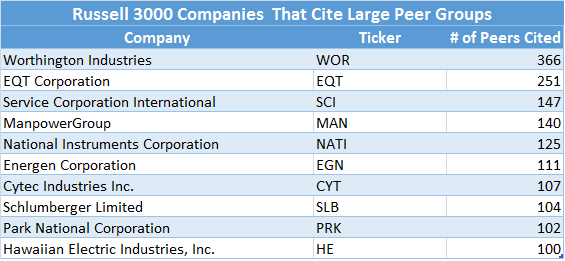
Audit Analytics’ recent analysis of Russell 3000 executive pay peer groups revealed these and other interesting findings:
– Notwithstanding the fact that pay benchmarking peers usually include close competitors, companies of similar size and stature, regional companies, etc., 12 of the 13 companies most frequently named as a peer by others (at least 44 times) are considered manufacturing companies according to their SIC codes, and all are mature – with more than half having been public since at least 1965.
– Ten companies listed 100 or more peers (one company listed 366 peers), whereas the typical peer group for this index consists of 17 peers:
– Some companies don’t use any outside peers or other benchmarks.
– The most frequently cited peer company, 3M Company, disclosed in its March 2015 proxy statement the following compensation peer group selection factors:
Peer companies are monitored regularly by the same market analysts who monitor the performance of 3M (investment peers); and/or
Peer companies have similar business and pay models, market capitalization (based on an eight-quarter rolling average), and annual revenues.
Webcast: “Proxy Drafting – Mid-Cap & Smaller Company Perspective”
Tune in tomorrow, Wednesday, January 20th for the webcast – “Proxy Drafting: Mid-Cap & Smaller Company Perspective” – to hear Gunderson Dettmer’s Richard Blake, Denbury Resources’ Sarah Wood Braley, Covington & Burling’s Keir Gumbs, KBR’s Adam Kramer and JetBlue Airways’ Eileen McCarthy provide practice pointers on what approaches to preparing the proxy for mid-cap & smaller companies work best. Please print these “Course Materials” in advance.