As noted in this Steve Quinlivan blog and this Ning Chiu blog, the SEC approved Nasdaq’s golden leash disclosure rule last Friday – just before it’s July 4th extended deadline. Here’s the 14-page order from the SEC. Both of those blogs were written before Nasdaq released Amendment No. 2 yesterday. Amendment No. 2 contains the actual rule language (starting on page 30). The new rule will be effective in approximately 30 days.
Here’s an excerpt from Cydney Posner’s blog, which she tweaked after Amendment No. 2 was released:
Rule 5250(b)(3) will require each listed company to disclose, by the date the company files its definitive proxy statement for its next annual meeting, the parties to and material terms of all arrangements between any director or nominee and any person or entity other than the company relating to compensation or other payment in connection with that person’s candidacy or service as a director. A company must make the required disclosure at least annually until the earlier of the resignation of the director or one year following the termination of the agreement or arrangement.
The accompanying interpretive material indicates that the terms “compensation” and “other payment” as used in the rule are not limited to cash payments and are intended to be construed broadly. The disclosure requirement encompasses non-cash compensation and other forms of payment obligation, such as indemnification or health insurance premiums. Note that the rule does not separately require the initial disclosure of newly entered arrangements so long as disclosure is made under the rule for the next annual meeting. The information must be disclosed either on or through the company’s website (in which case it must be continuously accessible) or in its definitive proxy statement.
Nasdaq also explicitly states that, if a company provides disclosure in a definitive proxy or information statement, including to satisfy the SEC’s proxy disclosure requirements, sufficient to comply with the proposed rule, the company’s obligation to satisfy the rule is fulfilled regardless of the reason that the disclosure was made.
No disclosure will be required for arrangements that:
– relate only to reimbursement of expenses in connection with candidacy as a director;
– existed prior to the nominee’s candidacy (including as an employee of the other person or entity) and the nominee’s relationship with the third party has been publicly disclosed in a definitive proxy or annual report (such as in the director or nominee’s biography); or
– have been disclosed under Item 5(b) of the proxy rules (interests of certain persons in connection with a proxy contest) or Item 5.02(d)(2) of Form 8-K (description of arrangements in connection with election of a new director) in the current fiscal year. (However, this disclosure would not obviate the need for the company to comply with its annual disclosure obligations under the rule.)
Nasdaq cites as an example of an agreement or arrangement falling under the exception for arrangements that existed prior to the nominee’s candidacy is a director or a nominee employed by a private equity or venture capital firm or a related fund, “where employees are expected to and routinely serve on the boards of the fund’s portfolio companies and their remuneration is not materially affected by such service. If such a director or a nominee’s remuneration is materially increased in connection with such person’s candidacy or service as a director of the company, only the difference between the new and the previous level of compensation needs to be disclosed under the proposed rule.”
So long as a company has undertaken reasonable efforts to identify all arrangements — including asking each director or nominee in a manner designed to allow timely disclosure — if the company then discovers an agreement or arrangement that should have been disclosed but was not, then the company can remedy the inadvertent failure to disclose by prompt disclosure after discovery of the error by filing a Form 8-K, where required by SEC rules, or by issuing a press release; in that event, the company will not be considered deficient with respect to the rule. However, remedial disclosure, regardless of its timing, would not satisfy the annual disclosure requirements. In all other cases, the company must submit a plan showing that the company has adopted processes and procedures designed to identify and disclose relevant agreements or arrangements, subject to approval by Nasdaq.
Nasdaq is also amending Rule 5615 to provide that the required disclosure of third-party payments to directors will be among the provisions allowing a foreign private issuer, upon satisfying specified conditions, to follow home country practice.
Life as a Compensation Consultant
As part of my “Big Legal Minds” podcast series – check out this 25-minute podcast, during which Blair Jones of Semler Brossy describes her vast experience on being a compensation consultant, including:
1. How did you wind up getting into the compensation consultant industry?
2. Can you give us a sense of what the compensation consultant industry is like?
3. Can you give us a sense of what different types of roles folks play within a consulting firm?
4. What are the least understood things that you do?
5. What are the hardest parts of your job?
6. What are the best parts of your job?
7. What are consultants best at? Less effective at?
8. How has the job changed since you first got into the industry? How do you expect it might change over the next several years?
9. What advice would you give someone that is just joining a consulting firm?
Remember that these podcasts are also available on iTunes or Google Play (use the “My Podcasts” app on your iPhone and search for “Big Legal Minds”; you can subscribe to the feed so that any new podcast automatically downloads…
Transcript: “The Top Compensation Consultants Speak”
We have posted the transcript for our recent CompensationStandards.com webcast: “The Top Compensation Consultants Speak.”
Since we’ve still been getting so many questions about what the SEC Staff expects in the wake of Corp Fin’s recent issuance of new non-GAAP CDIs, we’ve calendared a new webcast – “Non-GAAP Disclosures: The SEC Speaks!” – that will be held tomorrow, Wednesday, July 6th with Mark Kronforst, the Chief Accountant of the SEC’s Division of Corporation Finance! Dave Lynn & Meredith Cross will join Mark as they parse the questions that Corp Fin has been receiving since the CDIs – as well as the type of comments that the Staff has been issuing (those comment letters aren’t public yet since the files aren’t “closed”).
If you can’t make the webcast live, the audio archive will be posted immediately after the program ends – and a transcript will be posted about 10 days after that. If you’re not a member of TheCorporateCounsel.net, try a “Half Price for Rest of ’16” no-risk trial now…
Non-GAAP Measures: 60% of Proxy Statements Include Them
As noted in this Audit Analytics blog, nearly 60% of proxy statements include non-GAAP financial measures this year – up from a 20% rate in ’09. Thus, the new Corp Fin CDIs aren’t merely directed at earnings releases, 10-Qs and 10-Ks. Learn more in our oodles of memos about the new CDIs posted in our “Non-GAAP Disclosures” Practice Area…
The Passing of Former SEC Commissioner Irving Pollack
I’m sad to note that Irving Pollack has passed away. As noted in this statement by SEC Chair White, Irving was a dynamo – he worked at the SEC for 34 years, in many high level jobs including SEC Commissioner, Director of Market Reg and Director of Enforcement. He was Enforcement’s first Director! Here’s an excerpt from the statement:
Once called “a father of modern securities regulation” by the New York Times, Irving was a man of incredible integrity who was truly passionate about securities law. Irving recognized the immense responsibility of the Enforcement Division to ensure honest business practices and pursued that goal vigorously. Each year, the SEC presents the Irving M. Pollack award to an enforcement staff member who demonstrates fairness and compassion as well as a dedication to public service and the SEC.
Here’s a note from Craig Sparks:
I was on the Staff at the SEC from August 1974 until November 1977. I have an absolutely indelible memory of Commissioner Pollack. I was fortunate to be in a car pool that had a parking pass for the underground parking facility at 500 North Capitol. One day as we were pulling into the facility, I noticed a middle-aged man in white shirt, dark suit, conservative tie bent over picking up trash and made some snarky comment to the others in our car about the dress code for janitors. Just then the man stood up and we all saw that he was Commissioner Pollack. He so loved the SEC that he could not tolerate trash on the floor of the parking garage.
I have told that story many times both in my law firm and in my entrepreneurial ventures to illustrate the point that we are all responsible for everything that goes on in our firm or business. No one should walk by trash on the floor without picking it up, no one should walk past an untended client or other visitor without offering assistance. We are all in this together. That Mr. Pollack was a Commissioner brings home the point better than anything else I could say.
Our July Eminders is Posted!
We have posted the July issue of our complimentary monthly email newsletter. Sign up today to receive it by simply inputting your email address!
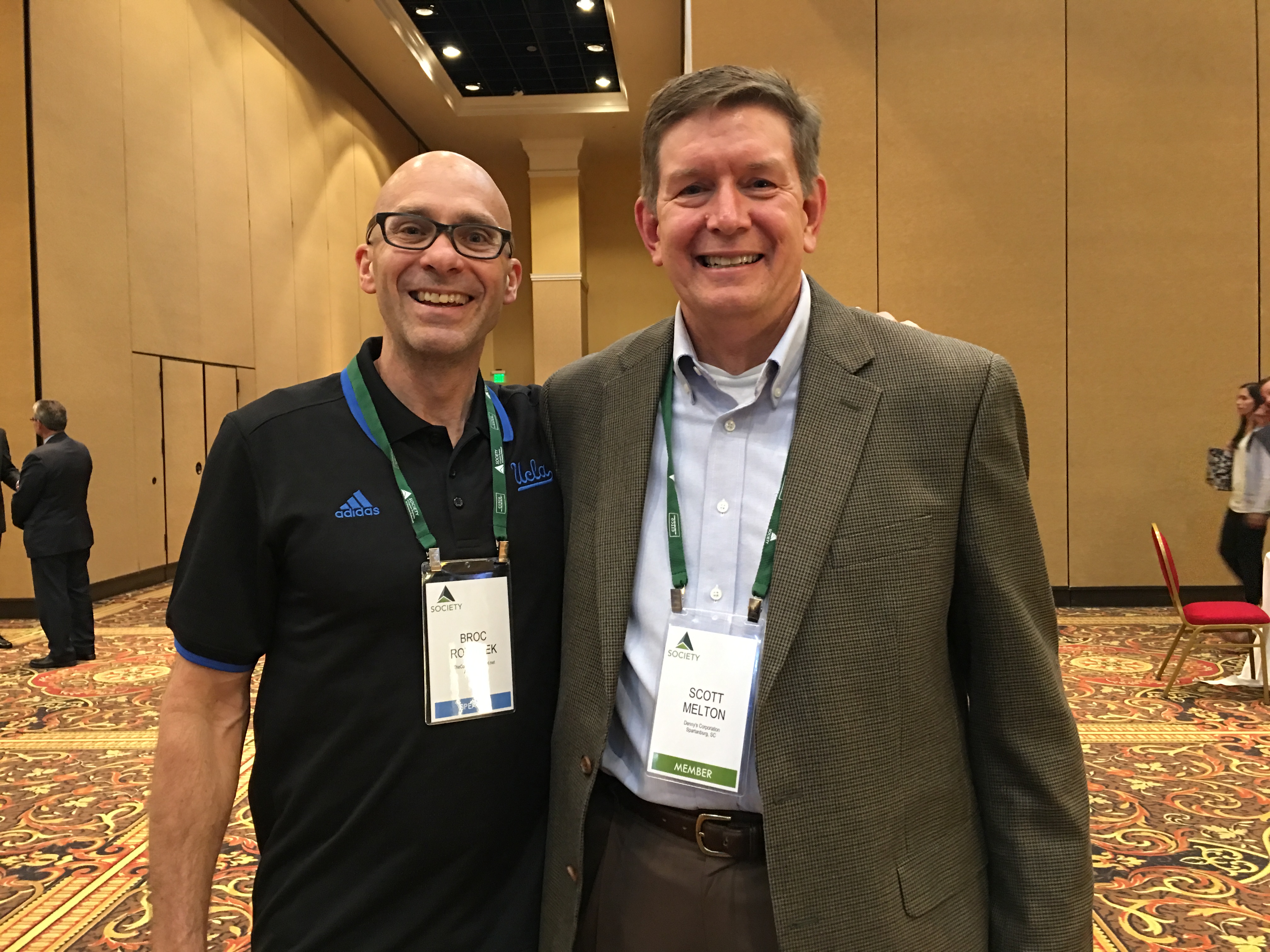
Cross another item off my bucket list: “Being forced to wear a borrowed jacket at a restaurant.” Thanks to Skadden’s Brian Breheny & Marc Gerber for that fine dinner out at the beautiful Broadmoor in Colorado! Taking my own advice about “how to maximize your conference experience,” here’s the ten new people I met during this year’s Society of Corporate Secretaries conference:
Johnson & Johnson’s Lacey Elberg
Whirlpool’s Bridget Quinn
Former SEC Commissioner Dan Gallagher & son
ConocoPhillip’s Shannon Kinney
Denny’s Scott Melton
Alston & Bird’s Julie Mediamolle
Eversource Energy’s Richard Morrison
Intelligize’s Dana Gerk
Davis Polk’s Laura Turano & Joele Frank’s Joele Frank
Since we’ve still been getting so many questions about what the SEC Staff expects in the wake of Corp Fin’s recent issuance of its new non-GAAP CDIs, we’ve calendared a new webcast – “Non-GAAP Disclosures: The SEC Speaks!” – for next Wednesday, July 6th with Mark Kronforst, the Chief Accountant of the SEC’s Division of Corporation Finance! Dave Lynn & Meredith Cross will join Mark as they parse the questions that Corp Fin has been receiving since the CDIs – as well as the type of comments that the Staff has been issuing (those comment letters aren’t public yet since the files aren’t “closed”).
If you can’t make the webcast live, the audio archive will be posted immediately after the program ends – and a transcript will be posted about 10 days after that. If you’re not a member of TheCorporateCounsel.net, try a “Half Price for Rest of ’16” no-risk trial now…
The ridic Senate battle over confirmation of the SEC’s two Commissioner nominees continues. Here’s an excerpt from this WSJ article by Andrew Ackerman:
The two nominees to fill vacancies on the Securities and Exchange Commission face new delays—as at least one Democratic lawmaker has moved to block a Senate confirmation vote. A procedural step known as a “hold,” has been placed on Hester Peirce, a Republican nominee for the agency, according to a Democratic Senate aide.
That throws into limbo the confirmation this year of Ms. Peirce—and that, in turn, is likely to stall consideration as well for Lisa Fairfax, a Democrat tapped for a second vacancy at the five-member commission. That is because the Senate usually considers Democratic and Republican nominees together, to ensure partisan balance at the commission. So it is highly unlikely the chamber would consider Ms. Fairfax without also voting on Ms. Peirce.
Delays in advancing the nominees mean it may be up to the next presidential administration and Congress to restore the top U.S. markets regulator to its full complement of commissioners. The agency has operated with only three since January. If the SEC remains with only three commissioners, it could be difficult for SEC Chairman Mary Jo White to advance her agenda in what is likely her final year at the markets regulator, due to agency rules requiring a quorum of three commissioners to attend all votes. The Senate aide declined to identify any senator behind the hold.
The procedural move means the Senate is unable to quickly confirm both SEC nominees. The nominees could still advance, but overcoming a hold generally requires the high hurdle of support from 60 senators. Consideration of their nominations also would eat up valuable floor time that is in short supply, as the legislation session is truncated in advance of November’s election.
The SEC’s Pinterest Page
I’m digging the SEC’s Pinterest page. Check out the video of Joe Kennedy from 1934. And Peter Romeo is in the picture on the top left from the ’70s – he still looks the same!
ISS Opens “Peer Group” Submission Window for Non-12/31 Companies
Starting new Tuesday, July 5th, ISS will open its “peer group” submission window until July 15th. Only companies that have made changes need to submit new peers. And only companies with meetings between September 16th, 2016 and January 31st, 2017 are invited to participate in this round.
This recent speech by SEC Chair White not only indicates that a rule proposal regarding board diversity disclosures is coming soon, it highlights that the Corp Fin Staff is actively reviewing climate change & sustainability disclosures – and it could conduct rulemaking in this area soon too. Here’s an excerpt:
Currently, disclosure of sustainability information under SEC rules is being addressed by a combination of our materiality-based approach to disclosure, guidance on certain issues,[55] and shareholder engagement on a range of sustainability topics, whether through direct dialogue with management or our Rule 14a-8 shareholder proposal process. Although we are seeing increased disclosure and engagement on sustainability matters, we are taking a more focused look at such disclosures, particularly related to climate change, in our annual filings reviews.
We understand, however, that there are those who do not believe that our materiality-based approach to sustainability disclosure goes far enough.[56] That is one of the reasons we included a discussion of the topic in our recent Regulation S-K Concept Release and solicited input from investors and others on whether we should consider line-item disclosure on certain issues.[57] I encourage you to share your perspectives and give us your input on whether changes are needed, and if so, what specifically should be changed.[58]
Brexit Risk Factors: Tailor Them!
When I blogged about Brexit last Friday, I wrote “companies should now be assessing how this uncertain future will impact them uniquely.” As I write on page 23 of my “Risk Factors Disclosure Handbook,” macro events or trends can be appropriate risk factors – but I also write on page 25 that you should illustrate how those macro trends specifically impact your company. As nicely fleshed out in this memo, how do those known uncertainties impact how your company is thinking about its future? What is the impact of currency fluctuations? You’ll be writing about this for your MD&A & forward-looking safe harbors – so tailor them like your risk factors too. See this MarketWatch piece with a mention of me.
Bass Berry’s Jay Knight sent along this risk factor for the Form S-1 that Titleist (corporate name – Acushnet Holdings Corp) recently filed for an IPO – a good example of a tailored risk factor:
Changes to the Rules of Golf with respect to equipment could materially adversely affect our business, financial condition and results of operations.
Golf’s most regulated categories are golf balls and golf clubs. We seek to have our new golf ball and golf club products conform with the Rules of Golf published by the United States Golf Association, or the USGA and The Royal and Ancient Golf Club of St. Andrews, or The R&A, because these rules are generally followed by golfers, both professional and amateur, within their respective jurisdictions. The USGA publishes rules that are generally followed in the United States and Mexico, and The R&A publishes rules that are generally followed in most other countries throughout the world. However, the Rules of Golf as published by The R&A and the USGA are virtually the same and are intended to be so pursuant to a Joint Statement of Principles issued in 2001. The Rules of Golf set the guidelines and establish limitations for the design and performance of all golf balls and golf clubs.
Many new regulations on golf balls and golf clubs have been introduced in the past 10 to 15 years, which we believe was one of the most active periods for golf equipment regulation in the history of golf. The USGA and R&A have historically regulated the size, weight, and initial velocity of golf balls. More recently, the USGA and R&A have specifically focused on regulating the overall distance of a golf ball. The USGA and R&A have also focused on golf club regulations, including limiting the size and spring-like effect of driver faces and club head moment of inertia. In the future, existing USGA and/or R&A rules may be altered in ways that adversely affect the sales of our current or future products. If a change in rules was adopted and caused one or more of our current or future products to be nonconforming, sales of such products would be impacted and we may not be able to adapt our products promptly to such rule change, which could materially adversely affect our business, financial condition and results of operations. In addition, changes in the Rules of Golf may result in an increase in the costs of materials that would need to be used to develop new products as well as an increase in the costs to design new products that conform to such rules.
Yesterday, the SEC proposed changes to the “smaller reporting company” definition, which would increase the number of companies falling into that reporting category. Here’s the 83-page proposing release. The proposed rules would enable:
– Companies with less than $250 million of public float to provide scaled disclosures as a smaller reporting company, as compared to the current $75 million threshold
– If a company doesn’t have a public float, it would be permitted to provide scaled disclosures if its annual revenues are less than $100 million, as compared to the current “less than $50 million” threshold
– As under the current rules, once a company exceeds either of the thresholds, it won’t qualify as a smaller reporting company again until public float or revenues decrease below a lower threshold. Under the proposal, a company would qualify only if its public float is less than $200 million or, if it has no public float, its annual revenues are less than $80 million.
– The proposing release includes a great table showing the items of Regs S-K and S-X and the various accommodations made for scaled disclosure
The SEC isn’t proposing to increase the $75 million threshold in the “accelerated filer” definition. As a result, companies with a float of $75 million or more that would qualify as smaller reporting companies would be subject to the requirements that apply currently to accelerated filers – including the timing of the filing of periodic reports and the requirement that accelerated filers provide the auditor’s attestation of internal controls. As noted in this blog, so much for the harmonization recommended by the SEC’s Advisory Committee on Small and Emerging Companies last year.
SEC Adopts Resource Extraction Rules (Again)
The SEC was on a tear yesterday. In addition to proposing the “smaller company” changes, it adopted resource extraction rules. These are the rules that were originally adopted in 2012 – but were then struck down by the US District Court for DC in 2013. The rules were re-proposed in December after being sued by Oxfam America for not moving fast enough – and a court ordered that they be re-proposed. When the SEC re-proposed the rules, it promised to adopt the rules by June 27th – and it did on the nose!
Here’s the 268-page adopting release. And here’s an order from the SEC adopt the rules qualifying for some European Union & Canadian stuff…
I love it when the SEC conducts rulemaking without an open Commission meeting and confuses everyone. As noted in this blog, the SEC is entitled to take action in seriatim. I’ll be blogging about the circumstances that likely leads to rulemaking in seriatim in the near future…#headfake
Financial Choice Act: Discussion Draft
I recently blogged about how a House bill – the “Financial Choice Act” – would unwind much of Dodd-Frank & more. In this blog, Cydney Posner reports that the discussion draft for that bill is finally available…
Transcript: “Proxy Season Post-Mortem – The Latest Compensation Disclosures”
We have posted the transcript for our recent CompensationStandards.com webcast: “Proxy Season Post-Mortem – The Latest Compensation Disclosures.”
Tesla, in an offer to acquire SolarCity, appears to be the first to announce a major proposed acquisition by a blog post. Since an 8-K was also filed, it can’t be sole proof that social media is a recognized distribution channel for Regulation FD. But dissemination was nonetheless rapid, with the first news apparently appearing on Twitter at about 4.11 pm, the 8-K being filed at 4.13 pm, and the first Wall Street Journal e-mail alert being received at 4.58 pm (all times Central).
There had to be some advance coordination between the parties, because SolarCity filed an 8-K almost simultaneously. The exhibit includes an email from SolarCity’s CEO, in which he wisely advises employees not to comment on social media.
The Tesla 8-K also discloses that Tesla adopted an exclusive forum by-law the day before the acquisition was announced.
On June 16, 2016, Delaware Governor Jack Markell signed into law House Bill 371, which amends the Delaware General Corporation Law (DGCL) with respect to, among other things, appraisal proceedings and “intermediate-form” mergers.
Specifically, the bill amends Section 262 of the DGCL to limit de minimis appraisal claims and to provide surviving corporations with the right to pay stockholders exercising appraisal rights prior to the time the Delaware Court of Chancery makes a final value determination, thereby limiting the amount of interest that would accrue on an appraisal award.
The legislation also clarifies the requirements and procedures relating to “intermediate-form” mergers under Section 251(h) of the DGCL, particularly those involving rollover of target equity.
I’m out West for the Society of Corporate Secretaries Conference. So I was up when the ‘leave’ vote stunned the world. I just did a quick Edgar search and ‘Brexit’ has been scarcely mentioned in recent 10-Ks & 10-Qs. I found about 20 companies that have disclosed Brexit risk factors – which includes a search of 20-Fs and prospectuses.
That likely will change as companies should now be assessing how this uncertain future will impact them uniquely. See our ‘Risk Factors Disclosure Handbook‘ – and see this memo that lays out the basic legal implications of Brexit…
Venture Capital: Cooley’s “Go” Site
In our “Venture Capital” Practice Area, we have links to a number of model documents that folks can use. But I wanted to highlight Cooley’s “Go” site because I think it does a great job of highlighting the people at Cooley who work on VC. Look at the bios on this site – they list interests & books. Potential clients get a better sense of who they are.
Too many law firms neuter their content so there is no human element. People want “human” – that’s why this blog is easier to read than most law firm blogs…
More on our “Proxy Season Blog”
We continue to post new items regularly on our “Proxy Season Blog” for TheCorporateCounsel.net members. Members can sign up to get that blog pushed out to them via email whenever there is a new entry by simply inputting their email address on the left side of that blog. Here are some of the latest entries:
– ISS: Moody’s Changes Outlook From Negative to Stable
– Shareholder Proposals: Is “False & Misleading” on Life Support?
– Environmental-Related Disclosures: Companies Facing Increasing Scrutiny
– Shareholder Proposal Trends
– Broadridge’s ’15 Proxy Season Stats
We have posted the transcript of our popular webcast that almost broke the Internet due to its demand: “Non-GAAP Disclosures: What Is Permissible?”…
SEC Finally Fixes “Insider Transactions” Links
For months, the links to “insider transactions” from a company’s “profile” on the SEC’s Edgar web pages has not been working. We’re happy to report that they are back online – and the tabular format for the insider transactions has been retooled. “Insider transactions” means Section 16 filings.
For example, here is the Edgar profile page for Microsoft. In the blue box at the top, you see these two lines in the bottom left:
Those two “insider transaction” links didn’t work until recently. Thanks to Weil Gotshal’s Howard Dicker for letting us know!
Note: Since I blogged this in the wee hours, a member has told me that the tabular data sometimes is screwed up even in this retooled format. Bummer! So you really need to look online after you file a Form 4 to verify that what’s posted matches your facts. More later…