The Trump administration on Wednesday abandoned its defense of the Securities and Exchange Commission’s in-house judicial system, siding with opponents who say the hiring process for the SEC’s judges is unconstitutional. In a brief filed with the U.S. Supreme Court, lawyers for the Justice Department wrote they now consider the SEC’s administrative law judges to be officers like other presidential appointees, instead of employees who are picked through a human-resources process. That means the way the SEC hires the judges may violate a constitutional clause that safeguards separation-of-powers principles.
The Justice Department’s brief didn’t explicitly describe the judges’ appointments as unconstitutional, but said the selection process for the in-house judge at issue in the case “did not conform” to a constitutional requirement. Mark Perry, a partner at Gibson, Dunn & Crutcher LLP who represented the challengers, said the Supreme Court’s involvement is still needed to resolve a disagreement between lower courts over the judges’ status. The Supreme Court would have to appoint an outside party to argue the case since the Justice Department has turned its back on defending it, the brief says. “We are one step closer to victory,” Mr. Perry said Wednesday.
The SEC didn’t sign the Justice Department’s brief. The regulator likely felt it couldn’t join the position because SEC commissioners have previously issued opinions in contested cases stating that judges are employees, not officers, said Andrew Vollmer, a professor at the University of Virginia School of Law and a former deputy general counsel of the SEC. An SEC spokesman declined to comment.
SEC Ratifies ALJ Appointments: Are Prior Decisions at Risk?
In response to the Trump administration’s action, the SEC announced that it had ratified its prior appointments of its current ALJs in order to resolve “any concerns that administrative proceedings presided over by its ALJs violate the Appointments Clause.”
The SEC’s decision to ratify these prior appointments raises an important issue – are cases that were previously decided at risk of being invalidated? Check out this tidbit from a K&L Gates memo about the D.C. Circuit case challenging the ALJ system that’s currently before the Supreme Court:
Despite a question from the bench, the parties did not discuss potential remedies to the possible Appointments Clause violation in detail. Should the D.C. Circuit rule in favor of Petitioners, the SEC Commissioners could ameliorate the issue simply by reappointing the Commission’s five ALJs directly. Because the SEC may risk invalidating other adjudicated findings of liability by acknowledging that its ALJs are unconstitutionally appointed, the SEC may instead choose to stay all administrative proceedings in which a respondent has the option to seek review in the D.C. Circuit while it appeals the case to the Supreme Court.
Interestingly, as part of its order ratifying the ALJ appointments, the SEC lifted a stay on administrative proceedings subject to the jurisdiction of the 10th Circuit that it had put in place in response to a decision in that circuit holding that they were unconstitutionally appointed. So, it looks like the SEC is all-in on the ratification approach.
When you think about it, the administration’s action left the SEC with no other choice – but it looks like there’s really big can of worms that could be opened depending on how the Supreme Court ultimately resolves the issue.
Late last month, the DOJ announced a revised FCPA corporate enforcement policy. The policy – which builds upon the DOJ’s pilot program that we’ve previously blogged about – is intended to provide further enhancements for cooperation. This Simpson Thacher memo reviews the key elements of the new policy (we’ve posted oodles of memos in our “FCPA” Practice Area). Here’s the intro:
On November 29, 2017, Deputy Attorney General Rod J. Rosenstein announced a revised U.S. Department of Justice Foreign Corrupt Practices Act Corporate Enforcement Policy, designed to further incentivize companies to self-report potential FCPA violations. Building on the framework announced in a DOJ pilot program last year, the new policy offers companies that voluntarily self-disclose, fully cooperate, and timely and appropriately remediate substantial cooperation credit—including the presumption of a declination from DOJ criminal prosecution (absent certain aggravating circumstances).
Companies will still be required to pay all disgorgement, forfeiture, and/or restitution resulting from any misconduct at issue. The policy has been added to the U.S. Attorneys’ Manual, which guides prosecutors on when and how to exercise discretion in reaching charging decisions.
The policy has no impact on other U.S. or foreign enforcement authorities, including the SEC.
This blog from Bass Berry’s Jay Knight flags a “sleeper issue” arising out of the lower corporate rates in the tax bill recently passed by the Senate & House – and if you’ve got deferred tax assets on your balance sheet, it just might cause you a few sleepless nights. Here’s the skinny:
At a high level, deferred tax assets are reported as assets on the balance sheet and represent the decrease in taxes expected to be paid in the future because of net operating loss (NOL) and tax credit carryforwards and because of future reversals of temporary differences in the bases of assets and liabilities as measured by enacted tax laws and their bases as reported in the financial statements. NOL and tax credit carryforwards result in reductions to future tax liabilities, and many of these attributes can expire if not utilized within certain periods. If a company believes it is more likely than not that some portion or all of the deferred tax asset will not be realized, a valuation allowance must be recognized.
By “recognized,” of course, Jay means “run through your income statement.” He highlights some disclosure from a major financial institution about the income statement impact of the UK’s rollback of corporate rates in 2013 – and suggests flagging this issue to your audit committee and reviewing your disclosures.
Do You Need an 8-K for the “Deferred Tax Assets” Sleeper?
Another thing to keep in mind is the possibility of tripping an 8-K requirement. For instance, if your deferred tax asset is impaired, you may need to consider whether an Item 2.06 Form 8-K is required. See this one, for example…
Release of “After-Hours” Info: SEC Approves NYSE Rule
On Monday, the SEC approved an NYSE rule limiting listed companies’ ability to issue material news releases shortly after the close of the market. Here’s an excerpt from this Ning Chiu blog summarizing the new rule:
A listed company must not issue material news after the NYSE closes trading until the earlier of (a) publication of the company’s official closing price on the Exchange or (b) five minutes after the Exchange’s official closing time. The NYSE amended its initial rule filing to make clear that the one exception to this revised requirement would be to permit companies to still publicly disclose material information following a nonintentional disclosure, if needed to comply with Regulation FD.
Trading on the Exchange ends at the Exchange’s official closing time of 4pm Eastern, or 1pm Eastern on certain days. The designated market maker, after close, facilitates the close of trading in an auction. Because there is trading of company securities on other exchanges and non-exchange venues even after the Exchange closes, there can be a significant price difference if a company issues news immediately after 4pm Eastern but before the closing auction on the Exchange is completed, leading to investor confusion.
In approving the rule change, the SEC noted that the price difference could increase market disruption and reduce investor confidence in trading on the Exchange, given that orders cannot be cancelled or modified to take into account the material news though the Exchange closing price may not yet have been established by the closing auction process. At the same time, however, the Commission recognizes that Section 202.05 of the Listed Company Manual requires a company to release quickly any news or information that might be expected to materially affect the market for its securities.
SCOTUS: Can State Courts Still Hear ’33 Act Claims?
Last week, the Supreme Court heard oral arguments in Cyan, Inc. v. Beaver County, which raises the issue of whether SLUSA strips state courts of jurisdiction over Securities Act claims. This recent blog from Lyle Roberts at “The 10b-5 Daily” reviews the arguments. Here’s an excerpt summarizing the legal background:
Congress passed the Private Securities Litigation Reform Act (PSLRA) to protect corporate defendants from meritless securities class actions. The PSLRA, however, only applied to federal cases. To evade the PSLRA’s impact, plaintiffs began filing securities class actions in state court, usually based on state law causes of action.
Congress passed SLUSA to close this loophole. Due to unclear drafting, however, there has been confusion in the lower courts over whether SLUSA also makes federal court the sole venue for class actions alleging Securities Act claims (which historically enjoyed concurrent jurisdiction in state or federal court).
The parties have put forward three competing interpretations of SLUSA. The petitioners say that SLUSA divests state courts of jurisdiction, the respondents say that it doesn’t – and the Solicitor General says that you can file in state court, but that cases can be removed to federal court.
We’ve previously blogged about the growing popularity among plaintiffs of state courts as a forum for Securities Act litigation – and about some of the steps that public companies have taken in response.
Whatever their underlying merits, coin offerings have quickly attracted their fair share of fraudsters – and the bad guys’ propensity for ICO scams hasn’t been lost on the SEC. In an October speech, Enforcement Co-Director Stephanie Avakian said that concerns about abuses in this area were one of the factors that led the SEC to create a new “Cyber Unit” in the Division of Enforcement:
As folks likely know, the Commission recently issued a Report of Investigation cautioning that offers and sales of digital assets by “virtual” organizations – often referred to as “Initial Coin Offerings” or “Token Sales” – are subject to the requirements of the federal securities laws, which can include the registration of securities offerings.
Blockchain technology presents many interesting issues and can of course present legitimate opportunities for raising capital. But, like many legitimate ways of raising capital, the popular appeal of virtual currency and blockchain technology can be an attractive vehicle for fraudulent conduct. We think that creating a permanent structure for the consideration of these issues within the Cyber Unit will ensure continued focus on protecting both investors and market integrity in this space.
Earlier this week, the Cyber Unit made its first big splash with the announcement that it had obtained an emergency asset freeze to stop what it called “a fast moving fast-moving Initial Coin Offering (ICO) fraud that raised up to $15 million from thousands of investors since August by falsely promising a 13-fold profit in less than a month.”
The alleged scam involves a recidivist securities law violator and his company, and the SEC’s complaint alleges that the defendants marketed and sold securities called “PlexCoin” – claiming that investments in PlexCoin would yield a 1,354% profit in less than 29 days.
The announcement notes that this represents the first action filed by SEC’s new Cyber Unit – and the extent of the ICO fraud problem strongly suggests that it won’t be the last. We’re posting memos in our “ICOs” Practice Area.
ICOs: Offerings Continue to Boom – But Class Actions Start to Bloom
The potential fraud issues associated with coin offerings haven’t just attracted the attention of the SEC. While these offerings continue to attract a high-level of investor interest, this “D&O Diary” blog points out that they’re also becoming an attractive target for securities class actions. Here’s the intro:
According to the latest update on the CoinSchedule website, there have been a total of 228 initial coin offerings so far this year through mid-October, raising a total of over $3.6 billion. At least five of this year’s ICOs have raised over $100 million. This burgeoning activity notwithstanding, ICOs are at the center of controversy.
Among other things, China and South Korea have banned ICOs. The SEC has already shown its willingness to pursue enforcement actions against ICO sponsors, as discussed further here. And now a high-profile statement by one of the country’s leading securities regulation experts suggests even greater scrutiny may lie ahead. In the meantime, as discussed below, ICO and cryptocurrency-related litigation appears to be proliferating.
The blog goes on to provide details on several recent class action lawsuits involving coin offerings.
Whistleblowers: Supreme Court Hears Argument on Internal Whistleblower Issue
Last week, the Supreme Court heard oral arguments in Somers v. Digital Realty Trust – which gives the Court an opportunity to resolve a split between the circuits concerning whether Dodd-Frank’s whistleblower protections extend to individuals who report wrongdoing internally, but don’t reach out to the SEC. This recent blog from Cydney Posner reviews the case and the issue before the court. Here’s an excerpt:
In this case, the 9th Circuit had refused to dismiss Somers’ whistleblower claim brought under Dodd-Frank’s anti-retaliation provision, even though he had failed to report the violation to the SEC. As you may recall, Dodd-Frank added Section 21F to the Exchange Act, establishing new incentives and protections for whistleblowers, including monetary awards for reporting information, confidentiality provisions and employment retaliation protections.
The statute defines “whistleblower” as a person who reports potential violations of the securities laws to the SEC; however, in promulgating rules under the statute, the SEC distinguished the whistleblower anti-retaliation provisions from the award provisions, applying a broader definition in the context of anti-retaliation that would not require reporting to the SEC.
The 2nd Circuit agrees with the 9th Circuit’s approach – but the 5th Circuit has held that in order to qualify for protection, a whistleblower must report the wrongdoing to the SEC.
Yesterday, the PCAOB Staff issued implementation guidance addressing the changes in audit reports that are mandated under its new standard – AS 3101. As Liz blogged at the time of the standard’s adoption, AS 3101 requires a major revision in how auditors think about what – and how – they communicate to boards & investors.
The PCAOB Staff’s new guidance addresses both format & content and includes an annotated version of the new auditor’s report. Here’s an excerpt addressing the most controversial aspect of the new standard – the requirement that the report include a discussion of “Critical Audit Matters” (known as “CAMs”):
When the relevant requirements take effect, auditors of certain issuers will be required to include in the auditor’s report a communication regarding CAMs. CAMs are defined under AS 3101 as matters arising from the audit of the financial statements that have been communicated or were required to be communicated to the audit committee and that (1) relate to accounts or disclosures that are material to the financial statements and (2) involved especially challenging subjective, or complex auditor judgment.
The communication of CAMs is not required for audits of emerging growth companies; brokers and dealers; investment companies other than business development companies; and employee stock purchase, savings, and similar plans.
CAMs may be included voluntarily before the effective date or for entities for which the requirements do not apply. In advance of implementation, auditors may want to discuss the new CAM requirements with management and audit committees.
With the exception of the provisions relating to CAMs, the new standard goes into effect for audits of fiscal years ending on or after December 15, 2017. For large accelerated filers, the provisions relating to CAMs go into effect for audits of fiscal years ending on or after June 30, 2019. They go into effect for all other filers for audits of fiscal years ending on or after December 15, 2020.
Yesterday, PCAOB Chair Jim Doty delivered this speech entitled “The PCAOB’s Initiatives to Bolster Investor Trust in the Audit”…
Still More on “GAAP Means Nothing to Me”. . .
As another follow-up to my recent blog about institutional investors’ increasing disdain for GAAP, Broc pointed me in the direction of a series of articles in “Accounting Today” that say that it’s time for a paradigm shift in the way the accountants & standard setters approach GAAP. Why? According to the authors – two accounting profs – it’s because GAAP simply isn’t very useful:
We’re convinced that the consequence of practitioners’ inability to change is a status quo that is an unserviceable hodge-podge remnant of out-of-date practices. Specifically, we find today’s GAAP financial statements are as far removed from reports that meet the capital markets’ needs as hand-cranked telephones differ from smartphones. It follows, then, that financial accounting is stunningly ready for disruption.
Toward that end, we’re offering up paradigm-challenging truths to suggest that today’s financial accounting is bound to collapse. So, why would it?
It’s because the inability of practitioners to question their paradigm also keeps them from actually serving accounting’s ostensible information-providing purpose. Although they say they aim to present useful information, many inconsistencies between those words and their actions prove otherwise. Ultimately, their choices always favor what’s useful to themselves, not users.
Subsequent articles in the series drill down into some of the specific problems they have with the current financial reporting paradigm.
Corp Fin Updates “Financial Reporting Manual” for New Accounting Standards
On Friday, as noted in this Cooley blog, Corp Fin updated its “Financial Reporting Manual” to revise guidance on the pro forma impact of new accounting standards, address adoption of new accounting standards upon termination of EGC status, and clarify the effective date of the new revenue recognition & lease accounting standards for certain entities.
Tune in tomorrow for the CompensationStandards.com webcast — “Your Upcoming Pay Ratio Disclosures” – to hear Compensia’s Mark Borges, Gibson Dunn’s Ron Mueller, Wilson Sonsini’s Dave Thomas and Cooley’s Amy Wood discuss all the latest about how to comply with the new pay ratio rule.
PCAOB Inspections: Internal Controls #1 Concern at Companies
Recently, the PCAOB released this report about its observations of inspections of auditor clients in 2016. Deficiencies relating to internal controls continue to be the most frequently-identified deficiency. Bear in mind that only a very small portion of the total number of public company audits are actually inspected – and only a portion of the selected audits, not the entire audit, is actually inspected…
By the way, I think the PCAOB’s release of inspection reports this year is behind the schedule of past years for some auditors. That might not be good news for those auditors…
Transcript: “Evolution of the SEC’s OMA”
We have posted the transcript for our recent DealLawyers.com webcast: “Evolution of the SEC’s OMA.”
Yesterday, Corp Fin announced that its Chief Accountant Mark Kronforst will leave in about a month after serving in that role for 4 years (and in Corp Fin for 14). Kyle Moffatt will serve as Acting Chief Accountant upon Mark’s departure…
D&O Questionnaires: How to Address Board Diversity?
A few months ago, a member posted this question in our “Q&A Forum” (#9223): “We received the letter from the New York City Pension Funds requesting a director matrix that discloses gender and race/ethnicity of the directors. If companies do end up agreeing to this, are they including in the questionnaire a request for how the director self-identifies by race/ethnicity (and perhaps even LGBTQ status)?”
This was Liz’s answer:
I wouldn’t add this type of question to the D&O questionnaire without first talking to the board’s governance committee about the NYC letter and coming up with a plan. Part of that plan may be to include a matrix in the proxy statement, or at least have some general disclosure about the board’s diversity. If that’s what is agreed on, then you could include this in the questionnaire and explain the context to the board. They will also need to understand that some people may decline to answer. These issues can be complex.
And one thing to keep in mind during these discussions is that while boards may support diversity and the female and minority directors in particular may believe in its importance, no one wants to feel like they are on the board for that sole reason or that there is even any suggestion of that. The NYC Comptroller’s initiative is a new development and we’ll be watching how practices evolve…
Our December Eminders is Posted!
We have posted the December issue of our complimentary monthly email newsletter. Sign up today to receive it by simply inputting your email address!
Sorry. I couldn’t help myself. The title of this blog was the title of a fictional play mentioned in last night’s episode of “Modern Family.” Not related at all to the title of this blog comes this news about a possible new PCAOB Chair, Bill Duhnke – who’s a veteran Staffer for Senator Richard Shelby (who used to be the Senate Banking Committee Chair). Here’s the intro from this Bloomberg article:
A little-known Republican Senate aide is in line to lead the accounting industry’s watchdog, setting up an official who lacks experience in the auditing profession for one of the highest-paying jobs in financial regulation. William Duhnke, a veteran staff member for former Senate Banking Committee Chairman Richard Shelby, is on track to be selected to become chairman of the Public Company Accounting Oversight Board, according to four people familiar with the matter. An announcement by Securities and Exchange Commission Chairman Jay Clayton could be made in the coming weeks, said one of the people, who like the others asked that they not be named discussing the plan.
The job is seen as one of the most attractive regulatory roles in Washington because it pays more than $670,000 per year — well above the president’s $400,000 salary. The selection of Duhnke, whose name has been circulating as a possible pick for more than a year, would likely be controversial among investor advocates concerned that he would promote a pro-business agenda.
Do You Need a Risk Factor for the Proposed Tax Reform?
We love blogging about risk factors – they can be tough judgment calls. And we are constantly updating our “Risk Factors Handbook” as a result. Anyway, this Dorsey blog by Kimberley Anderson gives us some nice “food for thought” (don’t forget to tailor your risk factors to your own company’s circumstances):
Tax reform efforts by Congress are ongoing, and the substance of the tax bills remains fluid. However, for foreign corporations with U.S. operations, there are some specific potential risks to consider, such as additional limitations on the deductibility of interest, the migration from a “worldwide” system of taxation to a territorial system, and the use of certain border adjustments.
Foreign corporations with U.S. operations may want to consider including a risk factor in their periodic reports or offering documents regarding the potential impact of U.S. tax reform. A sample risk factor (based on the current iteration of the tax bills) is below. As the tax bills are amended during the legislative process, the language of the risk factor may need to be edited prior to use.
Possible U.S. federal income tax reform could adversely affect us.
The new U.S. administration and certain members of the U.S. House of Representatives have stated that one of their top legislative priorities is significant reform of the Internal Revenue Code. Proposals by members of Congress have included, among other things, changes to U.S. federal tax rates, imposing significant additional limitations on the deductibility of interest, allowing for the expensing of capital expenditures, the migration from a “worldwide” system of taxation to a territorial system, and the use of certain border adjustments. There is substantial uncertainty regarding both the timing and the details of any such tax reform. The impact of any potential tax reform on our business and on holders of our common shares is uncertain and could be adverse. [Prospective investors should consult their own tax advisors regarding potential changes in U.S. tax laws.]
Poll: Does the PCAOB Chair Need Deep Auditing Experience?
Please take a moment to anonymously indicate whether you think the PCAOB Chair should have extensive auditing experience:
‘Tis the season for the “Big 4” accounting firms to weigh-in on Corp Fin comment priorities. Earlier this month, we blogged about EY’s take on the topic – and now Deloitte’s weighed in with its own study on Corp Fin comments for the 2016-2017 review period. The study found that the top 10 areas for comments were:
– Non-GAAP measures
– MD&A
– Fair value
– Segment reporting
– Revenue recognition
– Intangible assets & goodwill
– Income taxes
– State sponsors of terrorism
– Signatures, exhibits & agreements
– Acquisitions, mergers & business combinations
The list includes plenty of the usual suspects, but one of these things is clearly not like the others – here’s what the study says about comments addressing state sponsors of terrorism:
This category is new to the top 10 this year. The SEC staff has increased its focus on registrants that do business with countries designated by the U.S. State Department as state sponsors of terrorism, including Iran, Sudan, and Syria. SEC staff comments focus on disclosure about (1) the nature and extent of these contacts and (2) quantitative and qualitative factors about such activities.
The study includes examples of comments that the Staff has issued to companies disclosing business in these countries.
More on “Farewell to Corp Fin Giant, Bill Morley”
Recently, I blogged that Bill Morley passed away. We now have information about his memorial: “Glory Days Restaurant” in Edgewater, Maryland – this Friday, December 1st from 6-10 pm. It’s informal in a private room. Please RSVP to Marty Dunn if you (& others you know) plan on going as they need a head count.
Here are a few more remembrances:
– Marty Dunn, who worked with Bill for several decades, notes: “From the day I arrived at the SEC in 1988, I knew what the goal was. It was to be Bill. He had the ’33 and ’34 (and ’39) Act in his being. He understood them all. Their purpose was in his soul. He taught us all so much while being so humble. He said to me ‘our job is important, we’re not.’ That always stuck with me. Mr. Carter and Mr. Morley were incredible mentors & teachers. There is an entire generation of Corp Fin lawyers who appreciate their contribution to our careers. Bless you, Bill.”
– Paul Dudek, who left Corp Fin after 22 years last year, notes: “Thanks for sharing the sad news about Bill, and the stories and the picture. He was outstanding in so many ways, as a person, as a securities lawyer, as a manager, and much more. I think at some level he was a model for me staying in Corp Fin for so long, a shining example of how to carry out the mission of investor protection through full and fair disclosure, and all the corollaries to that simple statement, through thick and thin.”
– Stan Keller notes: “Here’s one outside perspective on Bill. For so many of us practicing on the outside, Bill was for so long the face of the SEC and a good one at that. Bill treated you as a professional with respect and was always willing to listen to your position and share his vast knowledge of the law and the lore with you. You knew that you would get a fair hearing and a thoughtful, considered response. We learned a lot about securities law from Bill in this way and we learned about the agency. Bill helped instill the Corp Fin Staff ethic of the SEC as being a service agency, which continues to this day. We remember him with fondness, respect and appreciation.”
Farewell to Mort Koeppel
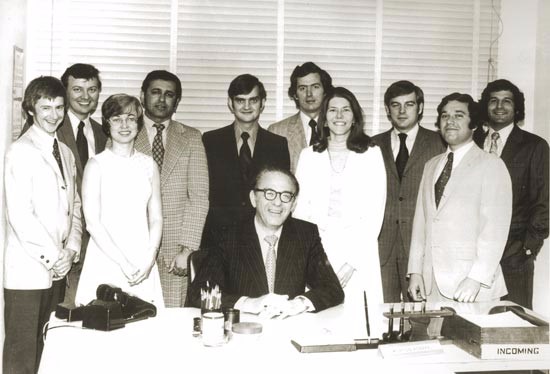
I’m also sad to report that Mort Koeppel also passed away recently. Mort retired in the early ’80s as an Associate Director in Corp Fin after 40 years at the SEC. He lived nearly another 40 years, passing away at 98. His son – Jeff Koeppel – who also served in Corp Fin a while back. Here’s a picture of Mort’s branch back in the day: (seated) Mort Koeppel; (standing, left to right) Bill Carter, Joe Hock, Becky Fleck, Alan Cohen, Jim McCabe, Paul Belvin, Letty Lynn, Mark Warner, Tom Klee & Laurence Lese:
As noted on their blog, Glass Lewis posted 54 pages of ’18 policy updates last week, which includes a summary of the policy changes on the first page (we’re posting memos in our “Proxy Advisors” Practice Area). As the blog notes, the updates include:
– Feature increased discussion of board gender diversity in our reports, including a phased policy that will see nomination committee chairs targeted with against/withhold recommendations if boards do not include a female director, or provide a cogent explanation for their absence, by 2019;
– Set out our phased policy on virtual-only meetings, which from 2019 will hold governance committees accountable if shareholders are not offered the same rights and opportunities to participate as at a physical meeting;
– Address the emergence of proxy access in international markets, including Canada, and explain our rationale for approaching such proposals in the context of the regulatory landscape;
– Harmonize our approach in areas such as board responsiveness and dual-class share structures, including within the context of recent IPOs and spin-offs; and
– Clarify our methodologies, including for our pay-for-performance (P4P) grades and treatment of outside commitments for NEOs, and on shareholder proposals relating to climate change and proxy access.
Whistleblowers: SEC Paid $50 Million in ’17
Recently, as noted in this memo, the SEC published its “Annual Whistleblower Report,” as fiscal ’17 saw over 4,480 tips, $50 million in payments and 700 matters under review or investigation. Which was growth by most metrics…
Cap’n Cashbags Loves Vea World Recipes Crackers!
I love the new “Vea World Recipes” crackers – particularly the flavor of “Andean Quinoa & Spices.” In this 20-second video, Cap’n Cashbags foregoes holiday bonuses for employees so he can buy Vea World Receipes for himself!
We have posted the transcript for the popular webcast – “Shareholder Proposals: Corp Fin Speaks” – during which Corp Fin Staffer Matt McNair was interviewed by Ning Chiu about Staff Legal Bulletin 14I…
Shareholder Proposals: Apple First to Seek New SLB Exclusion
Here’s the intro from this blog by Steve Quinlivan:
In the closely watch area of shareholder proposals, Apple is seeking to exclude a shareholder proposal regarding the establishment of a Human Rights Committee because it involves the company’s ordinary business operations under Rule 14a-8(i)(7). Apple is relying on newly issued Staff Legal Bulleting 14I.
Apple states SLB 14I provides that whether a policy issue is of sufficient significance to a particular company to warrant exclusion of a proposal that touches upon that issue may involve a “difficult judgment call” which the company’s board of directors “is generally in a better position to determine,” at least in the first instance. A well-informed board, according to Apple analyzing the SEC’s views, exercising its fiduciary duty to oversee management and the strategic direction of the company, “is well situated to analyze, determine and explain whether a particular issue is sufficiently significant because the matter transcends ordinary business and would be appropriate for a shareholder vote.”
ISS Releases “Preliminary” Compensation FAQs
Last week, as noted in this FW Cook blog, ISS released these “Preliminary” Compensation FAQs, which provide insight into ISS’ updated quantitative pay-for-performance screening methodology and its Equity Plan Scorecard (EPSC) evaluation for stock plan proposals. “Final” FAQs are expected in a few weeks…see this note from Ed Hauder for more…