For years there’s been a debate over universal proxy cards. The SEC hasn’t acted on its 2016 proposal. But according to this press release, we now we have the first US-incorporated company using one – SandRidge Energy. The proxy card names all SandRidge nominees and all Icahn Capital nominees – but Carl Icahn still sent a separate card with only the dissidents listed.
In its latest communication to shareholders, the company stresses that shareholders should use its card to vote for all company nominees and two (of seven) independent Icahn Capital nominees.
Perhaps this shows the strategy & gamesmanship that can be played with universal proxies? Maybe Sandridge knew it wouldn’t win a clean sweep – and wanted to facilitate vote splitting.
Corp Fin “Bedbug Letters”: Now Promptly Available on Edgar
Corp Fin has a longstanding practice of refusing to process registration statements with “serious deficiencies.” In the past, the Staff would send a “bedbug letter” to the company telling them to try again – and these letters would show up on Edgar 20 business days after the Staff completed its filing review. But in an effort to enhance transparency, Corp Fin recently announced that it’ll now post these letters on the company’s Edgar page within 10 calendar days. And as noted in this Cooley blog, the letters won’t beat around the bush:
The public release of these letters “will make it clear that the Division believes the filing under consideration is not minimally compliant with statutory or regulatory requirements.” Just to ensure there’s no mistaking it—and, some might say, to raise the humiliation quotient—these letters “will appear in companies’ filing histories as SEC STAFF LETTER: SERIOUS DEFICIENCIES.”
SCOTUS: No Tolling for Successive Class Actions
On Monday, the US Supreme Court unanimously held that a pending class action tolls the statute of limitation only for individual claims – not for successive class actions. Justice Ginsburg’s opinion in China Agritech v. Resh benefits companies because it effectively caps the period for exposure to class action claims that are premised on the same allegations as an earlier claim.
This particular case involved alleged violations of Sections 10(b) and 20(a) of the Exchange Act and Rule 10b-5 of the Securities Act – which are subject to a 2-year statute of limitations. We’re posting memos in our “Securities Litigation” Practice Area – here’s an excerpt from Arnold & Porter’s take:
Although the Court acknowledged that the decision could lead to the filing of multiple class-actions, it concluded that this could be beneficial as “efficiency favors early assertion of competing class representative claims” so that “the district court can select the best plaintiff with knowledge of the full array of potential class representatives and class counsel.” In making this observation, the Court noted that the China Agritech litigation was governed by the Private Securities Litigation Reform Act of 1995 (PSLRA), which requires parties filing putative class actions to provide notice to potential plaintiffs of the filing of a purported class action, and an opportunity to apply for status as a lead plaintiff. This reflects a congressional preference “for grouping class-representative filings at the outset of litigation.” In this action, shareholder Michael Resh had ignored such opportunities to join either of the prior class action complaints, and the Court saw no reason to allow such a plaintiff “to enter the fray several years after class proceedings first commenced.”
The Court held that the decision would apply to class actions generally. Although the Court’s judgment was unanimous, Justice Sotomayor issued an opinion concurring in the judgment in which she expressed her belief that the holding should be limited to securities class actions governed by the PSLRA. She explained that “instead of adopting a blanket no-tolling-of-class-claims-ever rule outside the PSLRA context, the Court could have held, more narrowly, “that tolling only becomes unavailable for future class claims where class certification is denied for a reason that bears on the suitability of the claims for class treatment.” But as the Court noted, “Endless tolling of a statutes of limitations is not a result envisioned by American Pipe.”
For quite some time, there has been a movement away from quarterly earnings guidance – and maybe towards foregoing quarterly reporting altogether (for example, see this blog from a few years back) – and John recently ran a blog entitled “Should We Lose the 10-Qs?”
Now, the Business Roundtable (BRT) (press release), the National Association of Corporate Directors (NACD) (press release) and the National Investor Relations Institute (NIRI) (press release) have joined the chorus – calling for an end to short-termism by eliminating quarterly earnings guidance. Also see this op-ed by Jamie Dimon and Warren Buffett supporting this view.
Insiders Selling More After Buyback Announcements?
In a recent speech, SEC Commissioner Robert Jackson called for rule changes to discourage insider sales during buybacks. Commissioner Jackson believes the Rule 10b-18 safe harbor – which protects companies from fraud liability if a share repurchase meets certain conditions – shouldn’t be available if the company allows executives to sell stock during a buyback. Here’s an excerpt from this WSJ article (also see this Cooley blog and Wachtell Lipton memo):
Insiders who sell stock into buyout bounces aren’t trading illegally, of course, and Mr. Jackson isn’t accusing them of that. And other investors also have the opportunity to take advantage of the bumps. But these price surges can be especially beneficial to corporate executives holding large chunks of corporate stock looking for an uptick to unload shares. “The SEC gives an exemption from market-manipulation rules to companies doing a buyback,” Mr. Jackson said in an interview. “The SEC shouldn’t be making it easier for executives to use them to cash out.”
Mr. Jackson, a former law professor, examined stock trades at 385 companies that announced buybacks in 2017 through this year’s first quarter. He found the percentage of insiders selling shares more than doubled immediately following their companies’ buyback announcements as many of the stocks popped. Daily stock sales by the insiders rose from an average of $100,000 before the buyback announcements to $500,000 after them. The sellers received proceeds totaling $75 million more than had they sold before the announcement, the study concluded. At 32% of the companies, at least one insider sold in the first 10 days after the buyback announcement.
And this blog from Steve Quinlivan notes that Commissioner Jackson is also attuned to the potential connection between buybacks & executive pay:
Commissioner Jackson also stated his view that corporate boards and their counsel should pay closer attention to the implications of a buyback for the link between pay and performance. In particular, the company’s compensation committee should be required to carefully review the degree to which the buyback will be used as a chance for executives to turn long-term performance incentives into cash. If executives will use the buyback to cash out, the committee should be required to approve that decision and disclose to investors the reasons why it is in the company’s long-term interests, according to Commissioner Jackson.
Amazon has amended its corporate governance guidelines to formalize a “Rooney Rule” for director nominees. The company – whose board consists of 7 white men & 3 white women – will now consider at least one woman or minority candidate whenever there’s a board vacancy. In April, Amazon had recommended “against” a shareholder proposal on this topic, but according to this Fortune article – and several notices of exempt solicitations – the company’s unwritten commitment to diversity wasn’t cutting it with employees, shareholders and some members of Congress.
The “Rooney Rule” – named after Dan Rooney, former owner of the Pittsburgh Steelers & former chair of the NFL’s diversity committee – started as an NFL policy that requires teams to interview minority candidates for head coaching and senior operation jobs. It doesn’t give preference to those candidates or impose a quota. This “Harvard Business Review” article discusses Amazon’s new policy – and how to avoid the risk of “tokenism” and resistance to change that can result when there’s a quota mentality. Here’s an excerpt:
Our research, which explored status quo bias, or the desire to preserve the current state of things, found that when there is only one woman or person of color in a finalist pool of job candidates, that candidate stands out so much that they have essentially no chance of being hired. But importantly, we also found that interviewing two women or minority candidates can make the difference and lead to their hiring. So the evidence suggests that mandating diverse candidate slates can improve diversity overall.
This Davis Polk blog notes there are six shareholder proposals on ballots this season that ask for increased board diversity or disclosure about board diversity. And Broc has previously blogged about sample language from other companies that have implemented a “Rooney Rule.”
What’s “Good” Board Diversity? Shareholders Weigh In
This “Rivel Research” survey finds that 67% of institutional investors think that “good” board diversity enhances stock price performance. But “good” diversity is hard to define. It comes down to having board composition that aligns with the company’s business & strategy and helps directors avoid “groupthink.”
About 90% of these shareholders view varied skills & experiences as a “very important” element of diversity – a much higher percentage than gender, geographic, ethnic and age diversity. But at the same time, they don’t think that boards are looking at a broad enough talent pool to find those skill sets: in one shareholder’s words, “the same people get recirculated.”
While most of the shareholders – particularly those in the US – don’t support demographic quotas, almost half of them will vote against boards that lack diversity. And that strategy might be yielding the type of independent thinking they’re looking for, according to this “Harvard Business Review” article:
It’s been found that CEOs who increased the demographic diversity of their boards elicited higher profit margins for the company, but it came at the expense of lower pay for themselves. And using 12 years of data on Fortune 500 companies, other researchers showed that demographically diverse boards are more likely to challenge the authority of the CEO and curtail CEO pay. A McKinsey study showed that only 14% of C-suite executives select board members on the basis of having a “reputation for independent thinking.”
Tomorrow’s Webcast: “D&O Insurance Today”
Tune in tomorrow for the webcast – “D&O Insurance Today” – to hear Holland & Knight’s Tom Bentz, D&O Diary’s Kevin LaCroix, Simpson Thacher’s Joe McLaughlin and Pat Villareal discuss all the latest in the D&O insurance area.
Occasionally, there’s an debate about whether directors should attend senior management meetings. Some think it’s a bad idea because directors might cross the line into operations. This “Stanford Rock Center” article presents the counterargument – by using Netflix as a case-study. At Netflix, directors regularly observe senior management meetings to get an unfiltered understanding of issues & strategies.
Of course, another benefit is that it’s an opportunity for directors to build relationships outside of the C-suite – and it gives them the ability to evaluate senior managers, which can eventually help with CEO succession planning. For more, see our “Checklist: Board Access to Management” – and our “Board Access” Practice Area.
Poll: Should Directors Attend Management Meetings?
Please take our anonymous poll about director attendance at management meetings:
customer surveys
Director Viewpoints: Anxious About Technology
The main finding from the annual “What Directors Think” survey – by NYSE Governance/Spencer Stuart – is that many directors share an “overwhelming concern” of being ill-equipped to keep up with cyber threats & disruptive technology. Here are five other takeaways:
1. Boards’ main strengths continue to center around strategy & finance – only 12% of directors list IT as a skill
2. Cybersecurity, disruptive innovations & succession planning are the main issues for which directors would seek outside advice
3. Directors are changing their tune about cybersecurity regulations – 60% now think they’re a good idea (compared to 22% last year)
4. Nearly 75% support board diversity efforts
5. 57% of directors say an enhanced brand image and reputation – and a greater ability to attract & retain employees – are big benefits of corporate social responsibility programs…but ESG initiatives are at the bottom of their priorities
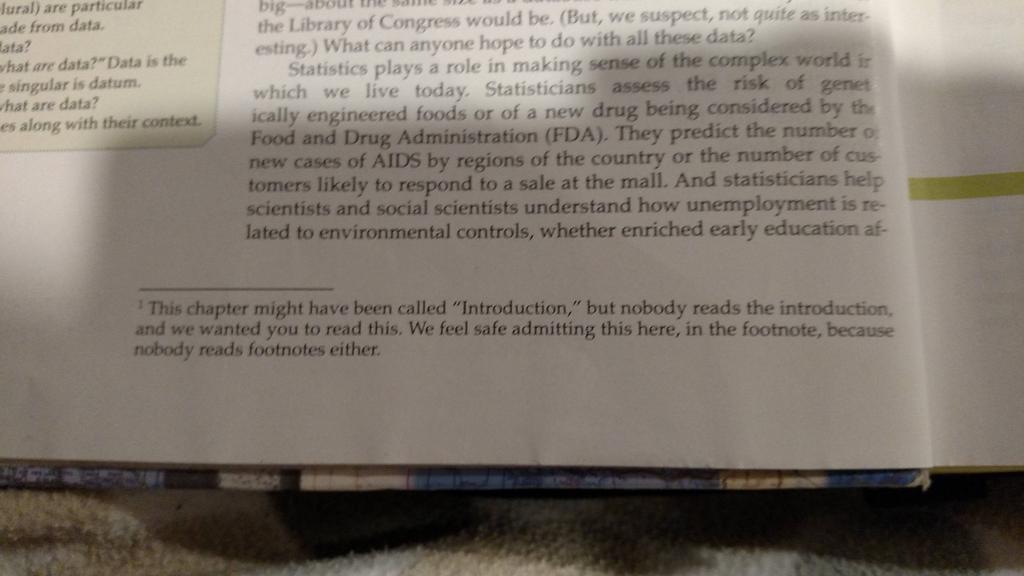
The hilarious picture below made me want to discuss the topic of “whether it’s okay to use footnotes when you write.” My take is that it depends on the context. In my opinion:
1. They’re okay for court opinions, SEC releases and research papers when authority needs to be cited.
2. But it’s not okay to bury substantive commentary in footnotes, even in the types of documents in #1 above. If it’s important enough to include in a document, put it in the body – don’t bury it in a footnote.
3. It’s never okay for informational articles. You might notice that nearly all of our content doesn’t include footnotes. For example, authority is cited within the body of our Handbooks. And commentary that might be considered as an “aside” is mentioned as an aside within the main body of our stuff. We don’t force our readers to dig around.
The Footnote of All Time
Saw this wonderful picture on @footnoted’s Twitter feed (courtesy of @AcademiaObscura). The footnote in the picture makes fun of footnotes (click the image to enlarge it & read footnote 1 at the bottom):
Poll: The Appropriateness of Footnotes
Take a moment for this anonymous poll to indicate your feelings towards footnotes:
I was excited to get an email from the SEC last night with the title of “Technical Issue Resolved.” Figuring that the SEC was finally ready to be transparent when Edgar goes down – yes, Edgar was down again yesterday – I eagerly opened the email. It said:
A technical issue that arose during routine maintenance caused a cache of previously issues materials to be be resent. The issue has been resolved but you may receive a limited number of additional outdated emails. We regret any inconvenience to you.
In other words, the SEC is willing to be transparent when it accidentally sends out old press releases – but the agency is still not willing to address the “elephant in the room.” As I have been doing for some time (see this blog for one of many), I will continue to hammer home the importance of fixing Edgar – and also hammer home the much easier fix of just informing us when Edgar is down (and then back up)…
More on “Big Brother’ is Watching You (Reading That Proxy)”
Got a number of interesting responses to my blog a few days ago about the SEC’s Edgar logs. This one was my favorite:
In its 2008 interpretive release about ‘use of company websites,’ the SEC was adamant that companies not track visitors to IR websites, in order to maintain anonymity of site visitors – but the SEC not only captures similar information on Edgar but actually makes that information publicly available. I’m baffled by the logic.
Director Compensation: Post-Investor Bancorp Reversal World Ain’t Pretty
We are beginning to see the impact of the Delaware Supreme Court’s reversal in the Investors Bancorp case – and it is not pretty. Two companies/boards recently agreed to settle lawsuits over non-employee director compensation and the attorneys for the parties and the Chancery Court Judge acknowledged that the settlement was influenced by Investors Bancorp.
In Solak v. Barrett, the lawsuit alleged that the directors of Clovis Oncology paid themselves excessive compensation in breach of their fiduciary duties and wasted corporate assets. According to the complaint, non-employee directors received an average of $617,700 in 2015, which was more than twice the average compensation of non-employee directors in the Fortune 50. Clovis is well outside the Fortune 500.
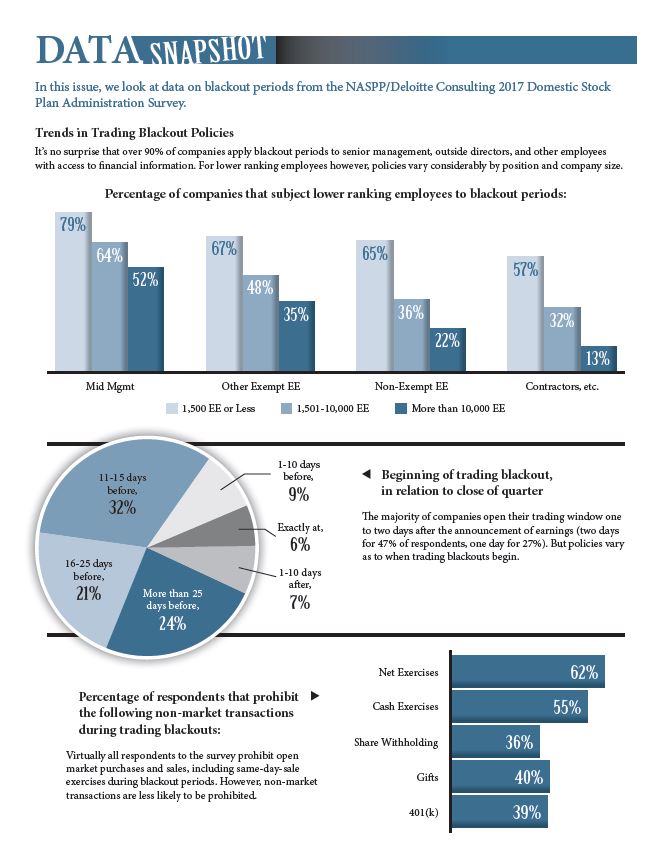
One of the areas that companies most frequently benchmark themselves is insider trading policies/blackout periods. We’ve surveyed that area over a dozen times over the past 15 years. We’re holding our semi-regular webcast about this area next month: “Insider Trading Policies & Rule 10b5-1 Plans.”
Another good source is the NASPP’s “Domestic Stock Plan Administration Survey” that it conducts every three years or so with Deloitte Consulting. Last year’s NASPP survey revealed that 100% percent of respondents to have an insider trading policy – and these other tidbits:
– 81% require officers/directors to acknowledge understanding and/or receipt of the policies of the insider trading compliance program
– 85% require insiders to pre-clear their trades
– 94% prohibit hedging
– 94% also prohibit trading in puts, calls, and similar derivatives
– 80% prohibit pledging
– In-house counsel is most commonly responsible for preparing Section 16 filings (64% of respondents), followed by stock plan administration (31%) and corporate secretary (21%). This was a ‘check-all-that-apply’ question; at some companies, multiple people might have this responsibility.
Insider Trading Policies: The Infographic
Here’s a nifty infographic from the NASPP with some of the survey stats:
Making IPOs Easier: Latest Congressional Activity
This Davis Polk blog lists all the latest attempts by Congress to pass legislation that would enable companies to go public more easily. Also see this Cooley blog about attempts by other organizations to push IPO reform…
Then there is this Kevin LaCroix blog about John Coffee’s views: “Is Over-Regulation Really the Reason There are Fewer IPOs?”…
Recently, John blogged about a Bloomberg piece that covered a study that uses Edgar’s logs – which are publicly available! – to track which SEC filings are being read by hedge funds. The upshot is that you can then infer whether a big name investor was looking into a particular company.
There also is this study that tracks whether mutual funds or proxy advisors are reading your proxy. Here’s an excerpt:
For 97 large mutual fund families and 3,706 companies over seven years, we can determine the precise times when each investor accessed each SEC filing for each company. In addition, for the three most recent calendar years within our sample, we also observe the number of times the largest proxy advisory service company, Institutional Shareholder Services (ISS), accessed each company filing.
We build our dataset using the publicly provided server log files from EDGAR. These files include partially masked internet protocol (IP) addresses, which do not reveal the full identity of the user but which are sufficiently detailed to enable a mapping to the IP address blocks held by institutional investors. Several contemporaneous papers similarly rely on this approach, including for example Chen, Cohen, Gurun, Lou, and Malloy (2017) to study investment decisions; Crane, Crotty and Umar (2018) to study hedge funds; Bozanic, Hoopes, Thornock, and Williams (2017) to study the IRS; and Gibbons, Iliev, and Kalodimos (2018) to study sell-side analysis. However, we are the first to use these data to study the governance-related fundamental research performed by key investors.
The problem is that this approach of using Edgar logs is quite limited. Folks might be accessing SEC filings posted directly on a company’s IR web page. Or in the case of proxies, posted directly on Broadridge’s platform. And of course, folks might be reading proxies in paper. If I was an institutional investor, I would still be asking for paper as that seems like a far easier way to actually read a proxy…
Corp Fin Hires an “Digital Assets & Innovation” Associate Director
As noted in this press release, Corp Fin has hired Valerie Szczepanik as an Associate Director & Senior Advisor for “Digital Assets & Innovation.” Valerie will coordinate efforts across all SEC offices regarding the application of the securities laws to emerging digital asset technologies & innovations, including ICOs and cryptocurrencies. She was hired away from the SEC’s Enforcement Division where she most recently served as an Assistant Director in their Cyber Unit…
Our “Section 16 Forums”: Only a Few Weeks Away!
In response to those doing Section 16 work who have told us that they want to network with those similarly-situated, we are holding a pair of “Section 16 Forums” in June – one on each coast. Hosted by Alan Dye, these are one-day events for all Section 16 practitioners – not just beginners.
Another overseas stock exchange has gotten into the “unilateral” listing business (here’s a blog about the older ones; here’s our “Practice Area” about this stuff). Here’s the intro from this Skadden memo about the latest:
In April 2018, the Moscow Exchange, reportedly the largest exchange in Russia, announced that it intends to admit securities of approximately 50 major U.S. and other foreign companies to public trading in the non-quotation section of the list of securities admitted to trading. The intent of this move is apparently to provide Russian investors with access to a wider range of financial instruments.
Under Russian securities laws, a Russian stock exchange can unilaterally admit foreign securities to trading without the consent of the issuer of such securities. In the last several years, the St. Petersburg Stock Exchange admitted securities of a number of foreign companies to trading in a similar fashion.
Importantly, in the event of such unilateral listing by a Russian stock exchange, responsibilities for public reporting and disclosure requirements, and associated costs, rest with the Russian stock exchange, and issuers of the relevant securities are relieved from such responsibilities and costs.
Insider Trading: Greed Kills
Whenever an i-banker is involved in an insider trading case, I’m shocked. This latest one from the SEC is no different. The dude worked at Goldman Sachs!
According to this article, in 2016, a good performing VP at a bulge bracket firm could expect to make between $375-975k per year – and you know Goldman ain’t at the low end of that. How stupid do you have to be to throw that away? And as noted in this Bloomberg article, some of his inside trades resulted in paltry returns…
1. The SEC All-Stars: A Frank Conversation
2. Parsing Pay Ratio Disclosures: Year 2
3. Section 162(m) & Tax Reform Changes
4. Pay Ratio: How to Handle PR & Employee Fallout
5. The Investors Speak
6. Navigating ISS & Glass Lewis
7. Proxy Disclosures: The In-House Perspective
8. Clawbacks: What to Do Now
9. Dealing with the Complexities of Perks
10. Disclosure for Shareholder Plan Approval
11. The SEC All-Stars: The Bleeding Edge
12. The Big Kahuna: Your Burning Questions Answered
13. Hot Topics: 50 Practical Nuggets in 60 Minutes
14. Dave & Marty: True or False?
15. Steven Clifford on “The CEO Pay Machine”
Reduced Rates – Act by June 29th: Huge changes are afoot for executive compensation practices with pay ratio disclosures on the horizon. We are doing our part to help you address all these changes – and avoid costly pitfalls – by offering a reduced rate to help you attend these critical conferences (both of the Conferences are bundled together with a single price). So register by June 29th to take advantage of the discount.
Let’s say you’ve filed a registration statement & one of your directors – we’ll call him “David Dennison,” for absolutely no reason in particular – signed the document through an attorney-in-fact. Is there a possibility that the now famous “he didn’t sign it” defense could call into question the validity of David’s signature?
This Olshan blog says that if you’ve properly complied with the requirements applicable to powers of attorney, there’s no reason to be troubled by the fact that one or more signatories executed the registration statement through an attorney-in-fact:
Proper powers of attorney should cover the specific filing being made by the company and any and all amendments to that filing, as well as all other documents in connection with the filing. The power of attorney, though electronically filed with a typed conformed signature in the document, should be manually executed by the officer or director and the original should be saved for at least five years.
If the power of attorney is in the Signatures section in Part II of the registration statement (with an appropriate reference thereto in the exhibits index), the manually executed original should be saved for five years, and all amendments to the registration statement manually signed by the attorney-in-fact on behalf of the officer or director should likewise be saved.
There are many valid business reasons to utilize a power of attorney and there is no legal reason why a corporate officer or director should not be deemed to have signed a registration statement in reliance upon a valid power of attorney.
Of course, if David subsequently says that the registration statement is “fake news,” that might be another kettle of fish. . .
Should You File That Shelf Now or Later?
Check out this Bass Berry blog if you’re trying to decide whether you should file a shelf S-3 now or wait until you’re planning to do a deal. For non-WKSI’s, the answer is usually easy – since your S-3 won’t automatically go effective, you can’t be sure that you won’t be delayed when you need it unless you get it on file & effective now.
The answer for a WKSI issuer is a little more complicated – and the blog lays out the pros & cons. Here’s an excerpt addressing one of the big reasons that even a WKSI might want to get a registration statement on file before a deal is imminent:
Given the fact that filing a registration statement has the potential to trigger financial statement filing requirements (such as the potential need to file retrospectively revised financials in connection with a change in business segments, the occurrence of discontinued operations, or probable or completed significant acquisitions or dispositions), filing a registration statement on a clear day at a time when such filing does not trigger financial statement filing requirements may prove beneficial in comparison to waiting to file a registration statement at the time of a future public offering when such financial statement filing requirements could be triggered.
Cons include the need to incur the costs associated with registration and the potential adverse effect on the stock price due to the perception that the company is signaling the market that a deal is coming.
Our June Eminders is Posted!
We’ve posted the June issue of our complimentary monthly email newsletter. Sign up today to receive it by simply inputting your email address!