Wrapping up a project that I feverishly commenced two years ago, we are happy to say the inaugural 2015 Edition of Romanek’s “The In-House Essentials Treatise” is done being printed. Here’s the 79 pages of our “Detailed Table of Contents” listing the topics so you can get a sense of the Treatise’s practical nature. You will want to order now so you can receive it as soon as possible.
With over 1400 pages, this tome is the definition of being practical. You can return it any time within the first year and get a full refund if you don’t find it of value.
Compliance Program Improvement: DOJ Gives Cooperation Credit for 1st Time
A few weeks ago, the DOJ made good on a promise made last fall to give credit to companies that improve their compliance programs when a Barclays plea deal included a provision along those lines. Here’s an excerpt from this memo:
For the first time, the antitrust division of the U.S. Department of Justice (DOJ) has awarded a company sentencing credit for implementing an effective compliance program after the start of an investigation. Getting credit for compliance efforts should not be as hard as space travel, but up until last week, a company’s chances for getting any credit (short of being the winner-takes-all leniency applicant) were no better than landing on the moon. Barclays PLC, along with four other investment banks, entered into a plea agreement with the DOJ on May 20, 2015, for its participation in the alleged FOREX cartel conspiracy to manipulate the price of U.S. dollars and euros exchanged in the foreign currency exchange (FX) spot market.
The sentencing credit is apparent from a single line in the plea agreement: “The parties further agree that Recommended Sentence is sufficient, but not greater than necessary to comply with the purposes set forth in 18 U.S.C. §§ 3553(a), 3572(a), in considering, among other factors, the substantial improvements to the defendant’s compliance and remediation program to prevent recurrence of the charged offense.”1 The four other major banks that entered into plea deals did not have this same provision, and it appears that they did not receive credit for their compliance programs.
Shareholder Engagement: ESG Style
In this 68-page guide, BlackRock & Ceres have teamed up to provide guidance for institutional investors on how to engage on sustainability issues. The guide includes tactics & case studies as 30 institutional investors describe their priorities and strategies they use to engage with companies across different asset classes, both internationally and domestically, on ESG matters. Here’s more from this Davis Polk blog…
Meanwhile, as reported in the Society of Corporate Secretaries’ Alert, based on data from Proxy Insight (see pages 8-9), CalSTRS is one of the least likely of the public pension funds to support the election or re-election of directors – supporting management nominees just 36.7% of the time. CalSTRS is also almost twice as aggressive as the next pension fund on the list identified as least likely to vote for management’s slate – the Illinois State Board of Investment – coming in at 67.4% support.
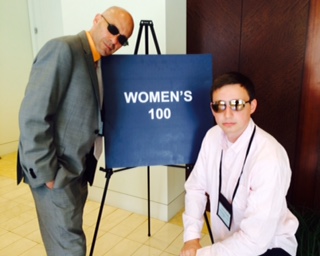
Sights & Sounds: “The Women’s 100 Conference” in DC
I’ll be blogging more about yesterday’s magical event in the near future. But I can’t resist posting this pic of the two men shepperding the event – my newly graduated high school son & me:
Parsing through the dozens of memos about the SEC’s recent KBR action, law firms seem to vary about what you should be doing now with your agreements. The positions fall into one of these three camps: (a) KBR settlement language is sufficient; (b) KBR settlement language is overly broad; or (c) not sure at all what is sufficient. The SEC’s Enforcement Division seems to still be looking at – and asking – for agreements to review – but I believe that will settle down soon enough. I’ve just calendared a September webcast that includes the SEC’s Chief of the Whistleblower Office Sean McKessy to help us sort through these choices (and more).
Meanwhile, here’s an excerpt from this WSJ article entitled “Whistleblowers Find SEC Rewards Slow and Scarce”:
The SEC program pays out based on sanctions that have been collected, rather than the amounts imposed by a judge that are up to the agency to recover. That can leave whistleblowers with nothing to show for their efforts if the money has vanished in the fraud or if the perpetrator has fled beyond U.S. jurisdiction. So far, more than 10,000 tips have been submitted to the SEC whistleblower program, about 300 people have applied for awards and 17 payouts have been made, according to SEC data. An SEC spokeswoman declined to say how much money has been collected for any of the 658 enforcement actions the agency’s website lists as being potentially eligible for awards. She also declined to say how many, if any, of the pending award claims relate to cases in which no bounty is available, even if the claim is approved.
Montana Joins Massachusetts in Regulation A+ Challenge
As I added late to last week’s blog, Montana has joined Massachusetts in suing the SEC over Regulation A+. Here’s the Montana scheduling order – the Montana & Massachusetts cases have been consolidated by the US Court of Appeals for DC…
Even though contingent fee audits in the escheatment area have been around for some years now, companies continue to be shocked when they find themselves subject to one. Tune in tomorrow for the webcast – “Escheatment Soup to Nuts: Handling Unclaimed Property Audits & More” – to hear Reed Smith’s Diane Green-Kelly, Keane’s Valerie Jundt and Exelon’s Scott Peters cover everything you need to know about escheatment, from the basics to handling the growing number of unclaimed property audits.
Cleary Gottlieb just created this chart with the status of the SEC’s Dodd-Frank rulemakings fyi
Our June Eminders is Posted!
We have posted the June issue of our complimentary monthly email newsletter. Sign up today to receive it by simply inputting your email address!
As the PCAOB continues to toy with the long-floated idea of “expanded” audit reports – which means that auditors would be required to include some narrative in their boilerplate – I thought it would be helpful to provide an example of what that might look like. Since 2012, companies in the UK have been required to provide this type of expanded audit report. And last year’s audit report (see page 130) for Rolls Royce has been held up as one of the best since the company & its auditor – KPMG – go further than what the UK’s Financial Reporting Council’s rules require. Here’s an excerpt from this CFA Institute Blog:
In short, the auditor reports the greatest risk of material misstatement and how it responded to those risks. KPMG could have stopped there to be in compliance with the new standard, but that wasn’t good enough for Rolls Royce. With the investor user in mind, KPMG in cooperation with management took it a step further and included the findings. Aside from the communicative value of this information to investors, extending the auditor’s report to include the findings demonstrates a willingness on the part of the auditor and management to work together toward meaningful communication to investors — a major departure from past practice.
In addition, check out this explanation from KPMG about what they did – and this article about the UK requirements…
PCAOB Seeks Comment on Specialists Use
Yesterday, the PCAOB issued this Staff Consultation Paper – “The Auditor’s Use of Specialists” – that seeks input on potential changes to standards for the auditor’s use of the work of specialists, specifically the objectivity and oversight of specialists and the use of their work in audits.
BE-10 Reports: Deadline Flexibility & How to File
Here’s a question posted yesterday on our “Q&A Forum” (#8437): “Tomorrow, May 29, 2015 is the due date. Does anyone know if the BE-10 reports must be in the hands of the BEA by tomorrow or is it sufficient if it is postmarked with tomorrow’s date? Also, any reason we can’t Fed Ex the survey? The instructions however state to send the reports filed by mail “through the U.S. Postal Service.”
Here’s an answer that I received from Gibson Dunn’s David Wolber: “I haven’t heard officially from BEA on the due date aspect – and haven’t seen much explicit guidance – but I note the BE-10 Instructions say: ‘A fully completed and certified BE-10 report comprising Form BE-10A, and Form(s) BE-10B, BE-10C, or BE-10D is due to BEA no later than May 29, 2015 for U.S. Reporters required to file fewer than 50 forms, and June 30, 2015 for U.S. Reporters required to file 50 or more forms.’ This would tend to imply the report must be in there hands by sometime on Friday.
However, note that the BEA recently extended the deadline for all ‘new filers’ to June 30th. A new filer is ‘a U.S. company or person that is required to file on the BE-10 survey but has never filed any BEA survey of U.S. direct investment abroad, including the BE-10, BE-11 and BE-577 surveys.’ This is probably good news for quite a number of folks. Also, it appears that 30- and 60-day extensions are being readily granted.
Regarding method of delivery, BEA guidance in the BE-10 Instructions and in FAQs on the website contemplates a range of acceptable methods including mail, hand delivery and fax. Although I haven’t seen anything official from BEA on this, overnight would seem to be a safe choice, and I suspect that, as long BEA gets the report at the end of the day, they shouldn’t care too much if it arrived via USPS or some other carrier such as FedEx.”
If you haven’t heard about this, brace yourself. Some sophisticated scammers have been successful learning the style of how your CEO and other senior executives write their emails – and then are capable of sending emails from their email addresses. For example, a scammer will write an email that looks like it comes from your CEO to your controller asking for a wire transfer to be made to an offshore account. And the controller naturally will do it. This will be among the topics covered in our upcoming webcast: “Cybersecurity: Governance Steps You Need to Take Now.”
A large number of U.S. businesses have recently been the target of a very sophisticated email scam that is designed to convince company employees who are responsible for executing financial transactions to wire funds to overseas accounts that are controlled by the perpetrators of the scam. The FBI’s Internet Crime Complaint Center (“IC3”) refers to these kinds of frauds in their various forms as Business Email Compromise (“BEC”) scams, which are usually aimed at companies that regularly wire money outside of the United States. In recent months, there have been over 2,000 reported incidents of these scams, resulting in hundreds of millions of dollars in losses.
Political Contributions Disclosure: Three Former SEC Commissioners Support It
Yesterday, three former SEC Commissioners – Bevis Longstreth, William Donaldson & Arthur Levitt – sent this letter to the SEC supporting the push for political contributions disclosure rulemaking (remember how the SEC was recently sued for not rulemaking in this area). These former Commissioners are the latest in a number of folks that continue to weigh in on the 2011 rulemaking petition, including this letter from 70 foundations and this letter from a group of State Treasurers.
Transcript: “The NYSE Speaks ’15: Latest Developments and Interpretations”
We have posted the transcript for our recent webcast: “The NYSE Speaks ’15: Latest Developments and Interpretations.”
Barbara Blackford’s 2500-Mile Ride!
I’ve blogged before about the inspirational Barbara Blackford. She recently stopped in DC, about 1500 miles through her ride up the East Coast. Check out her blog – and Facebook page, as well as this explanation of “Cycling for Good” and how you can donate…
Last Friday, in this “Petition for Review,” the Massachusetts Secretary has sued the SEC in the US Appeals Court for the District of Columbia asking the court to vacate the portion of the SEC’s new Regulation A+ rules that preempt state law – and issue a permanent injunction prohibiting it from going into effect on June 19th. The petition is just two paragraphs! Here’s the scheduling order. According to this article, Montana has filed a similar lawsuit.
During the rulemaking process, NASAA – the association of state securities regulators – repeatedly argued that the preemption aspects of Regulation A+ were inconsistent with legislative intent…
I just calendared a new webcast to track developing market practices in the wake of the new Regulation A+ rules…
The SEC’s Waiver Controversy Extends to Other Federal Agencies
This Reuters article notes how Senator Elizabeth Warren has called for hearings on the Department of Labor’s waiver practices in the wake of the SEC’s waiver controversy…
This Bloomberg article criticizes the pace of the SEC’s rulemaking – and notes how politics at the Commissioner level have contributed to that…
Hooli Board: A Lack of Gender Diversity
I’m a devoted fan of the HBO comedy called “Silicon Valley.” Pulled from the last episode, I thought this 7-second clip featuring the fictional tech giant’s CEO was hilarious as it shows him addressing his board with the opening: “Gentlemen of the Hooli board…and lady…” That says it all about the continuing problem of gender & racial disparity on boards:
Last month, Vanguard sent letters to its 500 largest holding as we blogged about a few months ago. Since then, a number of members have asked how to respond to the letters – and we’ve found that most companies responded by simply acknowledging receipt.
As for whether companies have actually formed these committees, I haven’t seen any other than this recent announcement from Tempur Sealy (note that H Partners didn’t request formation of this committee in its governance settlement with the company). But perhaps there are some others out there (or they’re coming). But I believe that many companies have concluded that there doesn’t need to be a specific committee to handle this role. Too many board committees is not a good thing.
Michael Levin of “The Activist Investor” recently wrote an email about the topic under the title of “A Shareholder Liaison Committee? Really?” – his punchline was: “Why isn’t the board of directors the “shareholder liaison committee”?” I agree.
For those considering creating a standing – or special – board committee along these lines, see our checklist about doing so…
Discretionary Bonuses: The Cost of Extramarital Affairs
Here’s an interesting blog by Rolf Zaiss & Kerry Berchem of Akin Gump about how a company cut the bonus of the CEO due to an affair with someone at a consulting firm. What price love (or lust)?
Last week, as noted in this blog, the House Financial Services Committee approved 13 bills, many of which are JOBS-Act related…
More on “The Mentor Blog”
We continue to post new items daily on our blog – “The Mentor Blog” – for TheCorporateCounsel.net members. Members can sign up to get that blog pushed out to them via email whenever there is a new entry by simply inputting their email address on the left side of that blog. Here are some of the latest entries:
– Blackholes in the Boardroom
– Stand-Alone Conflicts of Interest Policy Considerations
– Audit Committee Survey: Workload at Tipping Point?
– 2015 Cyber Risk Agenda
– Navigating Corporate Governance Hot Topics
This Q4 blog covers this recent study about how social media influences investment decisions. Here’s an excerpt:
The article pulls interesting research from Greenwich Associates, which notes that “almost 80% of institutional investors use social media as part of their regular work flow, and approximately 30% say the information consumed via social media has directly influenced an investment decision.” With input from 256 corporate and public funds, insurance companies, endowments and foundations in the U.S, Europe, and Asia, the research outlined that: 48% of investors noted that information from social media prompted them to do an additional research on an industry issue or topic; 37% said they shared information from social media with decision-makers at their companies; 34% said information learned on social media influenced a decision to work with a particular client or company; and that 33% said information obtained on social media triggered a discussion with their investment consultant.
Overall, the article points to the increasing effect that social media has on influencing investment decisions with investors. For example, 40% of the global institutions are expected to increase their use of social media in 2016. Using social media as part of your investor relations communications process will also benefit your company as it paves way for engagement, expands reach, and increases awareness with institutional investors and the financial media.
Social Media: Getting Up-to-Speed
Here’s other good stuff relevant to the use of social media:
Many of you are on Twitter – and perhaps you are looking for funny or interesting things to follow outside your worklife (& beyond following me). I canvassed what some friends do for Twitter entertainment & received these recommendations (send me yours):
– @BeschlossDC – Historian who posts historical pictures
– @BullandBaird – Wall Street perspective with humor thrown in
– @BorowitzReport – pretty funny on political commentary
Even with the SEC’s new policy on Reg A & D waivers fresh on the books, the topic of whether to grant waivers remains topical. Last week, SEC Commissioner Stein dissented from the SEC’s order granting a waiver to Deutsche Bank over its WKSI status (you may recall that Corp Fin issued a revised statement about how it would process WKSI waivers last year).
The WKSI waiver debate is new; there’s been controversy before. And interesting, although Deutsche Bank got its WKSI waiver request, apparently the same did not happen for Credit Suisse. According to this Reuters article, Credit Suisse withdrew a WKSI waiver request after SEC Staff informed it that the request would likely be denied.
But what apparently is new is a growing battle between the SEC and the CFTC, as noted in this excerpt from Stein’s dissent:
However, based on a loophole contained in Rule 506(d)(2)(iii), the CFTC has intervened and prevented the bad actor disqualification question from even coming before the Securities and Exchange Commission. The CFTC saw fit to opine on the SEC’s Rule 506 jurisprudence about whether Deutsche Bank AG should receive a waiver from automatic disqualification under SEC rules. It is unclear to me what, if any, analysis went into this decision and what prompted the CFTC to insert language into its final order stating that a bad actor disqualification “should not arise as a consequence of this Order.” The implications of the CFTC’s actions here — and in other actions — are deeply troubling. The Commission should closely review this provision and how it is being used.
The Rule 506(d)(2)(iii) provision has actually been used once before by the CFTC to “waive away” the 506 disqualification – last year in this CFTC order against JPMorgan for the London Whale incident. So two times now makes a trend perhaps.
But what may be the interesting trend is whether companies – faced with the SEC’s deadlock over 506 waivers – will look to get around the deadlock by relying on this provision in its negotiations with other state or federal regulators. The provision also allows courts to decree that there should be no 506 disqualification as well. Below is the language from the adopting release for Rule 506(d) (which was adopted by a 5-0 vote) that explains the purpose of this provision:
The amendments we are adopting include a provision under which disqualification will not arise if a state or federal regulator issuing an order advises in writing that Rule 506 disqualification is not necessary under the circumstances. We believe this provision will create cost savings for affected covered persons such as issuers, individuals and compensated solicitors by eliminating the need to seek waivers from the Commission or pursue other means of raising capital. We expect that some issuers and other covered persons will adjust their settlement negotiations to bargain for an express determination that disqualification from Rule 506 is unnecessary. As the provision applies only where state or federal regulators have determined that Rule 506 disqualification is not necessary, we do not believe it is likely to impair the intended investor protection benefits of the bad actor disqualification scheme.
Former Corp Fin Deputy Director Lona Nallengara to Leave SEC
Yesterday, the SEC announced that Lona Nallengara – who was Corp Fin’s Deputy Director before he headed upstairs to be Chair White’s Chief of Staff – will leave the agency at the end of next month. No next destination listed…
As noted in this blog, the House Financial Services Committee will mark-up a flurry of JOBS Act-related bills today…
More on “The Mentor Blog”
We continue to post new items daily on our blog – “The Mentor Blog” – for TheCorporateCounsel.net members. Members can sign up to get that blog pushed out to them via email whenever there is a new entry by simply inputting their email address on the left side of that blog. Here are some of the latest entries:
– Form 10-K Preparation Tips
– How to Proactively Tackle the Director Tenure Issue
– Code of Ethics/Conduct Primer
– Audit Committee Role in Improving Disclosure
– CEO Succession Planning Guidance for CEOs & Boards
If you have read this blog for a while, then you know I dig fake SEC filings. As noted in this blog last year on the topic, they tend to be one of my most popular types of blogs. So last week was Christmas for me as this fake Schedule TO about a $8 billion takeover bid caused a stir and caused Avon’s stock to tank (see this DealBook piece).
This latest incident is a cautionary tale for investors as it’s not the first fake takeover announcement. My favorite dates back to 2001, as noted in this piece, when a fake “blank check” company calling itself “Toks Inc.” filed a Form SB-2 with the SEC announcing plans to take over General Motors, General Electric, AT&T, Hughes Electronics, AT&T Wireless, AOL Time Warner and Marriot International – for roughly $2 trillion in “Toks” stock. The promoter – Ade O. Ogunjobi – didn’t give up even when the SEC issued a “Stop Order” to prevent the registration statement from going effective and suing him for selling unregistered securities, later launching a website to promote his wild ambitions and plans to then hold press conferences to announce his plans for these major US companies he was to take over!
Transcript: “Form S-8: Share Counting, Fee Calculations & Other Tricks of the Trade”
We have posted the transcript for our recent webcast: “Form S-8: Share Counting, Fee Calculations & Other Tricks of the Trade.”
More on “The Mentor Blog”
We continue to post new items daily on our blog – “The Mentor Blog” – for TheCorporateCounsel.net members. Members can sign up to get that blog pushed out to them via email whenever there is a new entry by simply inputting their email address on the left side of that blog. Here are some of the latest entries:
– Study: Data Breach Preparedness
– Survey: Current (& Future) State of Compliance
– Spencer Stuart Addresses Board “Refreshment”
– Avoiding & Managing Boardroom Disputes
– Using COSO to Assess & Manage Cyber Risks