D&O insurance premiums jumped somewhere between 44% and 104% in the first quarter of this year, compared with last year. That’s according to survey data from Aon & Marsh cited in this WSJ article. The cause of the increase is the ever-expanding specter of securities litigation, including event-specific litigation and suits over emerging ESG issues, which Lynn blogged in January would be likely to influence rates.
The latest threat? Covid-19 reopening decisions. Lynn blogged last week on “The Mentor Blog” about what boards need to consider to manage reopening risks – if boards get it wrong, they’ll not only be facing remorse over upended lives and a struggling workforce, they’ll also become a litigation target. Some believe that rates will more than double in the wake of the pandemic, according to this “Business Insurance” article. The WSJ reports that on top of tough decisions about the business, companies are having to decide whether to change deductibles, policy limits or insurance budget. Here’s an excerpt:
According to Aon, no primary policies that renewed in the first quarter with the same limits and deductibles fetched a lower price. To contain the increases, nearly half of the clients changed their deductibles or policy limits, and sometimes both.
In a June 10 report, A.M. Best Co. said a spike in litigation caused by specific events, such as cyberattacks, the #MeToo movement and wildfires, was driving the increases. Companies also face potential litigation over “emerging exposures” such as Environmental, Social and Governance, or ESG, issues and climate change, it says.
Exchange Act reporting is a key factor in reigning in premiums and reducing risk. According to the Journal and insurance companies, some companies also are setting up captive insurance companies in places like Singapore or Bermuda – as wholly owned subsidiaries that provide insurance to the sponsoring company alone.
Earnings Guidance: Most Important for Smaller Companies?
In this recent 6-minute interview with Andrew Ross Sorkin, Barry Diller – Chair of Expedia and IAC – takes a pretty firm stance against giving earnings guidance, and says the companies he oversees will no longer be providing granular predictions of the near-term future. This CFO.com article argues that guidance isn’t a waste of management’s time and outlines ways in which the practice can benefit companies – especially smaller companies. Here are some high points:
1. Volatility: Stocks are valued on expectations of future performance. Companies that give guidance help narrow the standard deviation of those expectations, and their words and numbers carry weight because they have the most information about their future. Volatility is less of an issue for widely-followed mega-caps, which have a “crowdsourced consensus on future value that can make guidance unnecessary.”
2. Visibility: For smaller companies, guidance is an important tool to enhance visibility on the Street. It makes analysts’ and investors’ jobs easier and shows management can deliver, which builds their credibility — the most valuable non-monetary asset on Wall Street.
3. Vulnerability: Companies that give guidance take the lead in shaping investor perception about future potential. Those that don’t leave a “consensus” opinion to a handful of research analysts who don’t have full perspective on the issuer’s culture, plans, and opportunities. Worse yet, management is nonetheless still held accountable by the market for hitting that consensus.
“All-Purpose” Securities Law Disclosure: Are We Reaching the Breaking Point?
As demands mount for “stakeholder”-oriented disclosure – and as the SEC faces understandable backlash about whether that type of disclosure is useful to investors – there’s a growing contingent suggesting that shoehorning extra info into an investor-focused disclosure scheme is a lot like two-in-one shampoo & conditioner: it simply doesn’t work. This article from Tulane Law prof Ann Lipton discusses whether the SEC has been a victim of “mission creep” – and why now’s the time to look at other avenues for required “stakeholder” disclosure. Here’s an excerpt:
The assumption — stated or unstated — that all public disclosure must necessarily run through the securities laws has distorted the discourse for decades. Academics, regulators, and advocates have conflated the interests of investor and stakeholder audiences, to the detriment of both. There has been little, if any, discussion of the informational needs of the general public, or when and whether businesses should operate under a duty of public transparency. At the same time, advocates for myriad causes try to flood the securities disclosure system with information relevant to their own idiosyncratic interests, overburdening the SEC and making it more difficult for investor audiences to interpret the information they are given.
How would this type of system work? Ann looks at the EU system “both as a model and a point of contrast” – and suggests that stakeholder disclosure would apply to these categories:
– Financial information – including issues pertaining to tax payments, anticorruption measures, and antitrust compliance
– Corporate governance
– Environmental impact
– Labor relationships – including diversity, working conditions, and pay practices
To minimize burdens on business, the initial system could focus on information that has already been compiled internally, such as reports that companies are already required to file with government agencies, or financial and governance information likely to be on hand. Doing so would spare companies the additional burdens of data gathering, and would go a long way toward standardization.
To be clear, this isn’t a call to “abolish” the SEC. Rather, it would emphasize the SEC’s focus on investors and use other ways to provide complementary info. However, we could see some ripple effects in SEC rules if something like this came to fruition, and it could expand the scope of work for people in our community, since we’re already involved with disclosure.
Last year, I blogged about an SEC enforcement action to halt an unregistered ICO that was being conducted in the most “best practices” way possible – through a “Simple Agreement for Future Tokens.” Under this structure, the company sells “pre-token” securities to accredited investors, which flip into non-security tokens at or after launch of a platform on which to use them. In this particular case, the SEC took issue with the fact that there would be no established cryptocurrency ecosystem at the point when the pre-tokens flipped to tokens.
On Friday, the SEC announced that it had settled the enforcement action – and the results aren’t encouraging for the crypto crowd. Here’s the highlights:
– The company agreed to return more than $1.2 billion to the initial purchasers in the offering
– The company’s paying an $18.5 million civil penalty
– For the next 3 years, the company has to notify the SEC before participating in the issuance of any digital assets
Yikes. The announcement includes this quote from the Chair of the SEC Enforcement Division’s Cyber Unit: “New and innovative businesses are welcome to participate in our capital markets but they cannot do so in violation of the registration requirements of the federal securities laws.” But with this SAFT arrangement drawing ire, a lot of folks are wondering how exactly a token offering would do that.
Reg S-T: Corp Fin Extends Temporary Relief for Signatures
In March, John blogged about Corp Fin’s temporary relief for manual signature retention requirements under Rule 302(b) of Regulation S-T. Last week, the Staff updated that statement to say that it’ll remain in effect until a date specified in a public notice, which will be at least two weeks from the date of the notice. So while the Staff continues to expect compliance, it won’t recommend enforcement if:
– a signatory retains a manually signed signature page or other document authenticating, acknowledging, or otherwise adopting his or her signature that appears in typed form within the electronic filing and provides such document, as promptly as reasonably practicable, to the filer for retention in the ordinary course pursuant to Rule 302(b);
– such document indicates the date and time when the signature was executed; and
– the filer establishes and maintains policies and procedures governing this process.
The Staff also extended for an indefinite period its temporary relief for submission of paper forms under Rule 144 and other rules – which had been set to expire June 30th. For more detail, see this Cooley blog.
Last week, the SEC, Corp Fin, the Division of Investment Management and the Division of Trading & Markets also issued this joint statement, which summarizes all of the relief & assistance that the Commission provided during the pandemic to accommodate capital raising & reporting, and says the Commission won’t be extending the relief that gave companies additional time to file disclosure reports that were due on or before July 1st.
But not everyone is happy about “deregulatory” efforts by the SEC these last few months – here’s a letter to SEC Chair Jay Clayton from Chair of the House Financial Services Committee, Congresswoman Maxine Waters (D-CA), calling for the Commission to halt rulemakings unrelated to the pandemic.
Climate Change Litigation: The Next “Mass-Tort” Frontier?
BP is facing state court action for nuisance claims from the cities of Oakland & San Francisco, after the Ninth Circuit denied the company’s motion to remove the case to federal court and dismiss the claims. This Wachtell Lipton memo predicts that the decision will invite “countless actions by states, municipalities, and private litigants in state courts all over the country” – and that liabilities will extend far beyond the energy sector.
Meanwhile, as Reuters reported a couple weeks ago, PG&E is pleading guilty to 84 counts of involuntary manslaughter in connection with the 2018 Camp Fire. Although no individuals will be held criminally accountable, this plea is pretty unique because the company is admitting criminal guilt. The company is also paying up to $19 million in fines & costs accepting tighter oversight – and pledging billions of dollars to improve safety and help wildfire victims. The company cited more than $30 billion in potential wildfire damages when it filed for bankruptcy, and it’s reached various settlements and rate agreements as part of the Chapter 11 plan.
Late last year, Liz blogged about Prudential’s “multi-stakeholder framework” and the company’s intent to report progress under that framework in future sustainability reports. Yesterday, the company issued its first report since making that commitment.
Our good friend Peggy Foran and her team organized the report by 5 “capitals of sustainability”:
– Corporate Governance: this pillar includes the “multi-stakeholder” framework that codified the board’s accountability to shareholders, employees, customers and society
– Business Model & Innovation: highlighting strategic acquisitions
– Human Capital: noting that Prudential created an “Inclusion Council” last year to ensure C-suite accountability for inclusion & diversity, explaining the director identification process and sharing that 80% of the company’s outside directors are diverse
– Social Capital: discussing the company’s sustainability commitment, support for stakeholders in the midst of Covid-19 and supply chain efforts
– Environment: describing Pru’s “Global Environmental Commitment” that includes operational and investment targets – the company was carbon neutral in its corporate travel and in early 2020, it was the first insurer to issue a green bond
Prudential has issued a sustainability report for several years so they might be further along than others, but for those starting down the path of pulling a similar report together, Prudential’s report is worth a look. The company also has a sustainability micro-site and there, you’ll find the report and a series of short videos with 6 senior leaders.
Covid-19: Investors Want Mandated Disclosures
As reported in a recent Davis Polk blog, Americans for Financial Reform sent a letter signed by over 90 investors, state treasurers, public interest groups and others calling on the SEC to create new Covid-19-related disclosure requirements. The letter says the disclosure requirements would help investors understand how companies are protecting workers, preventing the spread of the coronavirus and responsibly using any federal aid the companies receive. Depending on how companies respond to Covid-19, the letter says the potential impact of losses resulting from Covid-19 will be significant.
The requested disclosures are somewhat lengthy and it’s understandable that the information could be helpful to investors, although it would be more work for companies and securities lawyers. Requested disclosures dealing with cash flow and liquidity concerns and supply chain adjustments may have been addressed, in part, by Corp Fin’s Covid-19 supplemental guidance issued earlier this week. Some of the other requested disclosures relate to worker protections during Covid-19, compliance with public health recommendations about reopening, rationale supporting executive compensation modifications and all election spending and lobbying activity, including funds spent through trade associations.
With companies preparing Q2 disclosures, the SEC is holding a “Roundtable on Q2 Reporting: A Discussion of Covid-19 Related Disclosure Considerations” this coming Tuesday, June 30. SEC Chairman Jay Clayton is moderating the roundtable and it will include Gary Cohn, Former Director of the National Economic Council; Glenn Hutchins, Co-Founder of Silver Lake Partners; Tracy Maitland, President of Advent Capital Management; and Barbara Novick, Vice Chairman of BlackRock. The roundtable is being webcast and can be viewed on the SEC’s website.
Tesla Delays Its Meeting – And D&O Coverage Puts Glass Lewis “Against” Chair
Many have likely seen reports that Tesla postponed its annual shareholder meeting. The delay is due to social distancing concerns – it had been scheduled for July 7. Elon Musk tweeted news of the delay and a few days later tweeted that September 15 is the tentative reschedule date – Tesla filed additional soliciting materials with this information and as some would say, a screenshot is worth a thousand words.
With Tesla’s original meeting date just around the corner, proxy advisors issued their voting reports and the NYT reports that Glass Lewis has recommended investors vote “against” Tesla’s Chairwoman, Rhonda Denholm. Back in May, John blogged about Elon Musk’s cost-saving move by not renewing the D&O liability policy for directors and instead, that Musk intends to personally provide the coverage. According to the article, that cost saving move is behind Glass Lewis’s recommendation:
The recommendation was based on corporate governance concerns due to an insurance arrangement with Chief Executive Officer Elon Musk after Tesla’s decision to not renew its directors and officers’ liability policy due to high premiums quoted by insurers, Glass Lewis said. The article quotes Glass Lewis: ‘We are concerned that this D&O arrangement gives the company’s independent directors a direct, personal financial dependency upon the CEO they are tasked with overseeing.’ Since Denholm heads the audit committee that permitted the insurance arrangement, it recommends voting against her.
Rhonda Brauer shares her observations about our current crises and how SASB’s “financial materiality” disclosure framework could assist in bringing about societal change:
As news occurs literally outside my window, I see accelerated demands for societal change that are impacting company, investor and other stakeholder expectations. The following data points affect not only “human capital” and environmental issues, but also “social capital” issues encompassing community relations and human rights:
The killing of George Floyd and likely continuing protests calling for deeper structural changes to systemic racism in our country;
The Business Roundtable’s 2019 Statement on the Purpose of a Corporation, which committed to support the communities in which companies operate, as well as the World Economic Forum’s International Business Council’s recent statement;
SASB’s continuing work on possible revisions to its standards, including research on human capital management across its 77 industries. SASB notes that these themes are closely related to “social capital” themes, which focus on human rights and community relations in, g., the Oil & Gas – Exploration & Production (E&P) industry.
SASB’s “financial materiality” disclosure framework brings these issues together in a way that could result in profound societal changes, particularly given the supportive statements of large asset managers and re-energized public focus on structural racial health inequities. As noted in my earlier blog, large asset managers are among the investors from which SASB has gained increasing support.
Looking more closely at social capital issues, I note the 2020 shareholder resolution (#8) at Chevron — it requested a report on efforts to “prevent, mitigate and remedy the actual and potential human rights impacts of its operations.” The supporting statement and exempt solicitation went into more detail about the social capital aspects of the request, referencing SASB’s quantitative metrics and analysis, which incorporate related international conventions to which Chevron says it adheres. The proposal received 16.7% support, which is significant for a first-year company proposal. Nevertheless, the lack of support from larger asset managers, in particular, raises questions about why they were satisfied with the company’s current disclosure about its impact on communities that are home or adjacent to its operations.
Unlike As You Sow’s “materiality” proposals, the Chevron human rights proposal did not mention SASB in its RESOLVED clause. Proxy Insight has tracked – through mid-June — the 2020 E&S proposals that concern human rights and community relations. Of those requesting enhanced disclosures, As You Sow’s resolutions that referenced SASB passed in most cases, unlike most similar proposals. This suggests that larger asset managers – and their asset owner clients — are focusing on the SASB-referenced resolutions, which might not otherwise get their attention during the busy proxy season. When considered with As You Sow’s successful withdrawal settlements, this also suggests that companies are willing to act when faced with resolutions that request SASB-aligned reporting.
Chevron is one of the few E&P companies listed as a SASB reporter, although it does not provide the required social capital metrics and analysis to show its investors and other stakeholders how its policies are actually implemented. Until there is widespread required ESG disclosures, companies like Chevron will likely increase SASB-requested disclosures, as they navigate the competing concerns of different external and internal constituencies calling for more or less disclosure. More corporate case studies will likely be disclosed.
Stay tuned as companies, investors and other stakeholders re-prioritize their social capital plans, following stepped-up calls for combatting systemic racism and also updated, reliable and comparable reporting on ESG issues, as noted in my earlier blog. Companies who ignore these powerful trends risk scrambling to catch up with their peers’ disclosures and policies, as well as antagonizing a wide range of their stakeholders, which could result in, e.g., employee and customer retention issues, as well as being targeted with community protests and boycotts and also shareholder resolutions and vote-no director campaigns.
Final CCPA Regulations Released
Back in April, I blogged about how even though California was continuing to make changes to the California Consumer Privacy Act, California’s Attorney General planned to move ahead with enforcement beginning July 1. With that date fast approaching, this Thompson Hine memo reports that California has released final CCPA regulations. The memo says there are no material substantive changes from the modified regulations that were released March 11 but the rulemaking record provides clarification and insight about the AG’s interpretation and approach to the CCPA.
As a resource for our members, we’ve been posting memos about the CCPA and other data security topics in our “Cybersecurity” Practice Area.
Today’s Webcast: “M&A Litigation in the Covid-19 Era”
Tune in this afternoon for the DealLawyers.com webcast – “M&A Litigation in the Covid-19 Era” – to hear Hunton Andrews Kurth’s Steve Haas, Wilson Sonsini’s Katherine Henderson and Alston & Bird’s Kevin Miller review the high stakes battles currently being waged over deal terminations and other M&A litigation issues arising out of the Covid-19 crisis.
Yesterday, Corp Fin issued CF Disclosure Guidance: Topic 9A relating to operations, liquidity and capital resources disclosures companies should consider with respect to business and market disruptions from Covid-19. The guidance is intended to supplement Corp Fin’s earlier guidance, CF Disclosure Guidance: Topic 9, that John blogged about in March. Acknowledging that many companies have had to make operational adjustments in response to Covid-19, including for such things as telework arrangements, supply chain and distribution changes, new or modified customer payment terms, and other financing activities, the guidance reminds companies of their disclosure obligations:
It is important that companies provide robust and transparent disclosures about how they are dealing with short- and long-term liquidity and funding risks in the current economic environment, particularly to the extent efforts present new risks or uncertainties to their businesses. While we have observed companies making some of these disclosures in their earnings releases, we encourage companies to evaluate whether any of the information, in light of its potential materiality, should also be included in MD&A.
The latest guidance also discusses disclosure obligations for companies receiving federal assistance under the CARES Act and says such companies should consider the short- and long-term impact of that assistance on their financial condition, results of operations, liquidity, and capital resources, as well as the related disclosures and critical accounting estimates and assumptions.
Corp Fin’s guidance also reminds companies of their disclosure obligations where there is substantial doubt about a company’s ability to continue as a “going concern” or the substantial doubt is alleviated by management’s plans. Similar to Corp Fin’s earlier guidance, the latest guidance provides a helpful list of questions that companies should ask themselves when preparing disclosure documents.
Along with Corp Fin’s guidance, the SEC’s Chief Accountant, Sagar Teotia, issued a statement stressing the importance of high-quality financial reporting during Covid-19. The Office of Chief Accountant’s statement acknowledges many companies have had to make significant judgments addressing various accounting and financial reporting matters. Among other things, the statement reminds companies about disclosure obligations relating to such judgments as well as ICFR and “going concern” issues:
Companies should ensure that significant judgments and estimates are disclosed in a manner that is understandable and useful to investors, and that the resulting financial reporting reflects and is consistent with the company’s specific facts and circumstances.
With that, the statement says that many companies have had to adjust financial reporting processes in response to the crisis and reminds companies about disclosure requirements. These changes may include consideration on how controls operate or can be tested and if there is any change in the risk of the control operating effectively in a telework environment. In addition, changes to the business and additional uncertainties may result in additional risks of material misstatement to the financial statements in which new or enhanced controls may need to be implemented to mitigate such risks. We remind preparers that if any change materially affects, or is reasonably likely to materially affect, an entity’s ICFR, such change must be disclosed in quarterly filings in the fiscal quarter in which it occurred (or fiscal year in the case of a foreign private issuer).
Like Corp Fin’s guidance, Teotia’s statement reminds companies to assess whether there is substantial doubt about the company’s ability to continue as a “going concern” and related disclosures. In instances where substantial doubt about an entity’s ability to continue as a going concern exists, management should consider whether its plans alleviate such substantial doubt, and make appropriate disclosures to inform investors. Such disclosures should include information about the principal conditions giving rise to the substantial doubt, management’s evaluation of the significance of those conditions relative to the entity’s ability to meet its obligations, and management’s plans that alleviated substantial doubt. If after considering management’s plans substantial doubt about an entity’s ability to continue as a going concern is not alleviated, additional disclosure is required. We note that GAAP requires such disclosure in the notes of the financial statements and this may be incremental to other disclosure requirements in filings with the Commission.
Today’s Webcast: “Proxy Season Post-Mortem: The Latest Compensation Disclosures”
Tune in today for the CompensationStandards.com webcast – “Proxy Season Post-Mortem: The Latest Compensation Disclosures” – to hear to hear Mark Borges of Compensia, Dave Lynn of CompensationStandards.com and Morrison & Foerster and Ron Mueller of Gibson Dunn analyze what was (and what was not) disclosed this proxy season.
Yesterday, in an 8-1 decision, the US Supreme Court reaffirmed the SEC’s authority to seek disgorgement as a remedy in enforcement actions – but placed limits on the scope of the remedy. Justice Sotomayor’s opinion, in Liu v. SEC, held that a disgorgement award that doesn’t exceed a wrongdoer’s net profits and is returned to the “wronged investors” is equitable relief permissible under 15 USC §78u(d)(5). Justice Thomas issued a dissenting opinion. Briefly, here’s how the case arose:
Liu involved a case of a California couple that contested an SEC enforcement action brought against them in connection with their solicitation of nearly $27 million from foreign nationals to build a never-completed cancer treatment center. The district court ordered disgorgement of the full amount the couple raised from investors, less a small amount remaining in corporate accounts. The couple then objected, saying the disgorgement amount didn’t account for their business expenses. The Ninth Circuit affirmed and the couple brought the case before the U.S. Supreme Court.
The couple claimed that the Court’s Kokesh decision meant that disgorgement is a “penalty,” and thus not the kind of relief available at equity. Justice Sotomayor’s opinion in Liu said, ‘Not so.’ The Court remanded Liu to the lower courts to decide the issues about limiting the disgorgement order to the couple’s net profits from the cancer center investment scheme and awarding it to the victims. Justice Sotomayor’s opinion includes discussion of principles to help guide the lower courts’ assessment.
When the Supreme Court agreed to hear the Liu case last fall, it sparked speculation about whether disgorgement might be removed entirely from the SEC’s arsenal of remedies. If disgorgement was no longer available as a remedy in enforcement actions, it could’ve greatly reduced the SEC’s leverage in settlement negotiations. The questions started a couple of years ago when the Court decided Kokesh v. SEC, which held disgorgement in an SEC enforcement action constitutes a “penalty” for purposes of the applicable statute of limitations. Justice Sotomayor’s opinion in that case included a footnote saying the Court didn’t decide whether courts have authority to order disgorgement in SEC enforcement proceedings or whether courts have properly applied disgorgement principles in this context.
Now, we know that disgorgement will continue as a potential remedy in SEC enforcement proceedings – but that courts must deduct “legitimate expenses” and the award must benefit the victims. As this Goodwin memo notes, there are still some open questions. We’ll be posting more memos in our “SEC Enforcement” Practice Area.
Some PPP Borrower Names & Loan Amounts to be Released
Last week, John blogged about a lawsuit filed by several media companies seeking to compel disclosure of private borrowers and loan amounts under the Paycheck Protection Program. A recent Journal of Accountancy article says that the SBA and Treasury have now agreed to publish names and loan amounts for PPP loan recipients that received loans of $150,000 or more. For loans that are less than $150,000, the article says the amounts will be aggregated by zip code, industry, business type and other demographic data.
Although information on loan recipients is being released, the data isn’t as extensive as some might want – here’s a statement issued by the Chairs of the House Financial Services Committee, Ways and Means Committee and Small Business Committee reiterating their demand for full transparency.
Impairment Testing Disclosures
A recent Audit Analytics blog says the SEC is watching impairment testing disclosures. Audit Analytics reports that the SEC issued a comment letter to a company asking the company to expand on its disclosure regarding impairment testing conducted in the first quarter. As companies deal with the economic impact resulting from Covid-19, many have had to conduct non-routine impairment tests. The blog says that it’s likely the SEC will continue to concentrate on impairment testing disclosures as part of their review process.
The DOJ caused a stir late Friday with its announcement that the President intends to nominate SEC Chairman Jay Clayton to replace Geoffrey Berman as the United States Attorney for the Southern District of New York, which is arguably the most prominent prosecutorial position outside of DC. What will this mean for the SEC?
According to this NYT article, Jay notified Staffers on Saturday that he intends to stay at the Commission until he’s confirmed into the new position. It’s not yet clear whether Jay’s nomination will make it through the Senate, or how long it will take, especially since it’s been reported that even those on Capitol Hill were blindsided by the news – and Democrat New York Senator Chuck Schumer, who traditionally would have procedural blocking power over the nomination since it’s in his home state, released a statement calling for Jay to withdraw his name from consideration. Bloomberg also reported that it’s unlikely Jay expected his nomination to spark controversy and require removal of the current occupant from office.
If and when Jay does leave the SEC, many speculate that Hester Peirce, as the most senior remaining Republican Commissioner, would be appointed to the role of Chair for the time-being. She wouldn’t need Senate approval since they’ve already approved her appointment as a Commissioner. The digital token crowd is pretty excited about that prospect – but at this point, it remains speculation.
The effect on rulemaking could be murkier. First, the timing of the Congressional Review Act deadline was already up in the air due to the coronavirus. That’s the Act that marks the cut-off point after which agency rules are vulnerable to repeal by the next Congress, and it’s always especially relevant during a presidential election year. Often, this deadline falls sometime in May, but this article from the Brookings Institute notes that it could be as late as July or even August if Congress continues to meet regularly in the coming months. So, while many think the SEC is unlikely to adopt any more major rules at this point, the door may still be open.
Second, the SEC currently has four commissioners because former Commissioner Rob Jackson stepped down earlier this year – his post had ended last June. John blogged on Friday that the President nominated SEC Senior Counsel Caroline Crenshaw to fill the vacancy, but no timetable has been set for her confirmation. If Jay moves on before Caroline is confirmed, the SEC will be left with just three Commissioners. That’s enough for a quorum under the Commission’s procedural rules (17 CFR §200.41), but as Broc blogged back when Mary Jo White was Chair, it effectively gives each Commissioner “veto power” by not showing up.
If Jay departs after Caroline is confirmed, that would return the number of Commissioners to four – and they might split 2-2 in their decision-making, with Commissioners Roisman and Peirce taking one view and Commissioners Lee and Crenshaw taking another. So, if we’re going to see any further rulemaking, it would most likely have the best chance of getting through with Jay still in the seat as Chair.
“WFH” & Surging Whistleblower Reports
Working from home certainly saves on commuting time. And an unexpected effect of recent stay-at-home orders, which led many to work from home, might be an upsurge in whistleblower tips to the SEC. A recent WSJ article said that over 4,000 tips of potential wrongdoing were reported to the SEC from mid-March to mid-May – an increase of 35% over the same period last year. Among other things, the article cites lawyers as saying the tipsters have more time on their hands. It also says that recent publicity of whistleblower awards may have also led to the upsurge. What kind of tips are being reported? Here’s an excerpt:
In recent months, whistleblowers have raised red flags on possible foreign corruption in health care, pharmaceuticals and technology to the SEC, the Justice Department and the Federal Bureau of Investigation.
Another attorney said some of the whistleblower cases brought to him are connected to the pandemic, such as small, public companies promoting home-testing kits that were allegedly fictional. Others presented more typical infractions such as money-laundering, insider trading, accounting gambits and bankruptcy fraud, unrelated to the pandemic.
Transcript: “Middle Market M&A – The Latest Developments”
We have posted the transcript for our recent webcast: “Middle Market M&A – The Latest Developments.”
As we reach the end of another tough week, I thought this Law.com article about the results of a recent ACC poll on lawyer wellness was worth noting. This may come as a surprise to you, but dealing with a pandemic, quarantine, economic collapse, civil unrest, job security & health worries, Zoom fatigue & unpaid second jobs as homeschool teachers is apparently stressful:
Nearly 50% reported “feeling tired or having little energy” while also having trouble sleeping. More than 43% were experiencing anxiety; 40% had trouble concentrating; nearly 22% reported an “increased use of substances,” such as alcohol and tobacco; and nearly 19% said they’d been depressed. Nearly 44% had anxiety. Unsurprisingly, nearly 50% of respondents reported having trouble switching off from work and nearly 75% were experiencing moderate to very high levels of burnout.
The good news is that 88% of respondents are – like you & me – working from home, which means that we can all enjoy our mental and emotional collapses in our slippers. So, if you’re finding this time to be a tough slog, know that you aren’t alone, and take comfort in the knowledge that human beings can be remarkably resilient creatures, even under the most trying conditions.
I’ll give you an example. During the Falklands War, the H.M.S. Sheffield was sunk by an Argentine missile. That would be enough to ruin anybody’s day, but nevertheless, as the survivors waited for rescue in the ship’s life boats, they sang “Always Look on the Bright Side of Life” from Monty Python’s “Life of Brian.” Since then, the song has become a bit of a tradition among British forces when the chips are down.
We can learn a thing or two from the Royal Navy – after all, they figured out scurvy, right? When things are bad, look for some pleasant distractions to help lighten the load. I highly recommend a nice long daily walk if your schedule & surroundings permit, but I’ve found a few other things during the current troubles that have brought a smile to my face.
For instance, there’s Sponge Bob in box seats at a South Korean baseball game, Vogue’s guide to face mask fashions, and the delightful feeling of schadenfreude that comes from seeing so many people learn the hard way that the “unmute” option on Zoom has the same catastrophic potential as the “reply all” option to an email. I also discovered that religious services are best experienced while reclining in a La-z-boy, & that, if you throw in Peyton Manning & Charles Barkley, anything – even golf – can be interesting to watch. Also, I make a heck of an almond flour banana bread now.
This isn’t much in the face of pestilence, economic turmoil & civil unrest, but these are the kind of small consolations that will get us through – at least until the Visigoths show up. You folks are on your own when that happens, but until then, always look on the bright side of life.
SEC Nominee: Caroline Crenshaw
Yesterday, the White House announced that President Trump would nominate veteran SEC senior counsel Caroline Crenshaw for the Democratic seat on the SEC that was vacated by Rob Jackson’s departure. She joined the agency in 2013 and has served in several capacities, including counsel to commissioners Stein and Jackson.
May-June Issue of “The Corporate Executive”
We’ve wrapped up the May-June issue of The Corporate Executive – and will be mailing it soon! It’s available now electronically to members of TheCorporateCounsel.net who also subscribe to the print newsletter at each of their locations (try a no-risk trial). This issue includes pieces on:
– The Impact of COVID-19 on Executive Compensation
– ISS and Glass Lewis Voting Policy Changes Due to COVID-19
– New Proposed Regulations under Internal Revenue Code Section 162(m)
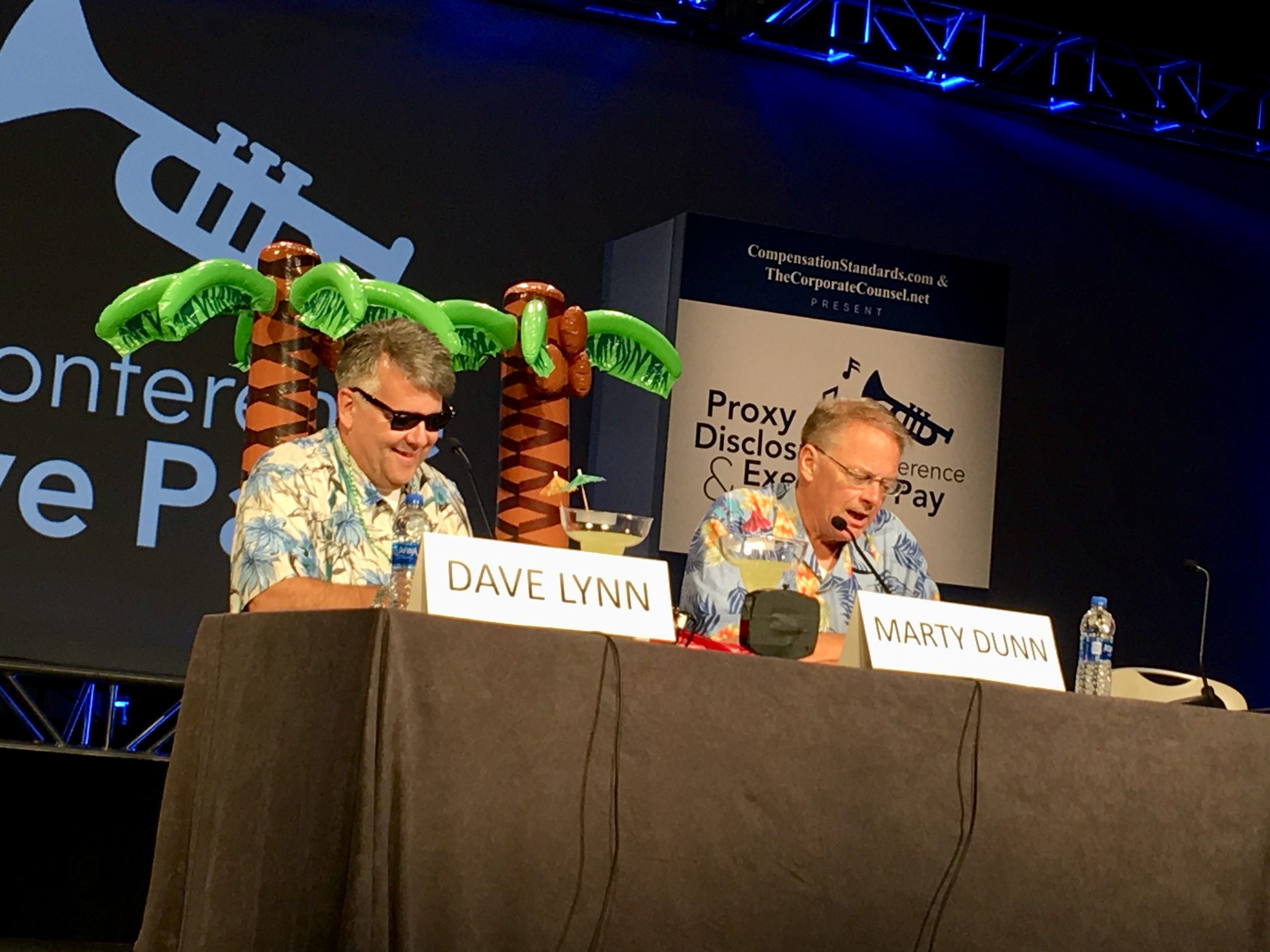
We lost a securities law legend when Marty Dunn passed away on June 15, 2020. Marty was the most recognizable person in the securities bar, having spoken at so many conferences and events for so long that it is impossible to count them all. Marty was also a key contributor to our publications, serving as an Editor of The Corporate Counsel for the past nine years, as a co-host of “The Dave & Marty Radio Show” on TheCorporateCounsel.net and as a panelist, comedian and puppeteer at the annual Proxy Disclosure Conference. Marty loved the securities laws and spent his life sharing that love with others, always seeking to teach us something new, while at the same time making sure that we did not take it all too seriously.
Marty’s wit and good humor was legendary. He always had a funny story or witty retort when speaking on an otherwise dry panel, and audiences loved him for that. For many years, Marty and I would travel around the country, like a pair of securities law troubadours, bringing the Dave and Marty show to conferences and events, although I must admit that it was mostly the Marty show. We had such a great time on those trips. I will treasure those memories forever.
Marty had spent nearly 20 years at the SEC, where he was responsible for many of the SEC’s most significant initiatives on disclosure, governance and capital-raising, including, among many others, reforming the securities offering process, implementing the Sarbanes-Oxley Act, adopting plain English requirements, implementing electronic proxy delivery, and easing capital formation for small businesses. Marty spent his entire government career in his beloved Division of Corporation Finance, where he held several key positions, including Associate Director, Chief Counsel, Deputy Director and Acting Director. Marty truly loved the SEC and Corp Fin. I can distinctly recall sitting in his office, drafting some new rule, interpretation or regulatory relief, and Marty would say, with a mix of amazement and admiration, “We just made that up!” Marty was the best at taking something complex and making it understandable, as well as taking on the most difficult problem and finding a practical solution for it. These skills made him the great teacher, mentor, regulator and counselor that he was.
After leaving the government, Marty was in private practice at O’Melveny & Myers and Morrison & Foerster. Clients and colleagues sought Marty out for his wise counsel and his aforementioned ability to solve difficult problems with practical solutions. I had the pleasure of working with Marty again for the past seven years and we were able to accomplish so much together, but yet we had so much more that we wanted to do. I am going to miss him as a valued friend, mentor and colleague.
Above all else, Marty was a family man. He loved his family so much and he talked about them all the time. Marty is survived by his wife Linda and daughters Emily, Molly and Maggie, as well as many other family members, friends, colleagues and clients who loved him.
– Dave Lynn
“I Like It Like That” – 2019 Proxy Disclosure Conference
Marty, Carrie Darling & Dave at the Del – Feb 2020
Marty Pitching for Corp Fin’s Softball Team – 1989 (part of our Staff photo gallery)
Several years ago, the SEC approved exchange rules requiring the comp committee to review the independence of a comp consultant before retaining that consultant. The requirement was prompted by concerns about how other lucrative services provided to the company might influence the consultant’s advice to the board. But is the potential impairment of consultant independence by fees for other services the right issue to focus on here?
A recent study from the American Accounting Association study suggests that it isn’t. Instead, the study found that the amount of fees the consultant receives for its advice to the comp committee may have a greater influence on its CEO comp recommendations than other services that it provides to the company. This excerpt from the press release announcing the study explains:
The new research suggests that since 2009 the reward to EC consultants for sumptuous CEO pay packages has had less to do with gaining access to additional company services (in other words, with cross-selling) than with securing repeat EC consulting at high fees. Researchers Jeh-Hyun Cho of Arizona State University, Jeong-Hoon Hyun of NEOMA Business School in France, and Iny Hwang and Jae Yong Shin of Seoul National University, Korea, write that among multi-service providers they “find no evidence that CEO pay is higher when non-EC fees are higher, providing no support for the cross-selling hypothesis.”
In contrast, among the same group they “find strong empirical support for the repeat-business hypothesis suggesting that consultants receiving higher EC fees recommend higher total [CEO] compensation in an effort to secure future engagement with clients.”
The study says that for every 1% increase ($1,770) in the average consultant’s fee, CEOs reap an additional $4,474 in pay. The authors suggest that one reason for the link between higher fees and higher comp is that comp consultant fees are rarely a significant issue for the board during the retention process, because the amount is relatively small in the grand scheme of things. In addition, many firms have spun-off executive comp practices from their broader business, effectively taking cross-selling off the table as an area of potential concern.
Financial Reporting: Covid-19’s Ongoing Impact
Last quarter’s financial reporting was a barrel of laughs, wasn’t it? Well, buckle up, because this Deloitte memo says that Covid-19’s ongoing impact may result in a bumpy ride for many companies in the current and future reporting periods as well. The memo addresses some of the key financial reporting issues and accounting topics that are likely to be confronted as the pandemic’s impact continues to play out. This excerpt addresses some of the considerations that come into play when dealing with modifications of revenue contract terms:
Some companies may seek to mitigate the effects of the pandemic by offering features such as price concessions, discounts on the purchase of future goods or services, free goods or services, extended payment terms, extensions of loyalty programs, opportunities to terminate agreements without penalty, or revisions to purchase commitments.
If revisions are made to a revenue contract, significantly different reporting outcomes may result depending on the nature of the changes. Companies must consider the specific facts and circumstances of changes in contractual terms (including their business practices and communications with customers) to determine whether to account for the impact of such changes at a single point in time (e.g., the quarter ended June 30, 2020) or over a longer period.
Other topics addressed include goodwill impairment, valuation of deferred tax assets, and modification of other contractual arrangements.
EDGAR: Get Those Notarized Authentication Docs In!
In March, the SEC adopted a temporary rule allowing EDGAR filers that were unable to obtain notary services due to the Covid-19 crisis to nevertheless obtain access codes if they subsequently submitted notarized authentication documents. Last week, the SEC issued a reminder that filers who relied or plan to rely on the temporary rule between 3/26/20 & 7/1/20 need to submit the required notarized authentication document as correspondence to EDGAR within 90 days of the date they submitted their application for EDGAR access. Failure to do so may result in suspension of EDGAR access.