In April, I blogged about a cert petition seeking SCOTUS review of the SEC’s use of “gag orders” in connection with the settlement of enforcement proceedings. Despite divergent approaches taken by lower courts on the validity of those orders, the Court declined to grant cert in Romeril v. SEC yesterday. This Bloomberg Law article on the Court’s decision notes that the cert petition had the support of two of the SEC’s most vocal foes:
The US Supreme Court Tuesday rejected a challenge—backed by Elon Musk and Mark Cuban—of the SEC’s power to “gag” parties who settle with the agency. The case stems from a challenge by former Xerox Corp. chief financial officer Barry Romeril, who sued for the ability to deny the Securities and Exchange Commission’s fraud allegations after he signed a 2003 settlement with the agency.
Romeril asked the high court to weigh in on whether his SEC deal, including a “no-deny” provision he referred to as a “gag order,” violated First Amendment free speech protections or constitutional guarantees of due process.
Musk, who last week appealed a ruling upholding his own settlement with the agency, joined an April amicus brief in support of Romeril’s petition. Musk’s “Twitter sitter” SEC deal calls for a Tesla Inc. attorney to screen all of his tweets related to the automaker after his 2018 missive indicating he had secured funding to take the company private.
The SCOTUS may have taken a pass on this issue for now, but with lower courts taking different positions on the issue and the willingness of folks like Cuban & Musk to back a fight over it, I doubt we’ve heard the last on the enforceability of SEC gag orders.
I read the SEC’s climate disclosure proposals shortly after they were issued in order to prepare an article for The Corporate Counsel newsletter. As I worked my way through the 500+ page proposing release, it became clear to me that in light of the breathtaking scope of the proposals, companies simply can’t afford to wait to begin preparing for the new disclosure regime. If companies want to avoid the risk of stumbling out of the gate, they need to start to work on their compliance efforts immediately.
We’re eager to get the word out on this and share practical step-by-step guidance. As a follow-up to our April webcast about “first steps” in response to the SEC’s climate disclosure proposal – and as a precursor to PracticalESG.com’s “1st Annual Practical ESG Conference” on October 11th, join PracticalESG.com for a FREE video Climate Disclosure Event about these landmark rules on July 13th at 2:00 pm Eastern. Our experienced panelists – from a variety of industries & backgrounds – will discuss practical steps to take RIGHT NOW in anticipation of the disclosure mandate.
As a bonus, we’ll unveil model disclosure that Lawrence Heim, Dave Lynn and I prepared and discuss the drafting challenges we faced — providing meaningful lessons to anyone looking ahead and preparing.
This Event consists of two one-hour sessions. Our first session, beginning at 2:00 pm Eastern, will cover:
– How to convey to your bosses & colleagues the major differences between this proposal and traditional SEC reporting, and existing ESG disclosures;
– Tips for overcoming the new challenges that this disclosure will create;
– Key steps for companies to take right now to prepare for compliance;
– Former regulators’ perspectives; and
– Lessons learned from preparing our model disclosures.
Hear step-by-step action items from these experienced practitioners:
– Stephanie Bignon – Assistant General Counsel, Delta Airlines
– Meredith Cross – Partner, WilmerHale
– Karen J. Garnett – Managing Director, Head of ESG Policy and Reporting, Charles Schwab & Company
– Denis Jacob – Chief Audit Executive, GE
– Dave Lynn – Partner, Morrison Foerster
Our second session, beginning at 3:00 pm Eastern, will cover:
– ESG data that investors and others want, compared to what’s currently available;
– Types of questions and disclosure reviews companies can expect from regulators;
– How companies can prepare disclosure with an eye towards minimizing questions & risks;
– How asset managers, institutional investors and other external audiences use climate disclosure; and
– A look at our model disclosure and how it anticipates these issues.
This session features:
– Amy Borrus – Executive Director at the Council of Institutional Investors
– Devika Kaul – VP, Asset Stewardship, State Street Global Advisors
– Satyam Khanna – SIEPR Policy Fellow at the Stanford Institute for Economic Policy Research
– Dave Lynn – Partner, Morrison Foerster
– Kosmas Papadopoulos, Executive Director, Head of Sustainability Advisory Services – Americas, ISS Corporate Solutions
To make this event an even bigger value, attendees are eligible for $100 off our 1st Annual Practical ESG Conference AND $200 towards an annual subscription to PracticalESG.com! Email sales@ccrcorp.com or call 1-800-737-1271 to claim this offer.
Register today for this FREE event, and please share it with anyone on your team or in your network who may be interested. That includes ESG, Sustainability & Impact Officers, Environmental Health & Safety Officers, Investor Relations & Public Relations professionals, in-house and outside counsel who are advising boards or preparing disclosures, and anyone involved with ESG strategies and disclosures. To register for this event and learn about our model disclosure, click here.
You may have noticed that our upcoming PracticalESG.com event is a video webcast, so it’s not surprising that given my previously noted “radio face” issues, I’m not going to participate other than as a spectator. However, I did help draft the model disclosures that we’ll unveil there. Lawrence and Dave will share more details about the challenges we faced preparing them, but since I’m not going to be there, I thought I’d share a few of my own thoughts here:
– Shame is the Name of the Game. The disclosures required under the proposed rules are designed to promote a proactive approach to addressing climate change and to shame companies that don’t follow the script by compelling them to make awkward disclosures. For example, proposed Item 1501’s requirement to disclose “whether and how the board of directors sets climate-related targets or goals, and how it oversees progress against those targets or goals, including the establishment of any interim targets or goals” is going to result in uncomfortable disclosure for companies that haven’t established those targets or don’t provide board oversight of progress in attaining them.
– The Boilerplate Potential is High. When disclosure requirements lay out the path that regulators want companies to take and are designed to shame those that don’t, companies tend to follow that path. An unfortunate consequence of that approach is the potential for lemming-like behavior that will likely result in a lot of boilerplate disclosure. And yes, a lot of this stuff lends itself to boilerplate, even though that’s an outcome the Staff says it wants to avoid.
– Item 1502 of S-K may be a Comment Magnet. Companies aren’t the only ones who are going to need to ramp up their expertise on non-traditional topics. The Staff faces that challenge as well, which I think means that in the early years of implementation, new disclosure requirements that are similar to existing ones are likely to be a magnet for Staff comments. Proposed Item 1502, which calls for companies to provide what is essentially a climate-centric MD&A, seems to me to be a prime candidate for Staff comments.
– You Can’t Do This Yourself. The proposed rules will require compliance with extraordinarily granular disclosure requirements dealing with matters that are beyond the expertise of the lawyers and accountants who traditionally take the lead in preparing SEC filings. That means that many companies – even those that currently provide climate disclosure – will need to add capabilities, enhance disclosure controls and procedures, and expand the group responsible for SEC reporting to include people with experience in climate-related disclosures and metrics.
Finally, it’s worth noting that you don’t have to start with a blank piece of paper. In addition to our model disclosure, there are some other disclosure documents out there that can help you start the process. Perhaps the most useful of these are the standalone TCFD reports that many large cap companies put out. Since the proposed rules incorporate a lot of concepts from the TCFD framework, those reports are likely to be quite helpful – check out this example from Microsoft. We’ll be posting additional samples & checklists – along with our model disclosures – on PracticalESG.com.
The May-June issue of “The Corporate Counsel” newsletter is in the mail (email sales@ccrcorp.com to subscribe to this essential resource). It’s also available now online to members of TheCorporateCounsel.net who subscribe to the electronic format – an option that many people are taking advantage of in the “remote work” environment. This issue includes the following articles:
– Considering the Disclosure Implications of the War in Ukraine
– The Trouble with Hyperlinks
– Mandatory Electronic Filing of Form 144 is Here
– EGC Status and Transitions: 10 Frequently Unanswered Questions
Dave & I also have been doing a series of “Deep Dive with Dave” podcasts addressing the topics we’ve covered in recent issues. We’ll be posting one for this issue soon. Be sure to check it out on our “Podcasts” page!
Yesterday, the Senate confirmed the nomination as SEC Commissioners of Jaime Lizárraga, who is currently a Senior Advisor to Speaker of the House Nancy Pelosi and previously served as a presidential appointee at the SEC, and Mark Uyeda, who has been a career attorney with the SEC since 2006. The existing Commissioners published this statement to welcome Jaime & Mark back to the Commission.
Mark replaces former SEC Commissioner Elad Roisman, to serve out the term that expires on June 5, 2023. Jaime replaces SEC Commissioner Allison Herren Lee – whose term expires this month – and his term expires on June 5, 2027.
This confirmation process has moved pretty quickly since President Biden announced the nominations in April. Once the new Commissioners are sworn in, the agency will be back to a full 5-person slate. Commissioner Lee previously announced that she would depart from the SEC once her successor was confirmed.
Does the SEC’s rule proposal on climate disclosure exceed the Commission’s statutory authority? That’s the theory that some have advanced in comment letters and that a recent court decision may portend. But this issue is far from being clear-cut. Here’s the intro from yesterday’s NYT DealBook:
A bipartisan group of 18 former top S.E.C. officials and legal luminaries are standing up for the agency’s power to make rules that require companies to disclose more information about their climate effects and risks. The group includes the former S.E.C. chairs Harvey Pitt, who was appointed by George W. Bush, and Mary Schapiro, who was appointed by Barack Obama, along with top legal experts like Leo Strine Jr., the former chief justice of Delaware’s Supreme Court, and Lucian Bebchuk, a corporate law professor at Harvard.
In a letter to the S.E.C. today, shared exclusively with DealBook, the group urges the agency to ignore claims that climate is a new issue and that it needs explicit permission from Congress to address it now, pointing to a history of S.E.C. rules going back “at least as far as the Nixon administration.”
Regardless of when this rule is adopted and how the eventual legal challenges play out, climate disclosure expectations will continue to march forward. Register today for our free 2-part webcast on July 13th, where we’ll discuss “lessons learned” from drafting model disclosures; practical steps to take right now to prepare for enhanced data collection, validation & communication; and expectations from investors and other stakeholders.
And don’t forget to take advantage of our “Early Bird” rate – which expires today! – and register now for our virtual “Proxy Disclosure & 19th Annual Executive Compensation Conferences.” Former Delaware Chief Justice Leo Strine Jr. is among the experts who will be speaking on ESG disclosures, risks & more. Here are the full agendas – 18 panels over 3 days.
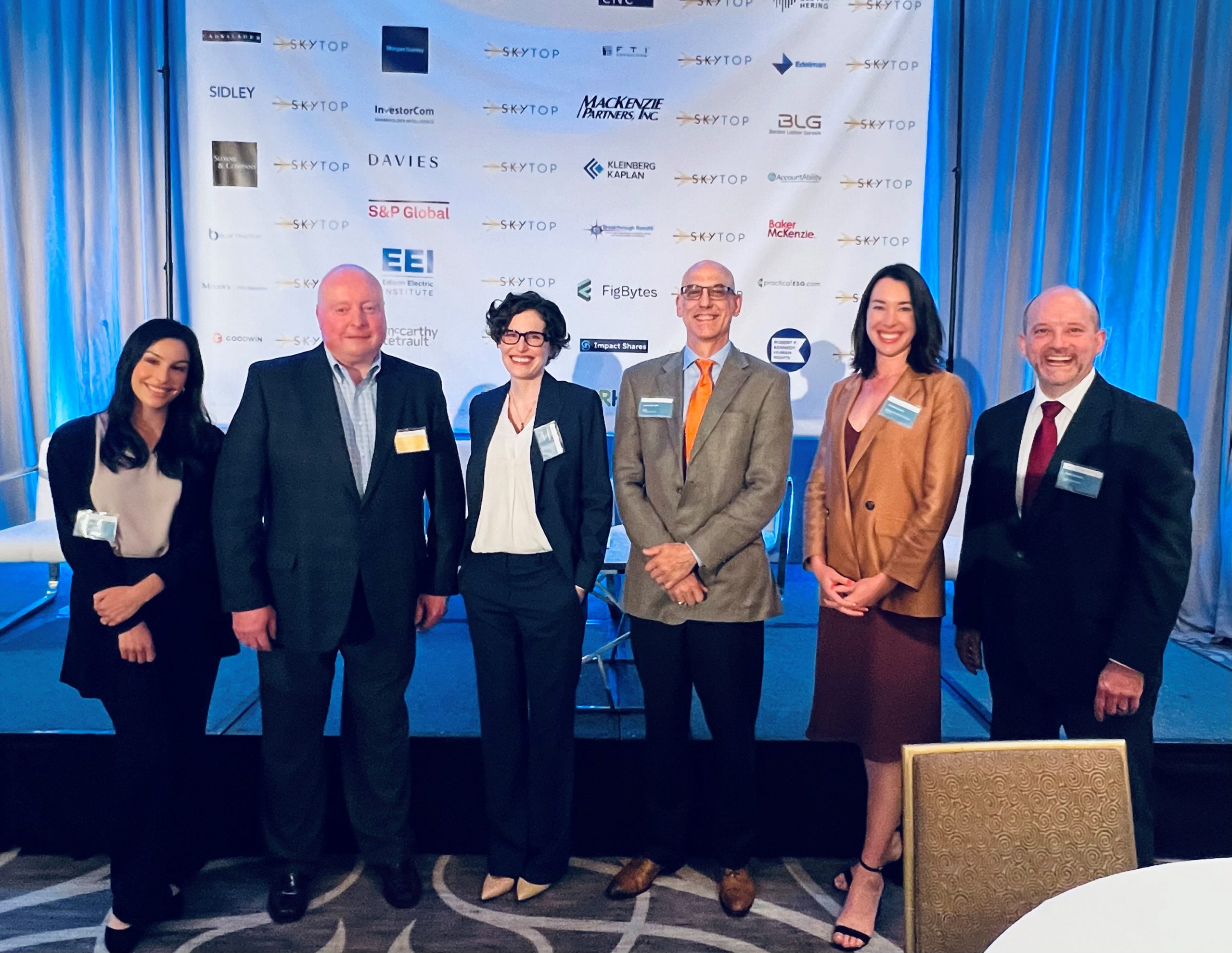
We emerged from our basements and met up this week at the Skytop Strategies “Shareholder Activism ESG Super Summit.” John & Lawrence were part of a fantastic speaker lineup. Here we are, living it up in 3D:
The CCRcorp contingent, L-to-R: Account Exec Kayla Talamantez, John, me, Lawrence, our Event Manager Victoria Newton, our Senior Sales Manager Chris Calaluca.
Pretty wild that many of us had never even met in person before, and it’s been 3 years since John & I have seen each other. It’s his birthday today – and anyone who has read this far should drop him a note to wish him a good one!
Programming note: In observance of Juneteenth, our office will be closed on Monday and we will not be publishing a blog. We will be back on Tuesday!
Yesterday, the SEC announced that it is seeking public comment on the activities of certain “information providers” – such as index providers, model portfolio providers, and pricing services – including whether, under particular facts and circumstances, they are acting as “investment advisers” under the Investment Advisers Act of 1940.
The 32-page request for comment identifies 40 specific questions on which the Commission is seeking feedback, but the SEC welcomes comments on other relevant issues as well. It was accompanied by statements from SEC Chair Gary Gensler and Commissioner Caroline Crenshaw that highlight the growing influence of index providers and model portfolio providers. Chair Gensler noted:
Registered funds that track indexes have grown substantially to over $10 trillion of assets under management. These indexes have grown not only in size but also in available types, ranging from broad-based indexes for general use to specialized, narrowly-focused ones designed for particular users. Having evolved in size and scope, these indexes are increasingly influential. Thus, an index provider’s decision to include a particular security in an index often influences users of the index to purchase or sell securities. This raises questions about whether the index provider is providing investment advice. Model portfolio providers and pricing services have similarly grown and evolved.
This request for comment directly follows a big hubbub over Tesla dropping out of the S&P 500 ESG Index due to a routine rebalancing – which Lawrence blogged about on PracticalESG.com. But this issue has been brewing for years. In 2017, there was a ton of hand-wringing over whether broad-based indexes would exclude companies that had dual-class capital structures. Eventually, BlackRock came out and said that it didn’t think index providers should be wielding such influence. Everyone seemed to fall in line with that position…but the rise of ESG & specialized indexing is bringing the issue back to the fore.
Sure, we’re now in a bear market – but hope springs eternal. IPOs will return – eventually – and Latham’s 148-page guide is a “must read” for anyone getting up to speed on the process. I have always loved how this guide is formatted like an actual prospectus and shares the “secret sauce.” Here’s what it covers:
– Summary (Preliminary Checklist, Pros & Cons, Timeline)
– The IPO Business (Basics, EGCs, Gun-Jumping)
– Financials
– Upsizing & Downsizing
– Specific Issues & Industries (FPIs, MLPs, REITs, Life Sciences)
– FINRA Review Process
– Beginning Life as a Public Company
– Liability Under the US Federal Securities Laws
– IPO Checklist
– NYSE & Nasdaq Listing Criteria & Governance Requirements
– Exchange Act Reporting Requirements
See our “IPOs” Practice Area for more resources – including surveys & memos that delve into specific topics.
We continue to post new items regularly on our “Proxy Season Blog” for TheCorporateCounsel.net members. With shareholder activism, amped-up engagement, and larger numbers of debt holders, “proxy season” now feels like a year-round affair – and this blog covers trends in proposals & engagements, no-action requests, shareholder meeting issues, and more.
Members can sign up to get that blog pushed out to them via email whenever there is a new entry by simply inputting their email address on the left side of that blog. Here are some of the latest entries:
– Icahn’s Animal Welfare Activism Comes to a Close
– Record Support to Eliminate Dual-Class Structures
– Early Returns From ’22 Proxy Season
– Engine No. 1 Makes a U-Turn?
– Shareholders Approve Proposal for Third-Party Human Rights Assessment at Firearms Manufacturer
– Plan for Continued Focus on Diverse Board Composition