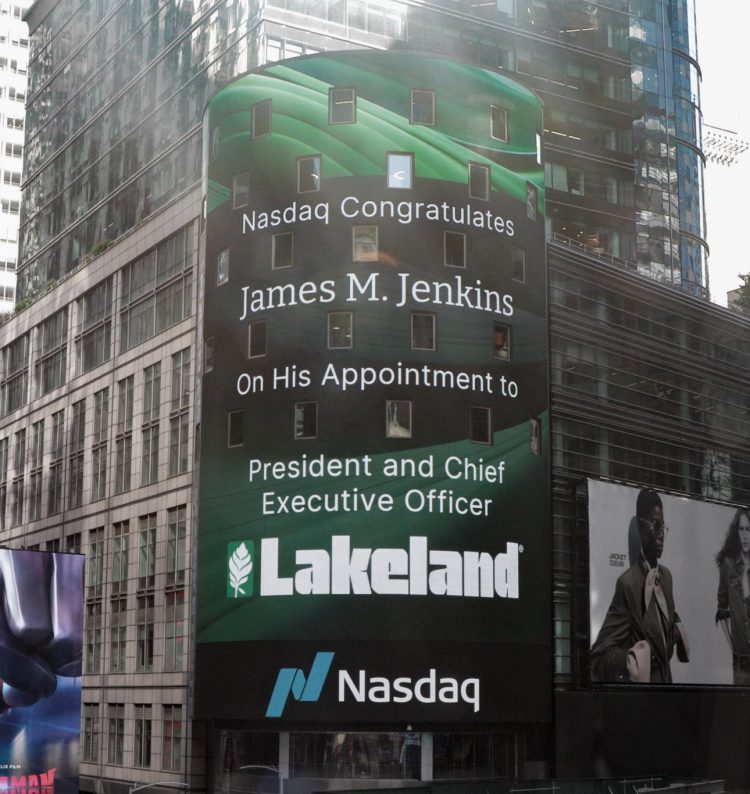
General counsels spend a lot of time in the board room, and many of them – and a lot of other lawyers who advise boards – would like to serve on corporate boards themselves. If you’re one of those people, then this Barker Gilmore blog has some advice for you about how to stand out from the crowd of potential candidates for board seats. I mentioned in a prior blog that the Barker Gilmore folks are from my hometown of Fairport, NY, which reminds me that if you’re interested in finding out how to make the transition from lawyer to public company director & CEO, there’s another Fairport native you could speak with – my brother Jim.
Members of DealLawyers.com may recall that Jim was my first guest on our “Deal Lawyers Download” podcast series, where we discussed, among other things, how he transitioned from law firm partner to GC & Chief Development Officer at a NYSE-listed company. Well, fast forward a couple of years, and Nasdaq’s pumping this video message into Times Square:
Yeah, the guy somehow ended up being appointed Chairman, President & CEO of a public company. This is very typical – I’m the oldest of three brothers, and we’ve always been very competitive with each other, so one-upmanship is a family tradition. For example, when we played high school football, I was All-League, Jim was All-Region, and my youngest brother, Jason, was All-State. So, naturally, when Liz opted to head back to Fredrikson full time & I became managing editor because I was the only full-time editor left, Jim just had to one up me. What about Jason? Well, he’s been the COO of a large private company for several years, so he one-upped me long ago, and I’m sure he has his sights set on Jim. Jason was All-Ivy League in college, so I like his odds.
I guess the dog days of August have officially arrived when the news is so slow that I find myself blogging about Non-Fungible Tokens, or NFTs. But here we are. Anyway, a recent complaint filed in the Eastern District of Louisiana challenges the SEC’s efforts to classify NFTs as securities. The plaintiffs allege that two SEC enforcement actions targeting NFTs on the basis that they are securities under the Howey test put the agency in the business of “determining when art needs to be registered with the federal government before it can be sold.”
The plaintiffs contend that the SEC is all wet when it tries to apply Howey to NFTs. This paragraph of the complaint provides the gist of their argument:
The relationship between a creator of digital artwork and a NFT holder is not meaningfully different from the relationship between any other type of artist and art owner. By acquiring artwork in the form of NFTs, the purchaser does not automatically (or typically) enter any ongoing contractual relationship with the seller or creator of the asset.
While the seller or creator—like Plaintiffs here—may publicly discuss their intentions to continue creating and marketing their art and may use the profits from the NFT sales to financially support themselves and their artistic endeavors, that does not mean that the seller or creator has any ongoing commitment or obligation to undertake any specific action or to manage any common venture for the purchaser’s benefit. Instead, the purchaser possesses and holds the asset outright, albeit perhaps with a subjective hope or belief that the asset will increase in value. Thus, no investment contract exists under the test established by Howey.
That’s an interesting argument, but since we’re dealing with NFTs, you’d expect to see a touch of goofiness to this lawsuit – and it doesn’t disappoint. Let’s meet our plaintiffs:
– The first is songwriter Jonathan Mann, aka “Song a Day Man.” According to the complaint, he’s in the Guiness Book of World Records for writing a song a day every day since January 1, 2009. He’s even written a song commemorating the filing of this lawsuit. Fittingly, it’s called “I’m Suing the SEC.”
– The second is Brian Frye, a professor at UK Law School. Prof. Frye is a true NFT afficionado, and one of his claims to fame is selling a piece of conceptual art called “SEC No-Action Letter Request” as an NFT. In what may be the most meta move of all time, Frye’s letter asked the SEC to opine on whether his plan to sell NFTs of the no-action request to the public constitutes an offering of a security that must be registered under the Securities Act.
We’ll keep an eye on this one. It has the potential to be more entertaining than the usual cases challenging the SEC.
One of this year’s favorite topics among corporate law pundits has been whether Delaware’s century-old dominance as the preferred jurisdiction of incorporation for public companies has been threatened by the alleged increasing unpredictability of the Chancery Court. We’ve spilled a lot of ink on this topic – and the efforts to amend the DGCL to address it – over on the DealLawyers.com blog. But Delaware’s status is a topic that isn’t relevant only to M&A lawyers, so I thought a recent article by UCLA’s Stephen Bainbridge titled “DExit Drivers: Is Delaware’s Dominance Threatened?” was worth sharing here.
Prof. Bainbridge looks at the recent sound & fury about Delaware and concludes that a mass exodus of corporations is pretty unlikely. Here’s the abstract:
For over a century, Delaware has led the corporate law landscape, though it has not been without competitors. States such as Georgia, Maryland, New Jersey, Ohio, Pennsylvania, Tennessee, and Virginia have attempted to rival Delaware, attracted by its significant tax revenue from incorporations. Today, Nevada emerges as a notable challenger, actively promoting “DExit”-a push for companies to leave Delaware. Consequently, this analysis primarily examines the choice between Delaware and Nevada.
Widespread discussion of the potential for mass DExit was triggered by recent criticisms from business leaders and prominent corporate lawyers. While such complaints have not yet triggered a mass exodus from Delaware, many firms are reportedly considering changing their corporate domicile. But is Delaware’s dominance genuinely at risk? Are these just isolated incidents or signs of a broader trend?
This article provides both an empirical and a qualitative analysis of firms that reincorporated from Delaware to another state between 2012 and 2024. It analyzes these firms based on size, filing status, and new state, along with their stated motivations.
The data suggest two main conclusions. First, almost all reasons given for reincorporation seem implausible. If DExit becomes more frequent, plaintiff lawyers should scrutinize these disclosures, particularly focusing on enhanced liability protections for controllers, directors, and officers, suggesting possible conflicts of interest requiring entire fairness review. Second, the number of reincorporations from Delaware remains minimal compared to the vast number of new incorporations Delaware attracts annually. Given the strong inertia behind the initial incorporation decision and the weak drivers for DExit, it is unlikely to become widespread soon.
One threat that the article doesn’t address is the idea that private equity and venture capital investors might be spooked by recent Delaware case law impinging on their ability to exercise post-IPO control and therefore decide to incorporate startups in jurisdictions perceived to be more friendly to controlling stockholders. However, that argument seems less compelling following the recent DGCL amendments, which become effective today.
I’m a big movie fan, so one of the things I love to do when I travel is visit the locations used in classic films shot in the city I’m visiting. For instance, my wife and I were in Vienna last year, and I dragged the poor woman across the city visiting sites of some of the iconic scenes in one of my all-time favorite films, “The Third Man.” These included the Vienna Riesenrad (Ferris Wheel), where the famous “Cuckoo clock” scene was shot, and the doorway of Schreyvogelgasse 8, where Harry Lime first appeared.
This October, my wife is accompanying me to San Francisco for our conferences. I’m very excited to be back in San Francisco for the first time in several years. My wife is too, or at least she was, until she found out my plans for our pre-conference itinerary.
Among its many other charms, The City by the Bay has served as a location for many classic movies, and I plan to spend time visiting some of the sites where two of my favorite SF filmed movies, “Vertigo” and “Bullitt“, were shot. Another of my favorite films set in San Francisco, “The Maltese Falcon”, wasn’t actually filmed there, so I’ll have to content myself with wandering around “Sam Spade’s San Francisco”, and visiting some of the places referenced in Dashiell Hammett’s novel.
It looks like a bipartisan consensus is emerging that the SEC should lighten up on crypto, but it would be a lot easier for me to buy into that position if the crypto bros would just dial back the whole fraud thing a little bit. Here’s an excerpt from the SEC’s announcement of its latest fraud-based enforcement proceeding against a prominent player in the crypto ecosystem:
The Securities and Exchange Commission today charged Nader Al-Naji with perpetrating a multi-million-dollar fraudulent crypto asset scheme involving a social media platform called BitClout and its native token of the same name (herein, “BTCLT”).
According to the SEC’s complaint, starting in November 2020, Al-Naji raised more than $257 million from unregistered offers and sales of BTCLT, while falsely telling investors that proceeds would not be used to compensate him or other BitClout employees. In reality, the complaint alleges, Al-Naji spent more than $7 million of investor funds on personal expenditures like rental payments for a Beverly Hills mansion and extravagant cash gifts to family members.
The SEC’s complaint further alleges that, to avoid regulatory scrutiny, Al-Naji portrayed BitClout as a decentralized project with “no company behind it … just coins and code,” and launched the project using the pseudonym “Diamondhands” to further create the illusion that the project was autonomous when he was actually behind the project. In addition, Al-Naji allegedly secured a letter from a prominent law firm opining, based on his mischaracterizations of the nature of his project, that BTCLT were not likely to be deemed securities under federal law. At the same time, Al-Naji allegedly secretly told certain investors that he was engaged in this subterfuge to avoid compliance with the law.
The SEC complaint charges Al-Naji with violating the registration and anti-fraud provisions of the Securities Act & the anti-fraud provisions of Exchange Act, and its press release says that the US Attorney for the SDNY has also filed criminal charges.
Ideagen/Audit Analytics recently released its annual study of financial restatements. The study provides data on restatements from 2004 through 2023, and the topics addressed include the number of Big R & Little r restatements, the average length of the restatement period, the impact of restatements on previously reported income, the filer status of companies that have restated results, and a breakdown of restatements by industry. Here are some of the highlights from the study’s discussion of the type of accounting errors that have prompted restatements:
– Seven of the top 10 most common issues cited in restatements since 2004 can also be seen in the top 10 issues for 2023. Inventory, vendor and cost of sale issues as well as consolidation issues, appear as top issues for 2023 but not for the 20-year period. Consolidation issues in 2023 included joint ventures, non-controlling interests, variable interest entities and foreign exchange translations.
– Overall, issues related to debt and/or equity accounts continue to be the most common accounting issues cited in financial restatements. This issue was tagged in 27% of all restatements since 2004, totaling 4,624 restatements. It’s notable that the SPACs alone have contributed to almost 1,100 of these citations over the years.
– Debt and equity securities continues to be the most common restatement issue, constituting 21% of all issues in 2023. In 2021, the debt and equity securities issue was associated with 81% of all restatements, largely due to the SPAC boom. This massive spike in debt and equity securities consequently created sharp declines for the remaining issues.
– Since 2021, revenue recognition, expense recording, liabilities and accruals and cash flow classifications issues have all rebounded from 2-3% to 10-16% in 2023.
The study notes that even after excluding the impact of the SPAC warrant mess, debt and equity issues have occurred more frequently than any other issue in restatements over the past 20 years. Debt and equity issues accounted for 35% of all Big R restatements from 2004-2023, while revenue recognition (15%), M&A issues (12%), deferred, stock-based and/or executive comp (11%) and liabilities, payables, reserves and accrual estimates (11%) round out the top five reasons for Big R restatements.
This Freshfields blog discusses the recent federal jury verdict against Chiquita Brands holding the company liable for financing a Colombian paramilitary group. The blog is a reminder that violations of the FCPA are far from the only risks facing companies with foreign operations. It reviews three specific statutes that can provide a basis for imposing liability for companies doing business in troubled parts of the world. The statutes are the Anti-Terrorism Act (ATA), the Alien Tort Statute (ATS) and the Torture Victim Protection Act (TVPA).
The blog discusses recent litigation arising under the statutes, and this excerpt highlights the need for good practices and the potentially staggering damages companies can face under these statutes and under local law:
As companies continue to work and expand their operations abroad, the Chiquita verdict and other litigations serve as an important reminder of the exposure that corporations may face for their international operations. Companies should therefore review their business practices in foreign jurisdictions and take steps to limit exposure. Good practices will likely include conducting risk assessments, implementing strengthened due diligence procedures, exercising caution when choosing counterparties, and identifying and addressing potential red flags in transactions.
Corporations should also be aware that conducting business in particular regions may drastically increase an entity’s likelihood of facing an ATA, ATS, or TVPA litigation. As the Chiquita decision shows, juries in such litigations may award sizable damages awards that might outweigh the benefits of operating in these areas—dramatically altering a corporation’s cost-benefit analysis. Going forward, operating in these regions could expose a company to millions, if not billions, of dollars in damages.
The blog also cautions that although the Chiquita verdict itself resulted from claims arising under Colombian law, it represents the first time that an American jury has held a major US corporation liable for human rights abuses in another country and may open the door to similar lawsuits under these statutes.
In the the latest issue of his “Audit Committee & Audit Oversight Update”, Dan Goelzer notes a new study that concludes that the SEC & investors don’t put a lot of trust into companies that use “trust words”. Here’s how Dan summarizes the study’s findings:
The authors counted the number of times 21 trust words appeared in the MD&A section of 3,595 reporting company Form 10-Ks from 1995 to 2018. The 21 words were: accountability, character, ethics, ethical, ethically, fairness, honest, honesty, integrity, respect, respected, respectful, responsible, responsibility, responsibilities, transparency, trust, trusted, truth, virtue, and virtues. About half of the sample used the trust words and the mean value of the number of trust words used was 1.8.
Study findings include:
– Market reaction to earnings announcements is lower for companies using trust words than for those that do not. This suggests “that the use of trust words is negatively associated with the information content of earnings.”
– “Lower ability managers” are more likely to use trust words.
– Companies that use trust words are more likely to receive comment letters from the SEC, and these comment letters are likely to raise accounting issues.
– Companies using trust words tend to pay higher audit fees. “Our result suggests that auditors assess higher audit risk or/and exert greater audit effort for firms using trust words in 10-Ks., suggesting higher audit risk for these firms.”
– There is a negative relation between the use of trust words and corporate social responsibility scores.
I don’t think any of these findings comes as a surprise – although I bet the one about “lower ability managers” is gonna leave a mark on a few management teams! I’ve always thought that the more cringeworthy a company’s investor communications are, the more reason people have to be skeptical about it. Anyway, Dan says that the study’s bottom line is that “firms using trust words tend to invite more scrutiny from investors, the SEC, auditors, and others. Thus, the use of trust words seems to reflect the opposite of a firm’s culture of trust.”
If you’ve ever been involved in changing a company name, you know what a hassle it can be. In addition to all the state law filings you’ll need to make, there’s a bunch of other stuff you’ll need to update. If you work for a financial institution, you’ll also have to put up with snide comments from your friends because the company likely will have changed its name from something very respectable (if a bit stodgy) to something that sounds like it should be the name of a new prescription drug for toe fungus.
Public companies changing their names have to deal with all of this and also sort out what they need to do with the SEC to properly address the name change. That’s where this recent Perkins Coie blog can be quite helpful. It identifies seven things that public companies need to do when changing their name, including the actions they need to take with the SEC. This excerpt addresses what you’ll need to do to update the company’s information on EDGAR:
While easy to overlook, you’ll need to change the company’s name on the SEC’s EDGAR database. You need to go to the SEC’s “Maintain and update company information” page and jump down to the “Editing company information” section and follow the detailed steps to make the address change.
You’ll make the request for this online through the EDGAR Filing Website or the OnlineForms Management Website. Your company name change must be reviewed and approved by the SEC’s EDGAR Staff, which can take a few days. So, bake that into your timeline.
Once accepted by the SEC staff, the updated name won’t appear on EDGAR until you make your first filing subsequent to that. After you do make that first subsequent filing, when people search EDGAR using your old name, the new name will pop up.
Note that your old company name will show up at the top of your company’s filing history on EDGAR after the name changes. For example, see the two former names listed beneath this company’s name on its EDGAR page.
Other SEC-related issues associated with a name change that are addressed by the blog include whether the company will need to file a preliminary proxy statement if it needs shareholder approval for the name change, the need to update the cover page of future filings to reflect any change in a CUSIP number or trading symbol, and 8-K and exhibit filings triggered by the name change.
A few weeks ago while I was surfing the Internet, I stumbled across a very helpful new tool for tracking SEC filings developed by Emory Law School Prof. Andrew Jennings. The tool is called KFilings, and it allows users to get email alerts for relevant new filings that pop up in the SEC’s EDGAR system. Users can create unlimited free alerts for one or more registrants and/or filing types. Alerts can be scheduled to go out in real time, or in daily or weekly email digests. Check it out, because the price is sure right!