As we reach the end of another tough week, I thought this Law.com article about the results of a recent ACC poll on lawyer wellness was worth noting. This may come as a surprise to you, but dealing with a pandemic, quarantine, economic collapse, civil unrest, job security & health worries, Zoom fatigue & unpaid second jobs as homeschool teachers is apparently stressful:
Nearly 50% reported “feeling tired or having little energy” while also having trouble sleeping. More than 43% were experiencing anxiety; 40% had trouble concentrating; nearly 22% reported an “increased use of substances,” such as alcohol and tobacco; and nearly 19% said they’d been depressed. Nearly 44% had anxiety. Unsurprisingly, nearly 50% of respondents reported having trouble switching off from work and nearly 75% were experiencing moderate to very high levels of burnout.
The good news is that 88% of respondents are – like you & me – working from home, which means that we can all enjoy our mental and emotional collapses in our slippers. So, if you’re finding this time to be a tough slog, know that you aren’t alone, and take comfort in the knowledge that human beings can be remarkably resilient creatures, even under the most trying conditions.
I’ll give you an example. During the Falklands War, the H.M.S. Sheffield was sunk by an Argentine missile. That would be enough to ruin anybody’s day, but nevertheless, as the survivors waited for rescue in the ship’s life boats, they sang “Always Look on the Bright Side of Life” from Monty Python’s “Life of Brian.” Since then, the song has become a bit of a tradition among British forces when the chips are down.
We can learn a thing or two from the Royal Navy – after all, they figured out scurvy, right? When things are bad, look for some pleasant distractions to help lighten the load. I highly recommend a nice long daily walk if your schedule & surroundings permit, but I’ve found a few other things during the current troubles that have brought a smile to my face.
For instance, there’s Sponge Bob in box seats at a South Korean baseball game, Vogue’s guide to face mask fashions, and the delightful feeling of schadenfreude that comes from seeing so many people learn the hard way that the “unmute” option on Zoom has the same catastrophic potential as the “reply all” option to an email. I also discovered that religious services are best experienced while reclining in a La-z-boy, & that, if you throw in Peyton Manning & Charles Barkley, anything – even golf – can be interesting to watch. Also, I make a heck of an almond flour banana bread now.
This isn’t much in the face of pestilence, economic turmoil & civil unrest, but these are the kind of small consolations that will get us through – at least until the Visigoths show up. You folks are on your own when that happens, but until then, always look on the bright side of life.
SEC Nominee: Caroline Crenshaw
Yesterday, the White House announced that President Trump would nominate veteran SEC senior counsel Caroline Crenshaw for the Democratic seat on the SEC that was vacated by Rob Jackson’s departure. She joined the agency in 2013 and has served in several capacities, including counsel to commissioners Stein and Jackson.
May-June Issue of “The Corporate Executive”
We’ve wrapped up the May-June issue of The Corporate Executive – and will be mailing it soon! It’s available now electronically to members of TheCorporateCounsel.net who also subscribe to the print newsletter at each of their locations (try a no-risk trial). This issue includes pieces on:
– The Impact of COVID-19 on Executive Compensation
– ISS and Glass Lewis Voting Policy Changes Due to COVID-19
– New Proposed Regulations under Internal Revenue Code Section 162(m)
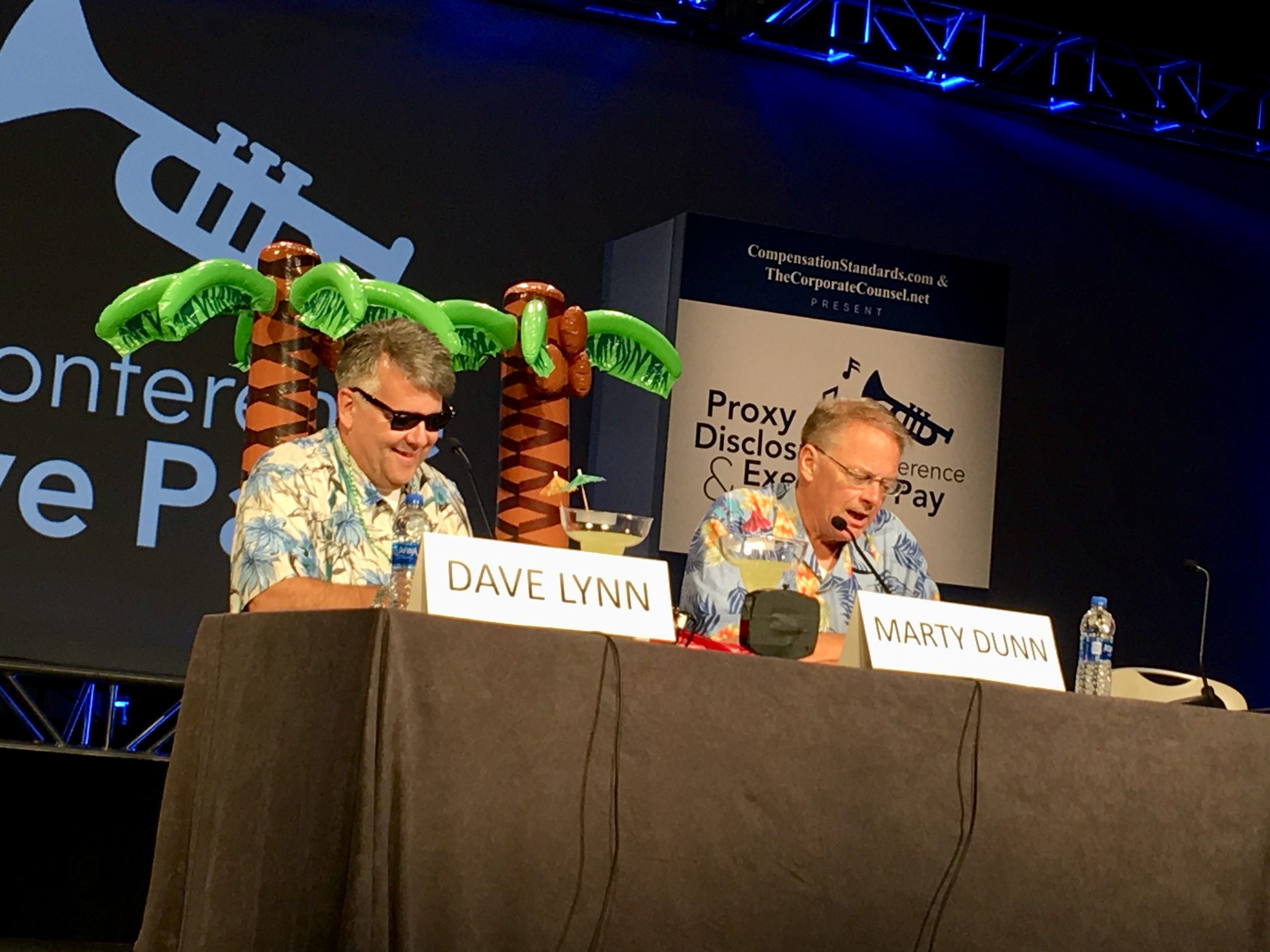
We lost a securities law legend when Marty Dunn passed away on June 15, 2020. Marty was the most recognizable person in the securities bar, having spoken at so many conferences and events for so long that it is impossible to count them all. Marty was also a key contributor to our publications, serving as an Editor of The Corporate Counsel for the past nine years, as a co-host of “The Dave & Marty Radio Show” on TheCorporateCounsel.net and as a panelist, comedian and puppeteer at the annual Proxy Disclosure Conference. Marty loved the securities laws and spent his life sharing that love with others, always seeking to teach us something new, while at the same time making sure that we did not take it all too seriously.
Marty’s wit and good humor was legendary. He always had a funny story or witty retort when speaking on an otherwise dry panel, and audiences loved him for that. For many years, Marty and I would travel around the country, like a pair of securities law troubadours, bringing the Dave and Marty show to conferences and events, although I must admit that it was mostly the Marty show. We had such a great time on those trips. I will treasure those memories forever.
Marty had spent nearly 20 years at the SEC, where he was responsible for many of the SEC’s most significant initiatives on disclosure, governance and capital-raising, including, among many others, reforming the securities offering process, implementing the Sarbanes-Oxley Act, adopting plain English requirements, implementing electronic proxy delivery, and easing capital formation for small businesses. Marty spent his entire government career in his beloved Division of Corporation Finance, where he held several key positions, including Associate Director, Chief Counsel, Deputy Director and Acting Director. Marty truly loved the SEC and Corp Fin. I can distinctly recall sitting in his office, drafting some new rule, interpretation or regulatory relief, and Marty would say, with a mix of amazement and admiration, “We just made that up!” Marty was the best at taking something complex and making it understandable, as well as taking on the most difficult problem and finding a practical solution for it. These skills made him the great teacher, mentor, regulator and counselor that he was.
After leaving the government, Marty was in private practice at O’Melveny & Myers and Morrison & Foerster. Clients and colleagues sought Marty out for his wise counsel and his aforementioned ability to solve difficult problems with practical solutions. I had the pleasure of working with Marty again for the past seven years and we were able to accomplish so much together, but yet we had so much more that we wanted to do. I am going to miss him as a valued friend, mentor and colleague.
Above all else, Marty was a family man. He loved his family so much and he talked about them all the time. Marty is survived by his wife Linda and daughters Emily, Molly and Maggie, as well as many other family members, friends, colleagues and clients who loved him.
– Dave Lynn
“I Like It Like That” – 2019 Proxy Disclosure Conference
Marty, Carrie Darling & Dave at the Del – Feb 2020
Marty Pitching for Corp Fin’s Softball Team – 1989 (part of our Staff photo gallery)
Several years ago, the SEC approved exchange rules requiring the comp committee to review the independence of a comp consultant before retaining that consultant. The requirement was prompted by concerns about how other lucrative services provided to the company might influence the consultant’s advice to the board. But is the potential impairment of consultant independence by fees for other services the right issue to focus on here?
A recent study from the American Accounting Association study suggests that it isn’t. Instead, the study found that the amount of fees the consultant receives for its advice to the comp committee may have a greater influence on its CEO comp recommendations than other services that it provides to the company. This excerpt from the press release announcing the study explains:
The new research suggests that since 2009 the reward to EC consultants for sumptuous CEO pay packages has had less to do with gaining access to additional company services (in other words, with cross-selling) than with securing repeat EC consulting at high fees. Researchers Jeh-Hyun Cho of Arizona State University, Jeong-Hoon Hyun of NEOMA Business School in France, and Iny Hwang and Jae Yong Shin of Seoul National University, Korea, write that among multi-service providers they “find no evidence that CEO pay is higher when non-EC fees are higher, providing no support for the cross-selling hypothesis.”
In contrast, among the same group they “find strong empirical support for the repeat-business hypothesis suggesting that consultants receiving higher EC fees recommend higher total [CEO] compensation in an effort to secure future engagement with clients.”
The study says that for every 1% increase ($1,770) in the average consultant’s fee, CEOs reap an additional $4,474 in pay. The authors suggest that one reason for the link between higher fees and higher comp is that comp consultant fees are rarely a significant issue for the board during the retention process, because the amount is relatively small in the grand scheme of things. In addition, many firms have spun-off executive comp practices from their broader business, effectively taking cross-selling off the table as an area of potential concern.
Financial Reporting: Covid-19’s Ongoing Impact
Last quarter’s financial reporting was a barrel of laughs, wasn’t it? Well, buckle up, because this Deloitte memo says that Covid-19’s ongoing impact may result in a bumpy ride for many companies in the current and future reporting periods as well. The memo addresses some of the key financial reporting issues and accounting topics that are likely to be confronted as the pandemic’s impact continues to play out. This excerpt addresses some of the considerations that come into play when dealing with modifications of revenue contract terms:
Some companies may seek to mitigate the effects of the pandemic by offering features such as price concessions, discounts on the purchase of future goods or services, free goods or services, extended payment terms, extensions of loyalty programs, opportunities to terminate agreements without penalty, or revisions to purchase commitments.
If revisions are made to a revenue contract, significantly different reporting outcomes may result depending on the nature of the changes. Companies must consider the specific facts and circumstances of changes in contractual terms (including their business practices and communications with customers) to determine whether to account for the impact of such changes at a single point in time (e.g., the quarter ended June 30, 2020) or over a longer period.
Other topics addressed include goodwill impairment, valuation of deferred tax assets, and modification of other contractual arrangements.
EDGAR: Get Those Notarized Authentication Docs In!
In March, the SEC adopted a temporary rule allowing EDGAR filers that were unable to obtain notary services due to the Covid-19 crisis to nevertheless obtain access codes if they subsequently submitted notarized authentication documents. Last week, the SEC issued a reminder that filers who relied or plan to rely on the temporary rule between 3/26/20 & 7/1/20 need to submit the required notarized authentication document as correspondence to EDGAR within 90 days of the date they submitted their application for EDGAR access. Failure to do so may result in suspension of EDGAR access.
Do you remember that “South Park” episode that aired during the financial crisis in which one of the characters deposits a $100 birthday check from his grandmother into the bank? The banker takes the money, “puts it to work” in a mutual fund and immediately announces “. . . and it’s gone!” That episode was the first thing that came to mind when I read this risk factor language in Hertz’s pro supp for a $500 million ATM offering launched in the midst of its Chapter 11 bankruptcy proceeding:
Although we cannot predict how our common stock will be treated under a plan, we expect that common stock holders would not receive a recovery through any plan unless the holders of more senior claims and interests, such as secured and unsecured indebtedness (which is currently trading at a significant discount), are paid in full, which would require a significant and rapid and currently unanticipated improvement in business conditions to pre-COVID-19 or close to pre-COVID-19 levels.
That’s pretty bleak disclosure, and nobody can say they weren’t warned about the perils of this investment. Even so, Hertz’s decision to tap the public equity market – which the bankruptcy court approved last Friday – in its current financial state definitely raises the bar when it comes to corporate chutzpah. On the other hand, can you blame the company for trying to capitalize on the recent speculative frenzy in its stock in order to increase the size of its bankruptcy estate?
If “Davey the Day Trader” & the gang are willing to sign up to buy stock that the company is basically telling them is worthless, then maybe instead of South Park, I ought to cite 1920s speakeasy impresario Texas Guinan, who famously welcomed her customers by exclaiming, “Hello suckers! C’mon in and leave your wallets at the bar!”
IPOs: Virtual Road Shows On the Rise
The grueling, globe-trotting – “if it’s Tuesday this must be Zurich” – road show process has long been a big part of the IPO experience for management teams & their bankers. In the Covid-19 era, however, this PitchBook article says that virtual road shows may become the “new normal”:
Virtual IPO roadshows likely are here to stay after the pandemic, said Andreas Bernstorff, head of equity capital markets at BNP Paribas. BNP was one of the lead bankers for Peet’s €2.25 billion (around $2.55 billion) IPO on Euronext in May. Bernstorff acknowledged that sizing up a founder or its executives can be more difficult through video without making eye contact or reading body language.
Nevertheless, he said, virtual roadshows have exposed inefficiencies in the IPO process.
“The benefits are obviously avoiding traveling around the world, but also the fact that it can be a faster and more efficient way to reach more investors,” Bernstorff said. “It also has a very distinct benefit of being able, up to a degree, to shorten the period in which one needs to be in the market.”
The article says that fully virtual road shows may not make sense for all issuers. Companies with a low profile and those that operate in volatile markets will likely continue to find it necessary to meet in-person with key investors as part of the marketing process.
Will CLOs Turn the Covid-19 Crisis into a Full Blown Financial Crisis?
If you find yourself sleeping too soundly, check out this article from the July issue of The Atlantic. The article says that collateralized loan obligations, or CLOs, share many similarities with the CDOs that nearly tanked the global financial system a decade ago – and the balance sheets of major banks are full of them.
The problem is that these AAA rated pieces of paper are comprised of a bunch of low-quality corporate debt, and the rash of bankruptcy filings expected in the wake of the pandemic may well upset the applecart when it comes to the default rate assumptions on which those investment grade ratings were based. What’s the worst “worst case” scenario? According to the article, it’s very, very bad.
We’ve just added Bill Hinman – Director of the SEC’s Division of Corporation Finance – as another top-notch speaker at our popular conferences – the “Proxy Disclosure Conference” & “17th Annual Executive Compensation Conference” – which will now be held entirely virtually, September 21-23rd. We’ve offered a Live Nationwide Video Webcast for our conferences for years – one of the only events to do so – and we’re excited to build on that platform and make your digital experience better than ever. Act now to get an “early bird” discount – here’s the registration information. Here are the agendas – 18 panels over three days.
Among the panels are:
– Bill Hinman Speaks: The Latest from the SEC
– The SEC All-Stars: A Frank Pay Disclosure Conversation
– The SEC All-Stars: Q&A
– Pay-for-Performance: What Matters Now
– Pay-for-Performance: Q&A
– Directors in the Crosshairs: Pay, Diversity & More
– Dave & Marty: True or False?
– Pay Ratio: Latest Developments
– 162(m): Where Things Stand
– Clawbacks: What to Do Now
– Dealing with the Complexities of Perks
– How to Handle Negative Proxy Advisor Recommendations
– Human Capital: The Compensation Committee’s Role
– The Big Kahuna: Your Burning Questions Answered
– The SEC All-Stars: The Bleeding Edge
– The Top Compensation Consultants Speak
– Navigating ISS & Glass Lewis
– Hot Topics: 50 Practical Nuggets in 60 Minutes
PPP Loans: Media Giants Seek to Compel Disclosure of Borrowers
A lawsuit filed last week by The Washington Post, Bloomberg, The New York Times, Dow Jones and Pro Publica in a D.C. federal court seeks an order compelling the SBA to produce that information pursuant to outstanding FOIA requests submitted by the companies. The SBA has been slow-walking these requests, and Treasury Secretary Steve Mnuchin recently said that the identities of PPP borrowers won’t be disclosed. He appears to be hanging his hat on Exemption 4 from FOIA.
I guess we’ll see. I’m no FOIA expert, but if the question is whether information about the identity of a private borrower & loan amount are required to be disclosed under a FOIA request, the answer that I’ve seen from lawyers who’ve looked at the issue is yes, that information must be disclosed.
Transcript: “Politcal Spending – What Now?”
We have posted the transcript for our recent webcast: “Political Spending – What Now?”
Late Wednesday, the Senate unanimously passed the House version of the Paycheck Protection Flexibility Act, which President Trump is expected to sign into law. Among other things, the legislation extends the period during which PPP loans may be spent from eight to 24 weeks, and decreases the percentage of the loan that must be spent on payroll from 75% to 60%. This excerpt from a Journal of Accountancy article highlights some of the law’s key provisions:
– Current PPP borrowers can choose to extend the eight-week period to 24 weeks, or they can keep the original eight-week period. New PPP borrowers will have a 24-week covered period, but the covered period can’t extend beyond Dec. 31, 2020. This flexibility is designed to make it easier for more borrowers to reach full, or almost full, forgiveness.
– Under the language in the House bill, the payroll expenditure requirement drops to 60% from 75% but is now a cliff, meaning that borrowers must spend at least 60% on payroll or none of the loan will be forgiven. Currently, a borrower is required to reduce the amount eligible for forgiveness if less than 75% of eligible funds are used for payroll costs, but forgiveness isn’t eliminated if the 75% threshold isn’t met. Rep. Chip Roy (Texas), who co-sponsored the bill in the House, said in a House speech that the bill intended the sliding scale to remain in effect at 60%. Senators Marco Rubio and Susan Collins indicated that technical tweaks could be made to the bill to restore the sliding scale.
– Borrowers can use the 24-week period to restore their workforce levels and wages to the pre-pandemic levels required for full forgiveness. This must be done by Dec. 31, a change from the previous deadline of June 30.
– The legislation includes two new exceptions allowing borrowers to achieve full PPP loan forgiveness even if they don’t fully restore their workforce. Previous guidance already allowed borrowers to exclude from those calculations employees who turned down good faith offers to be rehired at the same hours and wages as before the pandemic. The new bill allows borrowers to adjust because they could not find qualified employees or were unable to restore business operations to Feb. 15, 2020, levels due to COVID-19 related operating restrictions.
In addition, existing PPP loans – which originally had two year terms – may be extended to five years if the lender & borrower agree, and new PPP borrowers will have five years to repay their loans. The interest rate on PPP loans remains at 1%. PPP borrowers may also delay payment of their payroll taxes, which the CARES Act prohibited. The deadline to apply for PPP loans remains June 30th.
“Cha-Ching!” Whistleblower Hits for $50 Million
You know who isn’t going to need a PPP loan? The lucky individual who just hit the SEC’s whistleblower jackpot to the tune of nearly $50 million. This excerpt from the SEC’s press release announcing the award points out that it’s the largest in the whistleblower program’s history:
The Securities and Exchange Commission today announced a nearly $50 million whistleblower award to an individual who provided detailed, firsthand observations of misconduct by a company, which resulted in a successful enforcement action that returned a significant amount of money to harmed investors. This is the largest amount ever awarded to one individual under the SEC’s whistleblower program. The next largest is a $39 million award to an individual in 2018. Two individuals also shared a nearly $50 million whistleblower award that same year.
Here’s the SEC’s award order. As usual, all the good parts have been redacted, but this WSJ article has the details. The order indicates that another claimant sought a cut of the award, but the SEC shot that person’s claim down. Well, I guess we can’t all be winners. Personally, I think somebody like this should at least get some lovely parting gifts – you know, like Rice-a-Roni or a case of Turtle Wax – for playing the whistleblower game.
“What Then Must We Do?”
There’s a great scene in “The Year of Living Dangerously” in which photographer Billy Kwan takes journalist Guy Hamilton to witness the suffering of the poor in the slums of Jakarta. As they survey the scene, Kwan asks the question raised in St. Luke’s Gospel, “what then must we do?” Echoing John the Baptist’s response, Kwan’s answer is, “Don’t think about the major issues. You do what you can about the misery in front of you. You add your light to the sum of all light.”
As we end this week, I think many of us are asking Billy Kwan’s question. I thought about that when I read this article that a member passed along from the Yale School of Management about how white managers can respond to anti-black violence. It provides some suggestions about actions we can take in our own businesses to help make them places that aren’t just “non-racist,” but actively “anti-racist.” You may not agree with everything the author has to say, but engaging with these issues on our own turf is the first step in following Billy Kwan’s advice.
A recent Univ. of Georgia B-School study says that when it comes to maximizing the value of equity awards, corporate executives seem to never waste a crisis. Here’s an excerpt from a recent article discussing the study:
A recent study from management researchers at the University of Georgia Terry College of Business found a pattern of executives issuing negative press releases about their companies before their scheduled stock option grants. The practice, which is seen as unethical and sometimes illegal, allows the executives to increase their compensation by temporarily driving down the price of the stock when they are given the options.
“We can’t say with certainty that a given CEO is doing this,” said Tim Quigley, who studies CEO behavior and effectiveness at UGA’s Department of Management. “But we can look at the population and say, these trends would be very unlikely if a large number of CEOs were not purposely working to reduce the stock price before their option grants.”
If this sounds familiar, it might be because this is the second study in the last two years to suggest that CEOs may be manipulating the market price of the shares on the award dates in order to maximize the value of those awards. Of course, many companies time awards to occur shortly after the year-end numbers are announced, and if the numbers are bad, the stock price drops (and vice versa). Companies that have a practice of timing awards are required to disclose it in their CD&A discussion, but there isn’t anything illegal about it.
Nevertheless, these studies apparently suggest that there’s some intentionality on the part of senior executives when it comes to depressing stock prices around award dates. Since that’s the case, companies may want to take another look at the timing of their awards, and consider whether there is a pattern that might appear troubling. In that regard, the study suggests that spreading award dates throughout the year might provide a solution.
PPP Loan Certifications: D&O Issues for the Battles to Come
Most people expect the SBA & DOJ to engage in a robust enforcement effort when it comes to the PPP program. This recent D&O Diary guest blog by Pillsbury’s Peter Gillon addresses potential coverage issues under D&O policies that may be implicated by enforcement activities addressing loan certifications. This excerpt discusses the potential coverage for repayments of PPP loans:
A policyholder facing a PPP investigative or enforcement action might choose or be forced to repay the loan principal and would obviously like to claim this under its D&O policy. An insurer would likely argue that such amounts constituted disgorgement of “ill-gotten gains,” and deny coverage. Depending on applicable state law and the policy language, such an exclusion may or may not apply to preclude coverage for both the repayment of loan principal as well as defense costs.
For example, standard policy language defines covered “Loss” as “damages, judgments, settlements” and the cost of defense, but excludes amounts that are uninsurable as a matter of law. Carriers argue that, although they define the scope of what is covered Loss using broad undefined terms—“damages,” “judgments” and “settlements”—“public policy” prohibits them from indemnifying an insured for payment of restitution or disgorgement of ill-gotten gains. Insurers often assert this defense even when no case or statute declares such payments uninsurable.
However, Courts interpreting Delaware law (which for reasons beyond the scope of this piece generally applies to Delaware corporations) have rejected insurers’ attempts to deny coverage on this basis, holding that an insurer must meet its burden to prove that the personal conduct exclusion applies, including establishing by final adjudication that the gains were ill-gotten, before it can deny coverage on the basis that restitution is “uninsurable.”
Other issues addressed by the blog include those relating to coverage for governmental audits and internal investigations, criminal and civil penalties, entity and individual coverage, and the implications of the presence or absence of scienter on the availability of coverage.
PPP Loan Enforcement: En Garde!
This McGuire Woods memo says that regulatory agencies are already gearing up for enforcement activities surrounding the PPP loan program, and borrowers must prepare to respond quickly:
Regardless of borrower size or other qualifications, it is vital for companies to proactively document PPP compliance and prepare for effective defense of their eligibility and necessity certifications, as well as loan and forgiveness calculations. Waiting to receive an inquiry to gather supporting documentation may be too late.
Most inquiries provide 5-10 days for response. This is a very short timeframe for a company to research and gather supporting documentation. Applicants should consider seeking competent legal guidance related to collecting supporting materials and holding them in a central repository, contemporaneously as the events occur.
The memo offers tips to help companies prepare for the inevitable knock on the door, including the type of requests for production that they should anticipate receiving during the early stages of the government’s inquiry.
Last week, the Federal Reserve issued additional guidance on its “Main Street Lending Program” for small & mid-sized businesses. This Crowell & Moring memo provides an overview of the program, eligibility requirements, and the mechanics of how it will operate. Here’s an excerpt:
The Program, administered by the Boston Fed, is intended to facilitate lending to small and medium-sized businesses that were financially stable prior to the COVID-19 pandemic so that they may maintain operations and payroll during the COVID-19 pandemic emergency period. The Program operates through three types of loans (the New Loan Facility (“MSNLF ”), the Priority Loan Facility (“MSPLF ”), and the Expanded Loan Facility (“MSELF”)) each offering a 4-year term loan, with an adjustable interest rate based on LIBOR plus 300 basis points, and with principal and interest payments deferred during the first year of the loan. Loans range in size from $500,000 to $200 million, depending upon the loan facility selected.
The lending is conducted through lenders who meet the Program’s eligibility criteria (“Eligible Lenders”). Program loans are secured or unsecured new term loans originated after April 24, 2020 (in the case of MSNLF and MSPLF) or are based upon, and are an upsized tranche of an existing term loan to an ligible Borrower, originated on or before April 24, 2020 (in the case of MSELF).
The loans are full recourse loans, and unlike the SBA’s Paycheck Protection Programs (“PPP”) loans, the Program loans have no forgiveness of debt features. When the Boston Fed announces the opening of the Program, Eligible Lenders that wish to participate in the Program must first register with the Boston Fed. The Program will remain active until September 30, 2020, unless it is extended by the Federal Reserve and the Department of Treasury.
Eligible borrowers may use loan proceeds to maintain their U.S. operations & payroll until conditions normalize. While the new FAQs for the Program indicate that borrowers should undertake good-faith efforts to retain employees & payroll, businesses that have already laid-off or furloughed workers due to COVID-19 are eligible to apply for a loan. Copies of the FAQ and form documents for the Program are available on the Boston Fed’s website.
Reopening Risks: Covid-19 Waivers
For the first time in over three months, my pickup hockey group is going to be allowed to play this Sunday. Naturally, the rink is imposing all sorts of rules – we have to wear masks off the ice, we’re limited to 15 players, there is no locker room access, etc. Everyone also must sign a waiver that specifically addresses the risk of contracting the Covid-19 virus.
If your client is considering implementing a Covid-19 waiver policy, then you should take a look at this Cleary Gottlieb memo, which reviews the permissible scope of waivers & their enforceability. This excerpt addresses some of the unique issues raised by waivers purporting to address Covid-19 risks:
The primary question a court will likely consider is whether COVID-19 exposure is the kind of risk that can be waived. There is typically no requirement that the risks a customer waives be specifically related to the nature of the business drafting the waiver. Rather, waivers are limited by the common law requirements noted above, namely that the type of risk assumed be specifically enumerated and the presumption against the use of general waivers of all potential liability. It therefore seems that COVID19 waivers could be enforceable, provided that they are sufficiently concrete.
Whether these waivers would be seen as contrary to public policy, however, is a separate issue that courts will have to confront, and may well result in inconsistent outcomes as courts attempt to balance the public’s interests in preventing the spread of COVID-19, maintaining safe public spaces, and providing legal remedies for individuals exposed to COVID-19, against mitigating the chilling effect of legal risk on a reopening economy.
The memo also contains a helpful discussion of practical considerations for companies that are considering the implementation of waivers as part of their reopening strategies.
Transcript: “Capital Raising in Turbulent Times”
We have posted the transcript for our recent webcast: “Capital Raising in Turbulent Times.”
Companies and their auditors must periodically assess whether there is substantial doubt about the company’s ability to continue as a “going concern.” In normal times, this evaluation at major public companies usually results in the conclusion that the company doesn’t face going concern issues. But as this Gibson Dunn memo points out, these aren’t normal times, and going concern questions are on the front burner at many more companies than in years past.
The memo walks through the AICPA, FASB & PCAOB standards that apply to the going concern analysis, and the differences in the obligations imposed on issuers & outside auditors under them. It also addresses the implications that Covid-19 uncertainties may have for the analysis:
The list of adverse events set out in AS 2415 and Subtopic 205-40 that could potentially call a company’s viability into question includes items such as negative operating trends, work stoppages, and loan defaults. In some cases, the ultimate outcome of those events or circumstances will be uncertain at the time of management’s or the auditor’s assessment. The COVID-19 pandemic, however, raises a set of global uncertainties—concerning areas from public health to financial markets—whose complexity is an order of magnitude greater than that of the circumstances that may drive an entity’s going-concern analysis in normal times.
While Subtopic 205-40 requires only that an entity assess its ability to meet its obligations based on “relevant conditions and events that are known and reasonably knowable at the date that the financial statements are issued,” and AS 2415 similarly requires only that the auditor consider “his or her knowledge of relevant conditions and events that exist at or have occurred prior to the date of the auditor’s report,” both issuers and auditors should be aware that regulators and private plaintiffs will later assess their actions with twenty-twenty hindsight.
The memo says that in an environment like this, management & auditors should make, document & disclose their going concern evaluation process, the factors that could affect its ability to meet its obligations, and what is known and unknown about those factors and their implications. Finally, they need to make and document a good-faith assessment of how likely it will be that one or more of those factors will cause the company to be unable to meet its obligations during the relevant assessment period.
Going Concern: Covid-19’s Toll So Far
While Gibson Dunn’s memo focuses on issues companies and auditors must address when making a going concern assessment This recent Audit Analytics blog provides some input on the toll that Covid-19 has already taken when it comes to “going concern” conclusions:
As of May 20, 2020, there have been 30 audit opinions for SEC-registered public companies that have cited the COVID-19 pandemic as a contributing factor to substantial doubt about a company’s ability to continue as a going concern for the next twelve months. Of the 30 companies that received a going concern audit opinion citing COVID-19 as a contributing factor, 14 were issued their first going concern opinion within the last five years. This means that more than half of the companies receiving a going concern modification in their audit opinion citing COVID-19 were previously experiencing difficulties that could impact their ability to continue operating prior to the pandemic.
The blog reviews the disclosures made by companies that have cited Covid-19 as a contributing factor to a going concern qualification. Interestingly, for most of these companies, Covid-19 “unknowns” haven’t been the primary trigger for going concern issues. Instead, the blog says that going concern qualifications have been triggered primarily by the pandemic’s impact on other areas, such as a company’s inability to operate & subsequent liquidity concerns.
Cheat Sheet: Acquired Company Financials
If you’ve followed my blogs over the years, you know that aside from finding something that gives me an excuse to blog about celebrities, there’s nothing I like more than a good cheat sheet. This handy 2-pager from Latham & KPMG walks you through the process of determining whether you need to include acquired company financial statements in your registration statement – and yes, it’s been updated to reflect the SEC’s recent rule changes. Check it out!
I really don’t know how to lead things off today. It just doesn’t seem appropriate to jump into my usual spiel without acknowledging the events of the past several days. It’s been an awful weekend, at the end of terrible week, which wrapped up another dreadful month in an abominable year. I want to say something hopeful, and that’s hard right now, but I’m going to give it a shot.
I’m mindful that the epicenter of the latest crisis is Minneapolis, the beautiful city that my colleagues Liz and Lynn call home. But I’m from Cleveland, and when I saw a peaceful protest turn violent on the streets of my own city, I was struck by the fact that the unrest began just a couple of blocks from the old federal courthouse in downtown Cleveland. As I watched the news coverage, I thought about something that happened in that courthouse one day in 1918, and it reminded me that, no matter how bad things get, we seem to have been blessed throughout our history with more than our share of men and women who – to paraphrase Edward Kennedy’s eulogy for his brother Robert – “see things that never were, and say why not?”
It may surprise you to learn that a corporate tool like me thinks that the old lefty Eugene Debs was one of those people. Although I don’t agree with his politics, I still think he’s one of American history’s most interesting figures. He was a socialist, yet received over 6% of the popular vote in the 1912 presidential election. Debs also managed to get nearly 1 million votes in the 1920 presidential election – despite running from a prison cell. He was sent to that cell by a federal judge in that old federal courthouse in Cleveland.
To make a long story short, during the First World War, Debs gave an anti-war speech in Canton, Ohio and was convicted of violating the Espionage Act. He asked to address the court at his sentencing, and his speech that day has gone down in history. In the words of the journalist Heywood Broun, “he was for that one afternoon touched with inspiration. If anyone told me that tongues of fire danced upon his shoulders as he spoke, I would believe it.”
Debs stood up in the Cleveland courtroom, and began: “Your Honor, years ago I recognized my kinship with all living beings, and I made up my mind that I was not one bit better than the meanest on earth. I said then, and I say now, that while there is a lower class, I am in it, and while there is a criminal element I am of it, and while there is a soul in prison, I am not free.”
He went on to deliver a harsh critique of the American economic system, but also pledged his faith in the idea that the nation would change for the better, through non-violent means. He saved his best – and most poetic – rhetorical flourish for last:
“When the mariner, sailing over tropic seas, looks for relief from his weary watch, he turns his eyes toward the southern cross, burning luridly above the tempest-vexed ocean. As the midnight approaches, the southern cross begins to bend, the whirling worlds change their places, and with starry fingerpoints the Almighty marks the passage of time upon the dial of the universe, and though no bell may beat the glad tidings, the lookout knows that the midnight is passing and that relief and rest are close at hand. Let the people everywhere take heart of hope, for the cross is bending, the midnight is passing, and joy cometh with the morning.”
The judge was apparently unmoved by Debs’ eloquence, and sentenced him to 10 years in prison. President Harding commuted his sentence to time served in 1921. Please don’t misunderstand me – this isn’t meant to be a political statement. I don’t have a lot in common with Gene Debs when it comes to politics. But I don’t find that to be an impediment to admiring his fearlessness, idealism, and defiant belief that better days were ahead for the nation.
Those are qualities that Americans have always admired in our greatest leaders, regardless of their political affiliation. In trying times like these, I find hope in the knowledge that we can usually count on people with these qualities to step up, appeal to the better angels of our nature, and remind us of who we are supposed to be. If you take the time to look, you’ll see that lots of people like this are with us even now.
SPACs: Will More IPOs Mean More Lawsuits?
Last month, I blogged about the recent prominence of SPAC IPOs. While many traditional IPO candidates have put their deals on hold during the Covid-19 crisis, SPACs have prospered. But this recent Woodruff Sawyer blog cautions that the rise in SPAC IPOs may be followed by a rise in post-deal litigation. The blog says that it isn’t the IPO that SPACs have to worry about – it’s the M&A deals that come next that often trigger litigation. Here’s an excerpt addressing a recent SPAC-related M&A lawsuit:
Consider the 2019 case of Welch v. Meaux. The plaintiffs in this case brought both Section 11 and Section 10(b) claims against officers and directors of the publicly traded company in connection with a de-SPAC transaction. The case also included a claim concerning the subsequent follow-on offering. The SPAC in question, Landcadia, had raised $250 million in its 2016 IPO. Landcadia had 24 months to complete its business combination before being forced to return the proceeds to its investors. With two weeks to go before the deadline, Landcadia agreed to buy a mobile food ordering and delivery company.
Things did not go well with the target company after it became publicly traded. Plaintiffs ultimately brought suit, alleging material deficiencies in the proxy statement and subsequent registration statement. Their allegations included the charge that when the target company began publicly trading, investors were not told of all the risks being foisted onto them. Moreover, the plaintiffs alleged that they were deceived as to the company’s prospects for profitability. This case is still pending.
The blog also addresses securities class actions targeting SPAC-funded operating companies, and reviews some of the difficult issues that D&Os may face in bankruptcy proceedings due to the structure of SPAC transactions.
Our June Eminders is Posted!
We have posted the June issue of our complimentary monthly email newsletter. Sign up today to receive it by simply entering your email address!