With only three days left until the end of the federal government’s fiscal year, we appear to be no closer to seeing Congress act on an appropriations bill or an interim funding measure, so that means I am going to keep blogging about government shutdown developments!
Yesterday, Corp Fin issued an announcement titled Division of Corporation Finance Actions in Advance of a Potential Government Shutdown, providing guidance on Corp Fin’s operations during the shutdown and various considerations for filing matters that would inevitably arise in the event of a lapse in appropriations and the resulting furlough of the SEC Staff during the pendency of a shutdown. This guidance may seem very familiar, because it closely tracks the guidance that we have received from the Staff in past government shutdown situations.
My top ten takeaways from the Staff’s guidance include:
1. In the event that a government shutdown occurs, Corp Fin intends to provide as much advance notice as possible of any change of its operating status.
2. EDGAR will continue to accept registration statements, offering statements and any other required filings, regardless of the SEC’s operating status.
3. Once the SEC’s operations cease due to a government shutdown, the Staff will not be able to declare registration statements effective (including post-effective amendments to registration statements) and the Staff will not be able to qualify Form 1-A offering statements.
4. Given the uncertainty as to the timing of when the SEC’s operating status will change, the Staff suggests that an issuer may want to submit a request for acceleration or qualification while the SEC is open and operating, if that issuer has a pending registration statement or Form 1-A offering statement that is substantially complete, and that has met all the statutory requirements to request acceleration of the effective date or qualification.
5. The Staff indicates that, in a situation where the required “no objections” statement from FINRA has not yet been obtained, the Staff will consider granting requests for acceleration or qualification if the underwriters confirm in their request that they will not execute the underwriting agreement or confirm sales of the registered securities until they receive that statement from FINRA.
6. During a government shutdown, the issuer can file a post-effective amendment on EDGAR, but the Staff will not be in a position to declare that post-effective amendment effective. Issuers will have to decide for themselves if they can update a registration statement by prospectus supplement, which requires no action on the part of the Staff.
7. If an issuer does not price an offering within the 15-day time period provided in Rule 430(a), the Staff indicates that the issuer may file post-effective amendments, as necessary, under Rule 462(c) to restart the 15-business-day period so that, at the time of pricing, the issuer will be able to include the pricing information in a Rule 424(b) prospectus supplement.
8. The Staff notes that an issuer can elect to amend to remove a delaying amendment while the SEC is open or while the SEC is shut down; however, the Staff may request that the issuer amend the filing to include the delaying amendment if and when the SEC is operational.
9. An issuer does not need to hear from the Staff regarding a preliminary proxy statement during the ten-day period before the issuer may file definitive proxy materials; however, the Staff notes that it may review the issuer’s preliminary proxy statement when the SEC is operational.
10. During a government shutdown, the Staff will not be able to respond to any written or oral guidance for legal or interpretative questions, including Rule 14a-8 no-action letters. The Staff may consider a request for emergency relief under Rule 3-13 of Regulation S-X.
Perhaps the biggest takeaway here is that if you have a registration statement or a post-effective amendment to a registration statement that you need to get declared effective in the near term, or some other filing or interpretive issue that you need to get resolved, I suggest that you give the Staff a call first thing this morning, because they will no doubt be inundated with requests to resolve pending matters in advance of a potential September 30 shutdown date.
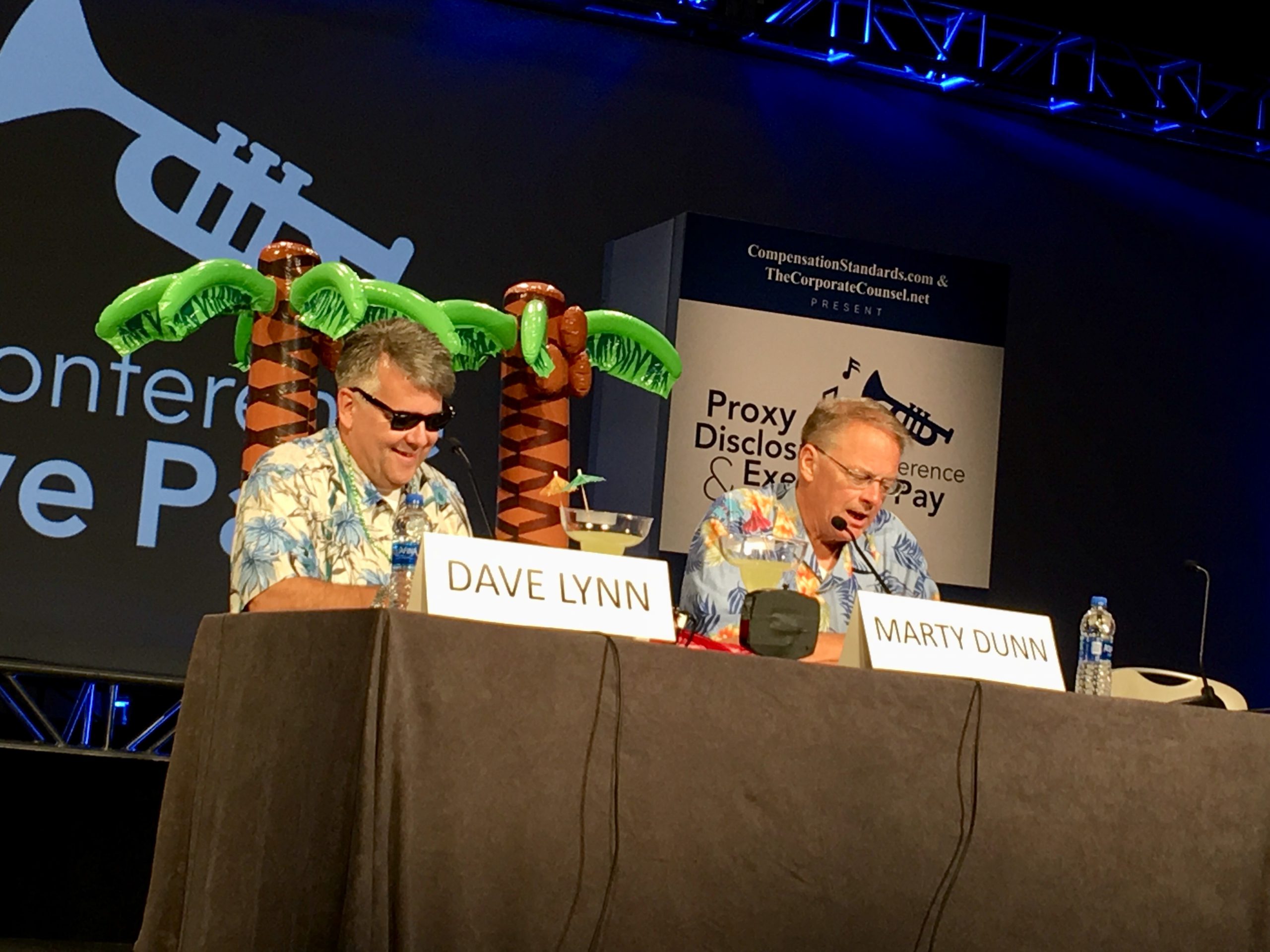
Now, if you want a blast from the past on the topic of government shutdowns, check out this Dave and Marty Radio Show from April 8, 2011. The discussion that I had with Marty way back then tends to prove the point that the more things change, the more they stay the same!
Yesterday, SEC Chair Gensler may have wished that the government shutdown had come a few days early as he faced some hostile members of the House Financial Services Committee at an oversight hearing. Chair Gensler’s written testimony highlighted the Commission’s efforts on a wide range of regulatory fronts.
Yesterday, the SEC announced the release of a report to Congress summarizing policy recommendations made during the 42nd Annual Government-Business Forum on Small Business Capital Formation. The SEC’s announcement notes that “[t]he report provides a summary of the forum proceedings, including the recommendations developed by participants for changes to the capital raising framework and the Commission’s responses to those recommendations.”
The report includes numerous recommendations and Commission responses, including:
– Expand the accredited investor definition to achieve greater diversity among startup investors and entrepreneurs.
– Expand the accredited investor definition to include additional measures of sophistication.
– Harmonize the annual reporting requirements for issuers that utilize different exempt pathways, such as Regulation Crowdfunding and Regulation A.
– Expand the accredited investor definition to include any person who invests not more than 10% of the greater of his/her annual income or net assets.
– Do not revise the accredited investor definition to make it more difficult to qualify based on wealth thresholds.
– Ensure capital-raising rules provide equitable access to capital for underrepresented founders and investors.
– Collaborate with market experts to establish a regulatory framework for finders that includes an exemption from broker-dealer registration and helps facilitate small business capital formation.
– Support entrepreneurs, including underrepresented founders, who lack the technical assistance to understand how to access capital from investors.
– Improve the exempt offering framework to reduce concentration and increase diversity – access to capital should not be practically limited to only rich people the company knows.
– Create a new private fund exemption to allow states to foster intrastate and regional funds focused on community-based investing that is open to non-accredited investors.
– Support underrepresented emerging fund managers—specifically minorities and women—building funds that diversify capital allocation, engage sophisticated investors, and challenge pattern matching trends.
– Allow non-accredited investors to participate in venture capital funds.
– Increase the number of investors allowed in 3(c)(1) funds (private funds structured in the traditional manner under Section 3(c)(1) of the Company Act above 100 investors.
– Increase the number of investors and the capital limit for funds structured under Section 3(c)(1), including traditional 3(c)(1) funds as well as Qualified Venture Capital Funds to achieve greater diversity among startup investors and entrepreneurs.
– Incentivize investors to invest in funds that support startup founders.
– Revise Exchange Act Section 12(g) to increase the number of holders that are non-accredited investors and increase the asset threshold.
– Before considering any changes that increase the smaller public company requirements, narrowly tie any changes to an identified problem so smaller public companies can have a stable and predictable regulatory environment.
– Facilitate the creation of venture markets that provide investors with a transparent and regulated environment for trading in stocks of smaller companies.
– Revise the proposed 2022 Climate-Related Disclosure rules to exempt smaller reporting companies, non-accelerated filers, emerging growth companies, and other midsized companies. If any of these issuers are subject to the rules, scale and delay the rules.
– Improve public trading for small companies by requiring more disclosures about short selling, institutional holdings, insider and affiliate holdings and transactions, paid stock promotion, and information about the security from transfer agents.
Well, I was hoping that I would not have to circle back to the topic of the looming government shutdown, but the situation does not seem to have improved on Capitol Hill since I last blogged about this topic. There is obviously still time for a resolution, as well as for the SEC Staff to provide some further guidance, but I thought it still might be useful to dust off some of the key considerations to keep in mind if there is a lapse in appropriations at the SEC. Today, I address what we can expect from an operational standpoint.
Operations – In some of the past shutdown situations, the SEC was able to maintain its operations for some period of time after other parts of the government were shut down, but there is no assurance this will happen if there is a lapse in appropriations this time around. If the SEC is forced to shut down, the Antideficiency Act – which dates back to the late 1800s – prohibits federal agencies from incurring obligations or expending federal funds in advance or in excess of an appropriation, and from accepting voluntary services. Government employees can face significant consequences for violating these restrictions, so do not expect any Staff members to be checking their emails or responding to telephone calls during the pendency of a shutdown. There is an exception to the restrictions in the Antideficiency Act which allow some limited staffing to address emergencies involving “the safety of human life or the protection of property.” During the 2019 shutdown, Corp Fin staff was available to address filing fee questions and emergency securities matters, which was generally subject to a very high bar. Keep in mind that the Antideficiency Act makes a government shutdown much different from a “snow day” at the SEC.
Status of Commissioners – Presidential appointees, such as the SEC’s Chairman and the other Commissioners, are not subject to furlough during the shutdown because their salary is an obligation incurred by the year, without consideration of hours of duty required, so they cannot be furloughed. As a result, the SEC Commissioners continue to report for duty during a shutdown, although they are limited in acting individually or as a Commission as long as no appropriation bill is enacted.
Status as a “Business Day” – While during a government shutdown the SEC is, for all intents and purposes, not conducting any business, the days that the SEC is subject to the shutdown should nonetheless be counted as business days for the purposes of, e.g., filing deadlines, Rule 430A. Rule 13e-3, Rule 13e-4, Regulation 14D, Regulation 14E and Regulation M.
EDGAR Soldiers On – While the Staff is furloughed, an issuer can still make all of its EDGAR filings, because EDGAR operates under a continuing contract that is not affected by the lapse in appropriations. Depending on the length of the shutdown, it is possible that EDGAR could cease operations, but as long as EDGAR remains up and running, issuers, investors, insiders and others must continue submitting their filings in accordance with existing deadlines. It should still be possible to submit a Form ID and thereby receive EDGAR codes during a shutdown, and in our experience the turnaround time for that function during the 2019 shutdown was pretty consistent with when the SEC is not in shutdown mode. Filer support personnel should also available to perform password resets, answer questions about fee-bearing EDGAR filings and other emergency questions regarding EDGAR submissions.
Rulemaking – The SEC continues to accept comment letters on rule proposals and concept releases during a federal government shutdown, but given the limited Staff, posting such letters to the SEC website could be delayed. Obviously, the limited Staff and the restrictions on the agency’s operations would prevent any rulemaking activities during the pendency of a government shutdown, including meeting with outside parties and the scheduling of open meetings to consider the proposal or adoption of rules.
Stop Order Database – The SEC’s online stop order database, which issuers have come to rely on in order to confirm that no stop order has occurred when closing a registered offering, would remain up and running during a shutdown and would in all likelihood continue to be updated, although any SEC stop order action during a shutdown would appear to be unlikely unless it meets the protection of “life or property” threshold.
In the latest episode of MoFo’s Above Board podcast, I am joined by my colleagues Adam Braverman, Jina Choi, and Christine Wong to address the latest developments coming out of the DOJ, the SEC, and the U.S. Attorneys’ Offices regarding voluntary self-disclosure policies, the preservation of electronic communications and corporate compensation and clawback policies. Be sure to check it out!
Last Thursday, the SEC’s Investor Advisory Committee met, and on the agenda was a discussion of exempt offerings under Rule 506 of Regulation D and the definition of “accredited investor.” This discussion comes about when the SEC has had “Regulation D and Form D Improvements” on the Reg Flex Agenda for some time now, and Commissioner Crenshaw caused a stir at this year’s Northwestern Securities Regulation Institute by noting several areas of concern with Rule 506 and the rise of unicorns that utilize the exemption, including those related to investor protection, inflated valuations, corporate governance and the impact on small businesses. Earlier this year, the Investor Advisory Committee also explored the growth of private markets at one of its meetings. This Mayer Brown Free Writings & Perspectives blog describes the proceedings at last week’s meeting:
Panelists examined the increased use of Rule 506 and provided recommendations regarding potential changes to improve information asymmetry and provide better investor protections. Craig McCann noted the increasing popularity of exempt securities offerings: at least $15 trillion of Reg D securities were sold from 2009 through 2020, compared to $16.4 trillion of registered securities sold and at least $4.4 trillion of Reg D securities were sold in 2021 and 2022, 13% more than the $3.9 trillion proceeds from public offerings. Panelists further discussed the background, purpose and effect of Form D filings and noted that Form D filings are intended to provide notice of exempt offerings and to allow the SEC to collect empirical data on these filings. However, while a Form D filing is a rule requirement, it is not a condition to the exemption. Panelists noted that some issuers may not make Form D filings, causing the data available to the SEC to be incomplete. Additionally, panelists discussed how Form D filings themselves can sometimes be a vehicle for fraud, as some investors do not understand that Form D filings are not reviewed and assessed by SEC staff and that the SEC stamp on the form can provide the contents therein with legitimacy for investors. Potential suggestions from panelists to alleviate these concerns would be to include a link on Form D filings to standard risk disclosure regarding start-ups already readily available on the SEC’s website, including a statement on Form D that the contents are self-reported or including a legend with standard risk disclosure on the form. Last, panelists suggested the SEC examine its rules and regulations covering the public market in order to make the market more accessible.
The Investor Advisory Committee also took up the topic of the accredited investor definition. The agenda for the Investor Advisory Committee stated that “under current securities regulations, individuals qualifying as “accredited investors” are permitted to invest in unregistered securities that, by nature, lack many of the protections provided by the regulatory disclosure requirements and attendant accountability through traditional public markets. Over the years, the SEC has continued to evolve standards on these qualifications, with the overarching goal of ensuring ‘accredited investors’ possess sufficient financial sophistication and necessary financial resources to participate in these inherently riskier and often highly illiquid markets.” On this topic, the Mayer Brown blog notes:
Panelists discussed the origins and intent of the “accredited investor” definition and considered whether the “accredited investor” qualifications remain fit-for-purpose. The panel explored whether updates to the rule may be necessary to ensure the SEC can balance the needs of investors through its tripartite mission of investor protection, ensuring fair, orderly, and efficient markets, and facilitating capital formation. While providing a background of the current “accredited investor” framework, Professor Usha Rodrigues cited stating the SEC’s 2015 Report on the Review of the Definition of “Accredited Investor” stating, “the accredited investor definition is a cornerstone of Regulation D” and “the concept intended to encompass those persons and entities whose financial sophistication and ability to sustain the risk of loss of investment or ability to fend for themselves render the protection of the Securities Act’s registration process unnecessary.” The panelists discussed the growing number of persons captured by the definition of “accredited investor” – 2% in 1982 and over 10% today. Multiple panelists further noted that wealth is not a proxy for financial sophistication and that accredited investors should possess both financial sophistication and wealth to allow them to better assess investment opportunities and isolate themselves from potential losses. Some suggestions proposed by panelists to limit the number of persons falling within the definition of an “accredited investor” include: excluding retirement income from the calculation of wealth; adjusting income levels for current inflation and including a financial acumen threshold; and including tiered pathways to participation for various Regulation D offerings.
It remains to be seen whether the Commission will have the bandwidth to propose changes to Rule 506 in the coming months. Reading the tea leaves a bit, the Investor Advisory Committee’s consideration of this topic may indicate that a proposal is closer to seeing the light of day. My only hope is that the Commission will choose to tread lightly here, given that Rule 506 is such an important linchpin of the capital markets.
While we have not yet seen a proposal from the SEC revisiting the human capital disclosure requirements, last week the SEC’s Investor Advisory Committee considered a draft recommendation on human capital disclosure that was recommended by the SEC Investor Advisory Committee’s Investor-as-Owner Subcommittee. As this Cooley PubCo blog notes, the Investor Advisory Committee voted to approve, with two abstentions, the subcommittee’s recommendation. The draft document that was voted on last week includes the following recommendations:
First, the IAC recommends that the Commission strengthen current Item 101(c) under Regulation S-K pertaining to human resources disclosures by requiring disclosure of the following:
1. The number of people employed by the issuer, broken down by whether those people are full-time, part-time, or contingent workers;
2. Turnover or comparable workforce stability metrics;
3. The total cost of the issuer’s workforce, broken down into major components of compensation; and
4. Workforce demographic data sufficient to allow investors to understand the company’s efforts to access and develop new sources of talent, and to evaluate the effectiveness of these efforts.
Second, the IAC recommends that the Commission consider narrative disclosure, in the Management Discussion & Analysis, of how the firm’s labor practices, compensation incentives, and staffing fit within the broader firm strategy. Such a discussion would address what portion of labor costs management views as an investment and why, including how labor is allocated across areas designed to promote firm growth (e.g., R&D) and those necessary to maintain current operations rather than increase sales revenue (e.g., compliance). Our recommendation here is consistent with the recommendation put forward in a June 2022 rulemaking petition submitted by former SEC commissioners and senior officials as well as professors of accounting and securities law.
Now that the Investor Advisory Committee has spoken, we will see what the Commission decides to do with human capital disclosure requirements.
The fact that the government is on the verge of shutting down does not affect business-as-usual in Washington, so tomorrow SEC Chair Gensler will be testifying at an SEC oversight hearing convened by the House Financial Services Committee. Undoubtedly, the Chair will be questioned regarding the climate change rules and digital asset regulation, among other pressing issues.
I hope you were able to join us last week for our 2023 Virtual Conferences – the “2023 Practical ESG Conference,” the “2023 Proxy Disclosure Conference,” and the “20th Annual Executive Compensation Conference.” I would like to send a big shoutout to everyone at CCRcorp who made these great Conferences happen, as well as to all of the fantastic speakers that we had participating in the Conferences – we covered so much ground during those four days! If you missed any parts of the Conferences, archives of the sessions are available, and be on the lookout for our continuing coverage of key takeaways in an upcoming issue of The Corporate Executive.
With a looming government shutdown dominating the headlines, it is yet again time to go down that well-worn path of trying to plan for the worst in the event Congress is unable to get its act together.
This shutdown talk always brings up bad memories for me, because I can remember starting my career in Corp Fin in the Fall of 1995 when, shortly after I began working in the Division, I was attending all-hands meetings with the Chairman talking about what would happen when the government shut down in the ensuing weeks. The partial government shutdown that ultimately happened, pitting President Bill Clinton against Republican Speaker of the House Newt Gingrich, only lasted for a few weeks. Fortunately, the SEC remained operational during that time using some appropriations that were apparently saved up in its piggy bank. While the crisis was averted, it was a good lesson for me in how a dysfunctional government could have a real impact on my life, as I was trying to figure out how I was going to pay my bills if my paychecks stopped arriving during a prolonged government shutdown.
Here we are, 28 years later, and the dysfunction has only gotten worse as the shutdown card is being played again. While the SEC and the Staff have not yet provided any guidance on how things will be handled in the event of a shutdown, we do have the 2018-2019 shutdown experience to draw on. The shutdown that began on December 22, 2018 and ended on January 25, 2019 was markedly different from the 1995 version, because there was no piggy bank to bail out the SEC, so we actually experienced several weeks of substantially curtailed operations at the SEC.
In advance of the 2018-2019 shutdown, the SEC published its Operations Plan Under a Lapse in Appropriations and Government Shutdown (updated July 2023), and Corp Fin issued fourteen FAQs, which no longer appear to be on the SEC’s website but which are described in this White & Case memo. In the absence of any further updated guidance from the SEC or the Staff, these are good resources to review as we plan for a shutdown. If history is any guide, the SEC may be able to remain fully operational for a few days, but an extended lapse in appropriations will ultimately mean that SEC Staff will be prohibited from doing any work, so Corp Fin will be staffed with only a skeleton crew to handle emergencies during the course of the shutdown. Recall that, during the 2018-2019 shutdown, issuers had to pull their delaying amendments in order to have registration statements go effective so they could proceed with their capital-raising transactions and mergers. There was no impact on the ability to make EDGAR filings during the last shutdown, because EDGAR is operated by a third party.
With only one week to go until the end of the government’s fiscal year and the potential for a lapse in appropriations, now is a good time to speak with your Corp Fin examiner about any registration statements that you have pending with the SEC. It may be the case that the Staff will be willing to resolve any outstanding issues and consider an acceleration request this week, so as to avoid the prospect of a prolonged delay for the issuer in the event of a shutdown. I will continue the coverage this week as events unfold.