I am very excited about our return to in-person conferences in October. Our “2024 Proxy Disclosure & 21st Annual Executive Compensation Conferences” will be taking place in San Francisco on October 14th & 15th. I am particularly looking forward to participating in a number of the panels that make up the two days of conferences, which will include:
– “Erik Gerding: The Latest From Corp Fin” on October 14th
– “The SEC All-Stars: Proxy Season Insights” on October 14th
– “Game Show Lightning Round: All-Star Feud” on October 14th
– “Climate Disclosures: Your New Action Items” on October 14th
– “The SEC All-Stars: Executive Pay Nuggets” on October 15th
There are many other topics on our agenda, and I will be joined by an outstanding group of speakers for the two days of programming. This will be a great opportunity to catch up on the latest developments as we ramp up for the next proxy and annual reporting season.
You can register now by visiting our online store or by calling us at 800-737-1271. Our early bird in-person Single Attendee Price is $1,750, which is discounted from the regular $2,195 rate! If you can’t make it in person, we also offer a virtual option so you won’t miss out on the practical takeaways our speaker lineup will share, and we offer discounted rate options for groups of virtual attendees.
As John noted last week, the new T+1 settlement cycle commenced last Tuesday and we did not end up in any sort of post-Y2K dystopian world. In fact, the move to T+1 settlement appeared to go smoothly. On Thursday, DTCC issued a statement noting:
Our analysis shows that as of yesterday, May 29, 94.55% of transactions were affirmed by the Depository Trust Company (DTC) cutoff time of 9:00PM ET on trade date. This represents a significant change from the affirmation rate observed at the end of January (73%).
When considering specific market segments as of end of day on May 29:
– Prime Broker Affirmation Rate: 98.6% (up from 81% in January)
– Investment Manager Auto Affirmation (central match) Rate: 97.5% (up from 92% in January)
– Custodian or Investment Manager (self) Affirmation Rate: 84.29% (up from 51% in January)
Statement from Brian Steele, Managing Director, President, Clearing & Securities Services: “After working closely with the industry for over three years, we are pleased these efforts are driving a smooth transition, including very high same day affirmation rates, which increased to 94.55% yesterday. While we are proud of this progress, we will continue to collaborate with SIFMA, ICI and the industry to ensure a successful T+1 implementation in the coming days and weeks.”
On Friday, the Investment Company Institute, SIFMA and DTCC issued a joint statement noting:
“With the U.S. T+1 settlement cycle for corporate bonds, municipal bonds, and equities transactions now in place, ICI, SIFMA, and DTCC thank all the stakeholders for their collaboration and support in successfully implementing this historic change to U.S. markets. There was a tremendous amount of partnership and hard work to make T+1 a reality.
“Early indications following T+1 implementation are positive, and we look forward to working closely with firms and key stakeholders in the coming weeks to monitor and address any issues that may arise.
“Shortening the settlement cycle to T+1 promises to deliver greater operational efficiencies and substantially lower margin requirements while reducing risk in the financial system. With T+1 now live, we’ve collectively begun to achieve those benefits together.”
For practitioners, the new T+1 settlement cycle will require some getting used to, as timelines for preparing closing documents and filing final prospectuses and prospectus supplements is accelerated.
We find ourselves in an uncertain time for the IPO market, and it has certainly been a rough ride for SPAC IPOs over the past couple years. It remains to be seen how the SEC’s new rules will impact the willingness of sponsors to bring SPACs to market through IPOs. For those brave souls who decide to dip their toes into the IPO waters, Woodruff Sawyer has provided a helpful publication with its 2024 edition of the Guide to D&O Insurance for SPAC IPOs. In the publication, the firm notes:
As it goes through the IPO process, the main assets of a SPAC are its cash in trust, its management team and directors, and the management team’s investment strategy.
SPAC management teams and directors are vulnerable to lawsuits from their public company shareholders as well as regulators like the Securities and Exchange Commission (SEC) and the Department of Justice (DOJ). D&O insurance is designed to mitigate the risk of litigation costs falling on individual directors and officers and the companies they serve.
The vulnerabilities associated with being a public company create a need for D&O insurance coverage for the SPAC’s management team and its board. Remember too that national stock exchange rules mandate that most of a SPAC’s board must consist of independent board members. Businesspeople who serve as independent board members typically do not accept a board appointment without the promise of good D&O insurance to protect them against lawsuits and regulatory enforcement.
The Guide to D&O Insurance for SPAC IPOs provides an overview of the most common litigation that SPACs have faced, a description of the regulatory enforcement environment, an explanation of the process for securing D&O insurance and questions to ask when engaging a broker, among other topics.
In this 23-minute episode of the “Women Governance Trailblazers” podcast, Courtney Kamlet & Liz Dunshee interviewed Susanna Morgan, who is a former public company CFO and is currently a director at Payoneer and Mixpanel. Susanna is also a founding member of Guilds by FirstMark. They discussed:
1. Susanna’s career path and current director roles, which include a public company and a private company backed by Andreesen Horowitz.
2. How directors can handle (or avoid) “information overload” so that they are able to focus on the most salient issues and keep the big picture in focus.
3. Why corporate governance is an important piece of financial, investor relations, and corporate development roles, and how corporate governance practices may differ between public companies and VC-backed companies.
4. Practices and approaches that allow executives and directors to get the most out of their relationship with each other.
5. Advice for effective cross-department collaboration, to balance incorporating different perspectives with moving deliberately toward strategic goals.
6. What Susanna thinks women in the corporate governance field can add to the current conversation on the societal role of companies.
To listen to any of the prior episodes of Women Governance Trailblazers, visit the podcast page on TheCorporateCounsel.net or use your favorite podcast app.
The SEC has announced that the SEC Investor Advisory Committee will meet on Thursday, June 6 at 10:00 am Eastern, and one of the topics to be discussed will be the regulation of artificial intelligence. The agenda for the meeting notes:
The rapid advancements in AI technologies have brought about significant benefits and challenges for companies, investment managers and other market participants. As AI becomes increasingly integrated into various sectors, it is crucial to address key issues related to disclosures, and other important aspects of AI such as data controls, bias, and education to ensure ethical and responsible AI practices within the existing regulatory framework and within any new guidance or rules. This panel aims to discuss and provide insights on how the SEC may promote the advancement of AI by helping practitioners navigate these critical aspects.
As anyone who has confronted the discovery of SEC violations at a client knows, one of the hardest things to tackle is whether to self-report the matter to the SEC and what level of cooperation with the SEC Enforcement staff is appropriate if an investigation commences. Much has been said over the years about the topic of cooperation, but that certainly does not mean the topic is not ripe for further discussion. Recently, at the Securities Enforcement Forum West 2024 program, SEC Enforcement Director Gurbir Grewal addressed the topic again in a speech titled “The Five Principles of Effective Cooperation with the SEC.” Grewal began his speech with this explanation of how cooperation in an Enforcement investigation is taken into account:
As numerous recent enforcement matters have shown, there are real benefits to parties that cooperate with Commission investigations. These benefits can affect both the charges and the remedies the Division may recommend, and that the Commission may ultimately impose.
On the charging side, we may recommend bringing reduced charges or we may decline to recommend charges altogether. On the remedies side, we may recommend reduced or even zero civil penalties. And where there’s been real remediation that addresses the misconduct, that may impact whether we recommend undertakings and, if we do, their scope.
Orders in a number of recent settled actions also highlight another benefit: a finding by the Commission that a party provided meaningful cooperation. This lets parties publicly demonstrate their positive conduct in what may otherwise be an unfavorable context.
A key reason we recommend that the Commission reward cooperation is because it helps us move investigations more efficiently. That benefits all parties to an enforcement investigation. For one, timely investigations and resolutions address misconduct, protect investors, and promote accountability. As I’ve spoken about before, all of that helps to enhance public trust and confidence in our markets. And timely investigations that don’t result in enforcement recommendations also mean that the cloud of investigation doesn’t hang over an entity or an individual for longer than necessary.
Now, this doesn’t mean that if you do all of the things highlighted in recent orders discussing cooperation or what I discuss today, you’ll always get to a no penalty resolution or a declination. That’s because, as you know, all of this is highly fact dependent and there’ll always be situations where some charges and remedies are necessary no matter the level of cooperation. But the bottom line is this: you’re likely to experience better outcomes with cooperation than without it.
I’m sure there are those lawyers and clients, perhaps not in this room, that say, “hey, we’ll just take our chances that the SEC doesn’t learn of a violation or, if they do, we’ll cooperate then.” While you may have run the probabilities in your heads, I think that’s a very risky gamble, with the odds increasing in our favor every day. That’s because, given the success of the Commission’s whistleblower program, our improved use of data analytics, and our increased use of risk-based initiatives, it’s really no longer a question of if we’ll find out about a violation, but often when.
The speech goes on to highlight the five principles for effective cooperation, which are as follows:
– Principle one: the best cooperation starts early and well before the SEC gets involved, with self-policing.
– Principle two: once you discover a possible violation, self-report without delay.
– Principle three: don’t stop with the self-report. Remediate.
– Principle four: the type of cooperation that earns credit requires going above and beyond what’s legally required — more than simply complying with subpoenas without undue delay or gamesmanship.
– Principle five: collaborate with Enforcement Staff early, often, and substantively.
In wrapping up, Grewal notes: “while an enforcement investigation has the potential to feel like an adversarial process, it doesn’t have to be.”
The SEC Historical Society has announced a virtual program taking place on June 14 at 4:00 pm Eastern to recognize the inaugural awardees for its Isaac C. Hunt Jr. Hall of Honor. The announcement notes:
In 1962, “Ike” became one of the first African American attorneys at the SEC’s Division of Investment Management, then called Corporate Regulation and served as an SEC Commissioner from 1996 to 2002. To learn more about Ike Hunt, visit the special museum exhibit.
The Hall of Honor in his name recognizes African Americans who have made outstanding contributions to the financial regulatory community both while at the SEC and elsewhere. Recognizing the awardees in conjunction with the federal Juneteenth holiday helps raise public awareness of African Americans’ meaningful efforts in financial services while cementing the SEC Historical Society’s vital role as a guardian and promoter of the full history of the SEC.
The 2024 awardees are:
– Richard M. Humes, who served as Associate General Counsel for the Litigation and Administration Practice;
– Aulana L. Peters, who served as an SEC Commissioner from 1984 to 1988;
– Paul F. Roye, who served as Director of the Division of lnvestment Management; and
– Erica Y. Williams, who served as Deputy Chief of Staff for three chairs.
This virtual program will be hosted by Keir Gumbs, Principal, General Counsel at Edward Jones and SEC Historical Society Trustee. The SEC Historical Society’s announcement notes “[t]he program is part of a larger annual initiative to recognize, honor and preserve the historical contributions of people from diverse racial and ethnic backgrounds in the financial regulatory community.”
The Exchange Act celebrates its 90th birthday on June 6th. Among other things, that statute created the SEC (the FTC was the original regulator under the Securities Act). The SEC is commemorating that milestone with a webcast event featuring two panels, one comprised of former SEC chairs, and another featuring historian Michael Beschloss, legal scholar Joel Seligman, and former Maryland lieutenant governor Kathleen Kennedy Townsend. Lt. Gov. Townsend is also the granddaughter of the SEC’s first chair, Joseph Kennedy.
The SEC has a rich history that you can learn quite a bit about by visiting the SEC Historical Society’s website. For example, this excerpt from the website’s discussion of the early days of the SEC provides a reminder that strong policy disagreements among commissioners are nothing new:
The Securities Exchange Act required a bipartisan Commission. The two Republicans appointed by Roosevelt were highly experienced: George C. Mathews had directed the Wisconsin Public Utilities Commission before joining the FTC; and Robert E. Healy sat on the Vermont Supreme Court and ran an FTC investigation of public utility holding companies before joining the Commission.
Not surprisingly, some conflict arose during the sessions that the Commission held nearly every day during its first three months. Pecora continually pushed for a more adversarial approach, hoping that further revelations would lead to greater reform. Owing to his public utilities knowledge, Healy sympathized, but sided with Kennedy in the end. Landis and Mathews both agreed with the Chairman that the SEC could best establish its legitimacy and further constructive reform by easing regulations and accommodating business.
Although he respected the Chairman’s abilities, Pecora tired of being in the minority and resigned after six months. For the remainder of Kennedy’s tenure, the four Commissioners handled the heavy load alone.
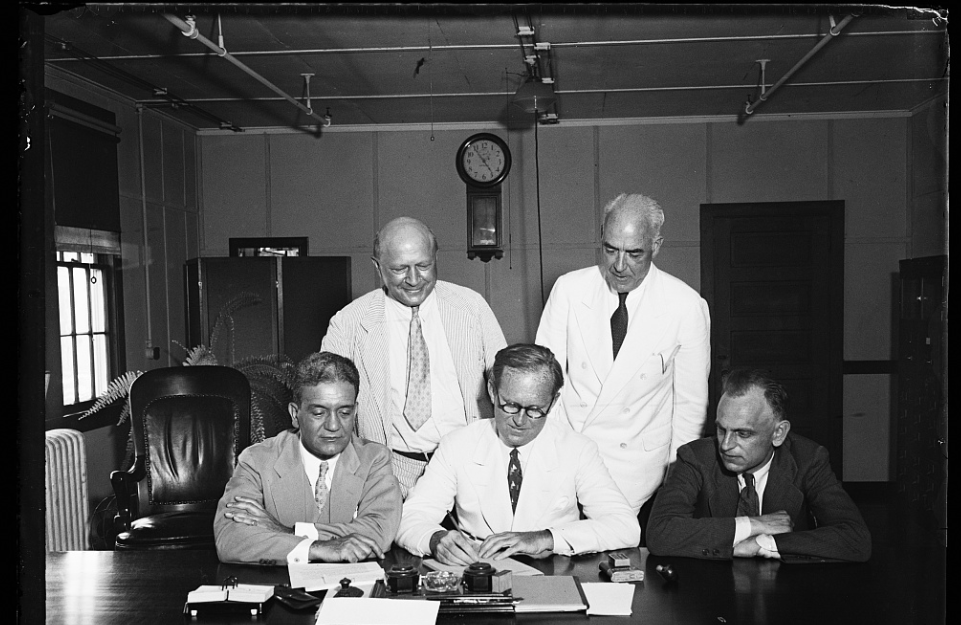
The Library of Congress also has resources devoted to the Exchange Act and the SEC, including this blog on how the agency’s activities have made public company information more transparent and broadly available, and this group photo of the first commissioners.
Seated, left to right: Ferdinand Pecora, Joseph P. Kennedy, James M. Landis. Standing, left to right: George C. Matthews, Robert F. Healy.
The last time we checked in on the PPP loan program we found that the SBA had concluded that the level of fraud was apparently massive & that the loan forgiveness process was snarled in red tape. Now, bankrupt small business lender Kabbage, which was one of that program’s largest lenders, has agreed to pay up to $120 million to the federal government in order to resolve fraud allegations raised by the US Attorney for the District of Massachusetts. Here’s an excerpt from the US Attorney’s press release announcing the settlement:
The first settlement, which provides the United States with a claim for recovery of up to $63.2 million, resolves allegations that Kabbage systemically inflated tens of thousands of PPP loans, causing the SBA to guarantee and forgive loans in amounts that exceeded what borrowers were eligible to receive under program rules. As part of the settlement, KServicing Wind Down Corp. admitted and acknowledged that Kabbage double-counted state and local taxes paid by employees in the calculation of gross wages; failed to exclude annual compensation in excess of $100,000 per employee; and improperly calculated payments made by employers for leave and severance.
The United States alleged that Kabbage was aware of its errors as early as April 2020, yet Kabbage failed to remedy all incorrect loans that had already been disbursed and continued to approve additional loans with miscalculations. The resolution also provides for Kabbage to receive a $12.5 million credit for payments it previously returned to the SBA during the Department’s investigation of this alleged misconduct.
The second settlement, which provides the United States with a claim for recovery of up to $56.7 million, resolves allegations that Kabbage knowingly failed to implement appropriate fraud controls to comply with its PPP and BSA/AML obligations. In particular, the United States allege that Kabbage removed underwriting steps from its pre-PPP procedures in order to process a greater number of PPP loan applications and maximize processing fees.
The government further alleged that Kabbage knowingly set substandard fraud check thresholds despite knowledge of SBA’s concerns that fraudulent borrowers might seek to benefit from the PPP; relied on automated tools that were inadequate in identifying fraud; devoted insufficient personnel to conduct fraud reviews; discouraged its fraud reviewers from requesting information from borrowers to substantiate their loan requests; and submitted to the SBA thousands of PPP loan applications that were fraudulent or highly suspicious for fraud.
During the pandemic, we blogged about Kabbage’s problematic PPP loans to purported agricultural businesses located on Long Beach Island, NJ. In addition to being my summer vacation destination of choice, LBI has recently achieved notoriety for another summer resident’s regrettable outdoor decoration choices. Anyway, I can assure you that LBI has miles of beaches, and plenty of ice cream shops, seafood markets, restaurants and delis – but like most beach communities, it’s pretty devoid of agricultural businesses, unless the Wawa in Ship Bottom somehow counts.
As many of you know, we hold our conferences in conjunction with our friends at the National Association of Stock Plan Professionals (NASPP), which is hosting its own annual conference in San Francisco that week. NASPP has set July 26th as the early bird registration deadline for its conference. We thought it would make sense to have a consistent deadline, so we’ve decided to extend our early bird deal to that date as well.
Our early bird in-person Single Attendee Price is $1,750, which is discounted from the regular $2,195 rate! If you can’t make it in person, we also offer a virtual option so you won’t miss out on the practical takeaways our speaker lineup will share, and we offer discounted rate options for groups of virtual attendees. You can register now by visiting our online store or by calling us at 800-737-1271.